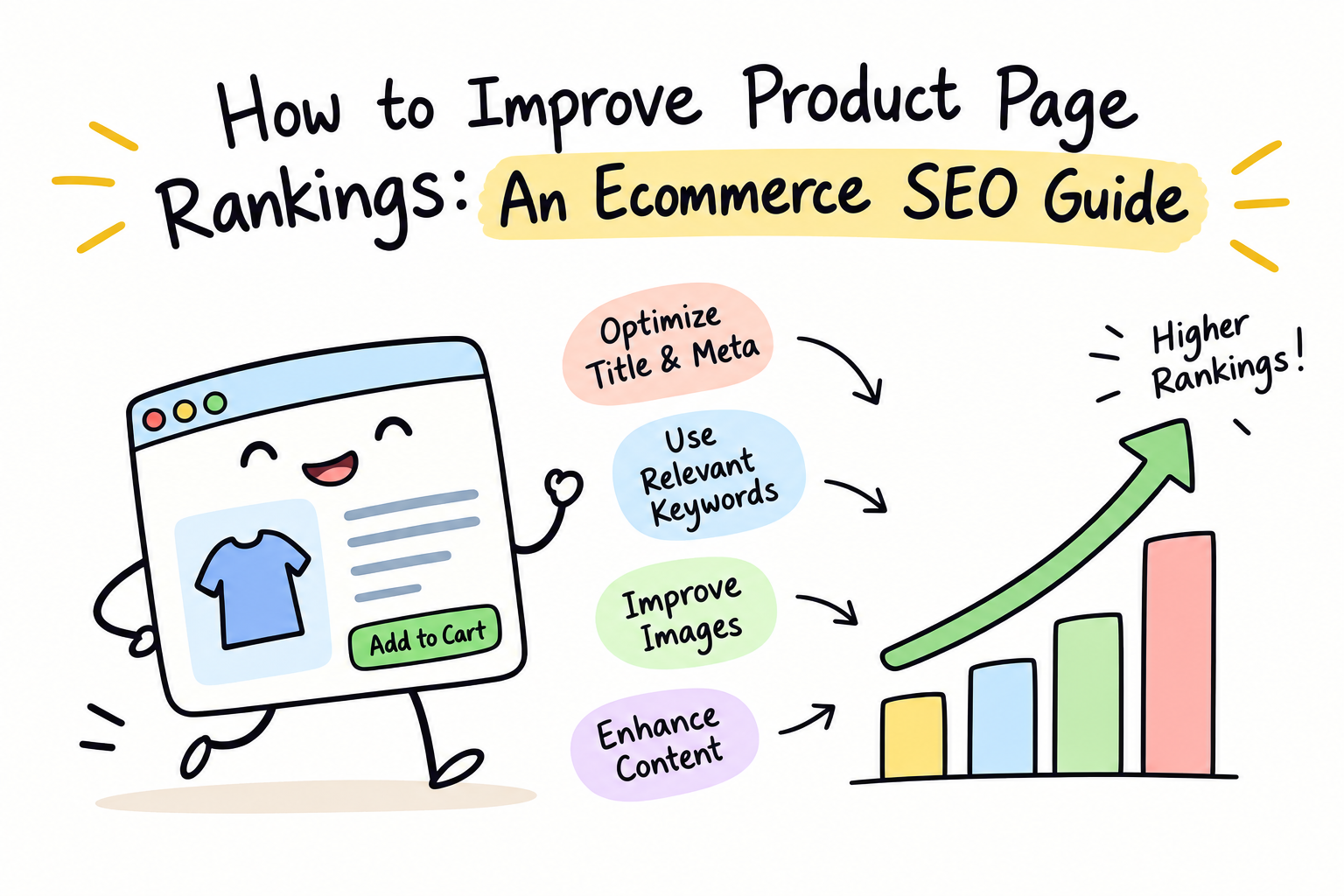
How to Improve Product Page Rankings: An Ecommerce SEO Guide
September 28, 2026
When it comes to ecommerce SEO, the advice you’ll come across often revolves around the same steps: choose a keyword, place it in the title, sprinkle it throughout the product description, and you’re all set. While there is some truth to this method, it is also outdated. Nowadays, modern ecommerce product page SEO goes way beyond keyword placement — it comes down to various other factors, such as structured data completeness and originality of content as well as the level of page experience and trust signals that search engines can verify. For example, two different shops can focus on the same keyword while using exactly the same amount of text and still appear in different places at the search results, because one store is seemingly only a valid online shop by Google while the other shop looks like a site using copy-and-paste methodology.
The Reason Keyword Optimization Has Stopped Working
Search engines are now more capable of understanding user intentions as opposed to just matching phrases. Ranking now is not about loading the websites with keywords but rather about proving that the page is what the audience really needs based on the search results. The AI-based search mechanism is focusing more on the content of the promotional page itself and evaluating it according to its quality and information rather than the use of certain words or phrases.
Consequently, a perfectly keyword-optimized page might still lose to a competitor boasting better metrics than the former. This is a gap that the basic SEO content fails to take into account.
The Basic SEO Ranking Factors Guides That Are Often Missed
Thin content adds another issue. A product page with fewer than about 100 original words, automatic filler, or duplicate web pages that all have the same text relays the same message: there is nothing new here. Thin content in e-commerce refers to little unique text of lower than 100 words, duplicated text on multiple pages, machine-generated filler text, or copied content from the producer of the merchandise and others. A very helpful thing to do is an internal audit: find out how many words each page has that remain unchanged across the web — navigation, footer, product list, etc. — and see how much text you write for each page. If the number of standard words used is higher than the number of original words written, then the text will be regarded by the search engines as standard text.
How Idiocom Builds SEO Visibility Into Your Product Catalog
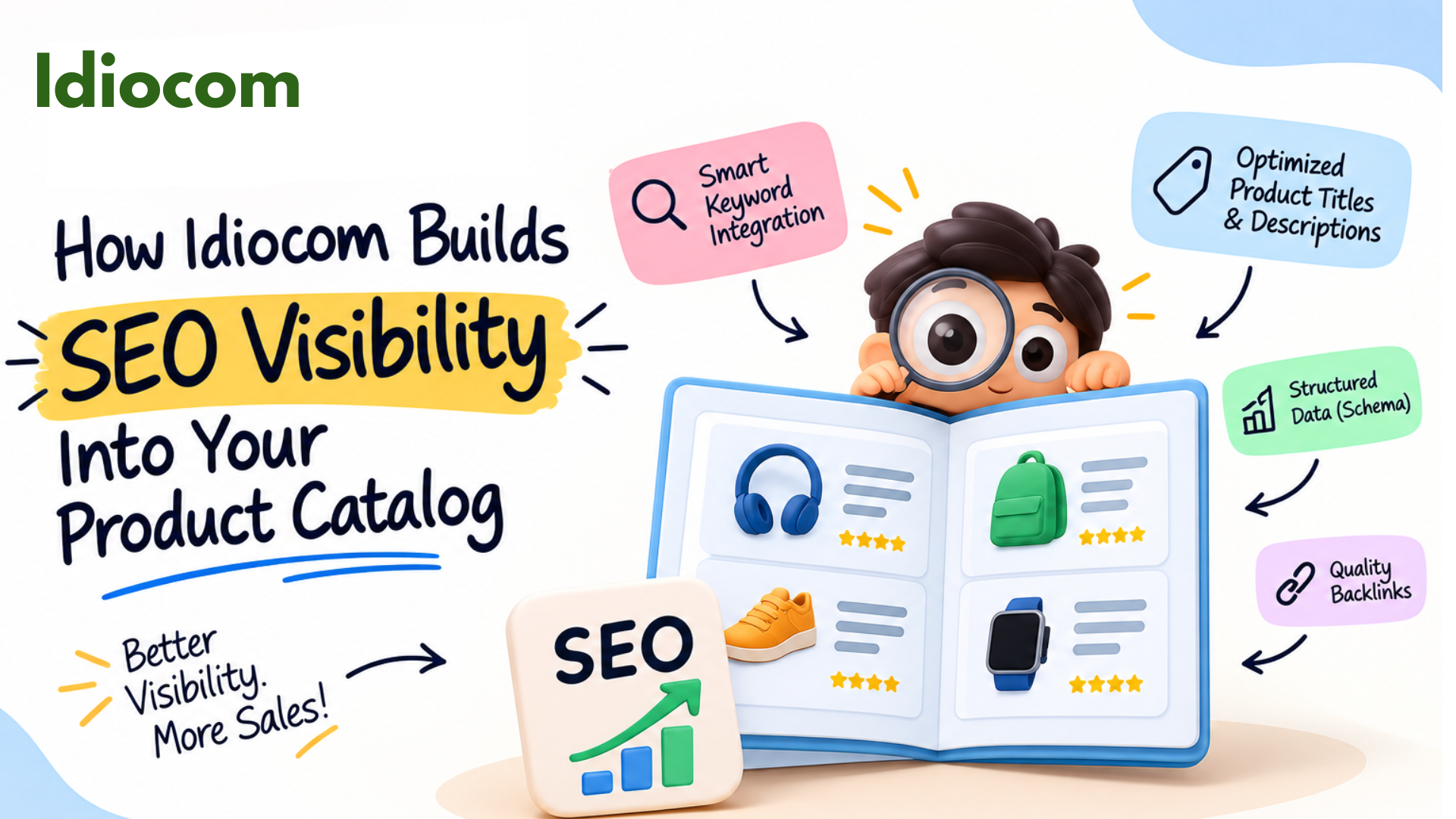
High-volume ecommerce SEO works best when search visibility is built into the product and store structure from the beginning rather than handled as a separate task after products are published. Idiocom combines catalog management, AI-assisted content, SEO-ready architecture, structured data, and product feeds to create a connected approach to ecommerce visibility.
1. Start with a Search-Ready Store Structure
Idiocom builds ecommerce stores with SEO-focused architecture so search engines can discover and understand growing product catalogs. Features such as editable titles, automatic redirects, and self-updating sitemaps help support the technical foundation required for organic visibility.
2. Build and Organize the Product Catalog
Products can be added and organized through Idiocom’s catalog management system, including bulk product upload capabilities. This helps businesses manage larger catalogs without relying on repetitive manual data entry for every product.
3. Use AI to Assist with Product Content
Idiocom’s AI tools can assist with product titles, copy, and images. Starting with basic product information, businesses can prepare more complete product listings while reducing the repetitive work involved in creating content for every SKU.
4. Support Structured Product Information
SEO visibility depends not only on written content but also on how product information is structured. Idiocom includes structured data alongside feeds and sitemaps as part of its SEO capabilities, helping create a more search-ready product catalog.
5. Connect Products to Search and Shopping Channels
Rather than limiting product visibility to the storefront, Idiocom connects catalog information with channels where customers search and discover products. Its platform supports distribution across Google Shopping, Google Images, Google Maps, YouTube, AI search, Meta Shopping, Pinterest, and other channels.
6. Keep Catalog and Channel Data Connected
Managing products across multiple channels can create additional operational work when product information has to be updated separately. Idiocom’s connected catalog approach is designed to keep product data synchronized across supported channels, making it easier to maintain consistent product information as the catalog grows.
7. Expand Visibility as the Catalog Grows
SEO for ecommerce is an ongoing process rather than a one-time setup. As businesses add products, categories, content, and new markets, the underlying store structure, product feeds, sitemaps, and SEO elements need to support that growth. Idiocom is designed to provide this foundation while allowing businesses to scale their catalogs and visibility together.
The process can be summarized as:
Build a search-ready store → Organize the catalog → Create AI-assisted product content → Structure product data → Connect products to search and shopping channels → Keep catalog information synchronized → Scale visibility as the business grows.
Let’s take a look at two retailers who sell an identical, imported cookware line:
Store A duplicates the manufacturer’s product description and uses the default schema from the platform. On the other hand, Store B creates its own copy that answers questions about the induction compatibility of cookware lines and manually fills in the GTIN, offer, and review schema. In both cases, the targeted keyword is the same. Despite this, Store B ranks higher than Store A. The key difference lies in the fact that while Google can identify the page of Store B as a unique and reliable page, Store A’s site is indistinguishable from hundreds of others offering the same product.
The concept of Search Engine Optimization for e-commerce product pages has moved beyond traditional notions of placing key phrases and words in a text on a subject. The best product pages today are the ones that provide search engines with straightforward structured and original information, and not just the key information laid in suitable positions. Therefore, for expanding catalogs, it is important to implement the principles of complete scheme creation and originality of content while developing a store — without regarding them as a separate piece of work.
Idiocom SEO Visibility is an approach to ecommerce SEO that combines a search-ready store structure, product catalog management, structured product data, AI-assisted content, sitemaps, and product feeds to help businesses improve how their products are discovered online.
Idiocom provides SEO-focused features such as editable page titles, automatic redirects, self-updating sitemaps, structured data, and product feeds. These features help create a technical foundation for managing SEO as the product catalog grows.
Idiocom provides self-updating sitemaps as part of its SEO functionality. This helps the store’s sitemap stay aligned with changes to the product catalog and website.
Idiocom connects product catalogs with multiple discovery and shopping channels, including Google Shopping, Google Images, Google Maps, YouTube, AI search, Meta Shopping, and Pinterest.