How Enterprise Ecommerce Solutions Simplify Multi-Channel Selling Operations
- June 8, 2026
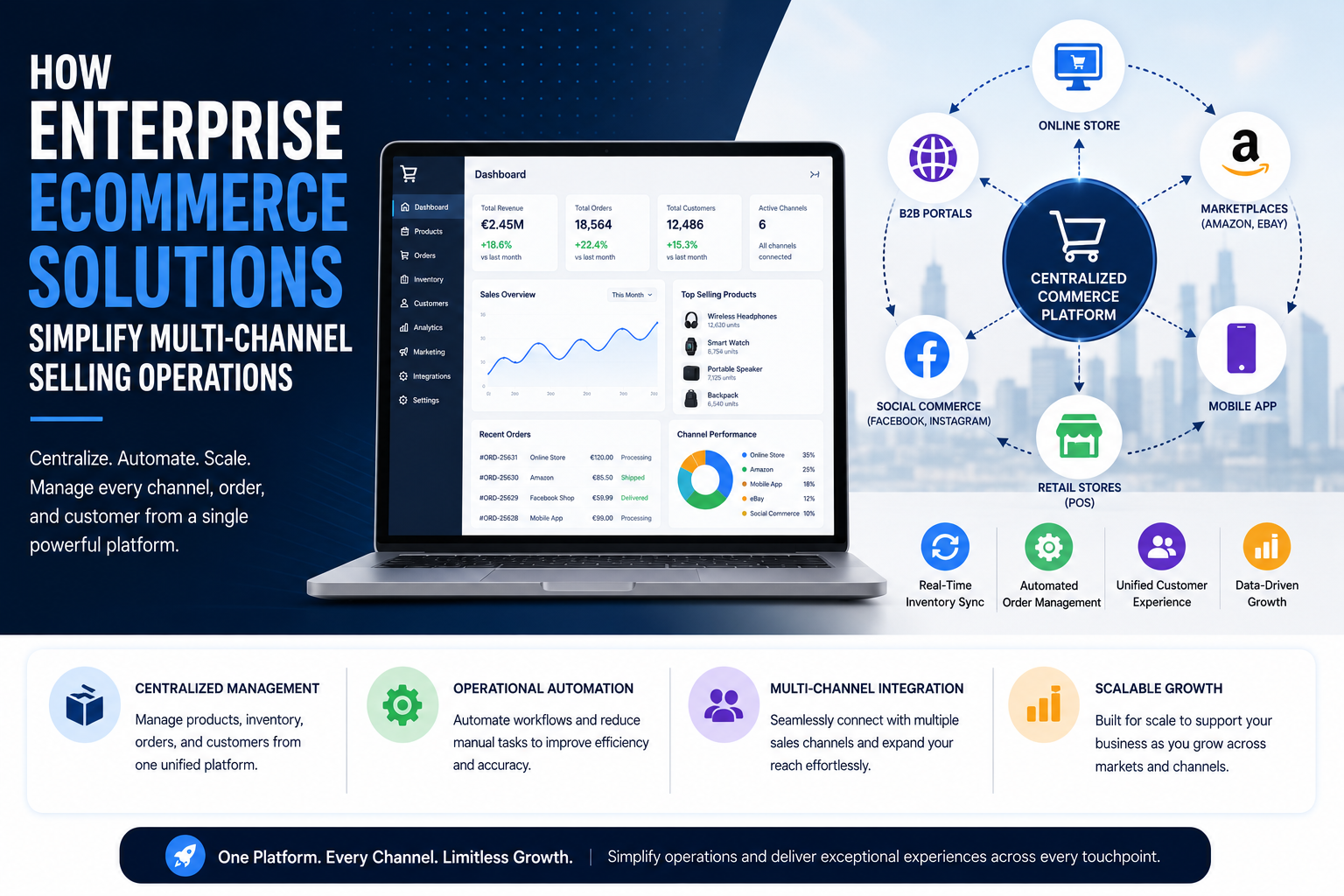
Modern ecommerce businesses are no longer limited to selling through a single online store. Today’s customers interact with brands across websites, online marketplaces, mobile apps, social commerce channels, and even physical retail locations. While these opportunities create new revenue streams, they also introduce significant operational complexity.
Managing inventory, orders, customer data, and marketing campaigns across multiple channels can quickly become overwhelming without the right technology. This is why businesses are increasingly investing in an enterprise ecommerce solution to simplify operations and support scalable growth.
By centralizing business processes and automating workflows, modern enterprise platforms help organizations streamline multi-channel selling while improving efficiency, customer experiences, and profitability.
The Rise of Multi-Channel Selling
Consumer shopping behavior has evolved dramatically in recent years.
Customers now discover and purchase products through:
- Ecommerce websites
- Online marketplaces
- Social media platforms
- Mobile applications
- B2B portals
- Physical retail stores
For businesses, these channels offer valuable opportunities to expand reach and increase sales.
However, managing each channel separately often creates operational challenges that limit growth.
This is where a powerful enterprise ecommerce solution becomes essential.
Common Challenges of Multi-Channel Selling
As businesses expand across multiple sales channels, they frequently encounter issues such as:
Inventory Synchronization Problems
Without centralized systems, inventory data can become inconsistent across channels.
This often results in:
- Overselling
- Stock shortages
- Customer dissatisfaction
- Lost revenue opportunities
Order Management Complexity
Orders arriving from different channels can create fragmented workflows and inefficient fulfillment processes.
Inconsistent Customer Experiences
Customers expect consistent product information, pricing, and support regardless of where they shop.
Maintaining this consistency manually becomes increasingly difficult as businesses grow.
Data Silos
Different platforms often store data separately, making it difficult to gain a complete view of customers and business performance.
An advanced enterprise ecommerce solution helps eliminate these challenges through centralized management and intelligent automation.
How Enterprise Ecommerce Solutions Centralize Operations
One of the biggest advantages of an enterprise ecommerce solution is the ability to manage all sales channels from a single platform.
Instead of switching between multiple systems, businesses can centralize:
- Product management
- Inventory control
- Order processing
- Customer information
- Reporting and analytics
- Marketing activities
This unified approach improves visibility and reduces operational complexity.
Real-Time Inventory Management
Inventory accuracy is critical for successful multi-channel selling.
Enterprise platforms provide real-time inventory synchronization across all connected sales channels.
Key Benefits Include:
- Accurate stock visibility
- Reduced overselling risks
- Faster replenishment planning
- Improved customer satisfaction
By maintaining consistent inventory data, businesses can operate more efficiently and avoid costly fulfillment errors.
Streamlining Order Management
Managing orders from multiple channels manually often leads to delays and inefficiencies.
An enterprise ecommerce solution automates order processing by:
- Consolidating orders into one dashboard
- Routing orders automatically
- Updating fulfillment statuses in real time
- Improving shipping coordination
This streamlined workflow helps businesses process higher order volumes without increasing operational costs.
Enhancing Customer Experience Across Channels
Modern consumers expect seamless shopping experiences.
Whether customers engage through a website, marketplace, or social platform, they want:
- Consistent product information
- Accurate inventory visibility
- Fast order fulfillment
- Personalized experiences
Enterprise platforms help businesses maintain consistency across every touchpoint.
Personalized Customer Experiences
Advanced systems use customer data to deliver:
- Product recommendations
- Personalized promotions
- Targeted marketing campaigns
- Improved customer support
These capabilities strengthen customer loyalty and improve conversion rates.
Automation Reduces Operational Workload
Automation is one of the most valuable features of a modern enterprise ecommerce solution.
Businesses can automate:
Inventory Updates
Stock levels are automatically synchronized across all channels.
Customer Communications
Order confirmations, shipping updates, and promotional messages can be triggered automatically.
Marketing Activities
AI-driven campaigns can engage customers based on behavior and purchase history.
Reporting
Automated analytics provide real-time business insights without manual data collection.
These efficiencies allow teams to focus on strategic growth initiatives instead of repetitive administrative tasks.
Supporting Marketplace and Social Commerce Growth
The importance of marketplaces and social commerce continues to increase.
Businesses now sell through:
- Online marketplaces
- Social media storefronts
- Mobile shopping experiences
Enterprise platforms simplify integrations with these channels while maintaining centralized control.
This flexibility allows businesses to expand into new revenue streams without adding unnecessary complexity.
Data-Driven Decision Making
Successful multi-channel selling requires accurate insights.
Enterprise ecommerce platforms provide centralized analytics that help businesses understand:
- Sales performance
- Channel profitability
- Customer behavior
- Product demand trends
- Marketing effectiveness
Access to real-time data enables faster and more informed business decisions.
Scalability for Long-Term Growth
As businesses grow, operational requirements become more complex.
A scalable enterprise ecommerce solution supports:
- Larger product catalogs
- Higher order volumes
- Additional sales channels
- International expansion
- Multiple currencies and languages
This scalability allows businesses to expand without constantly rebuilding infrastructure.
Future Trends in Multi-Channel Commerce
The future of ecommerce will be driven by:
Artificial Intelligence
AI-powered automation and predictive analytics will further improve operational efficiency.
Omnichannel Commerce
Businesses will continue creating unified customer experiences across all channels.
Real-Time Personalization
Customer interactions will become increasingly personalized through advanced data analysis.
Connected Commerce Ecosystems
Enterprise platforms will integrate more business functions into centralized systems.
Organizations that adopt these innovations early will gain stronger competitive advantages.
Conclusion
Managing multiple sales channels does not have to create operational complexity. A modern enterprise ecommerce solution enables businesses to centralize operations, automate workflows, improve customer experiences, and scale efficiently.
As customer expectations continue to evolve, organizations that invest in advanced technology will be better positioned to succeed in the increasingly competitive world of multi-channel selling.
CTA
Looking to simplify your multi-channel selling operations? Discover enterprise ecommerce solutions that help automate workflows, improve efficiency, and support sustainable business growth.