E-commerce Platform Pricing: The Costs Businesses Often Forget
October 29, 2026
When considering an e-commerce platform, the first question to ask is, “How much is the monthly fee?”
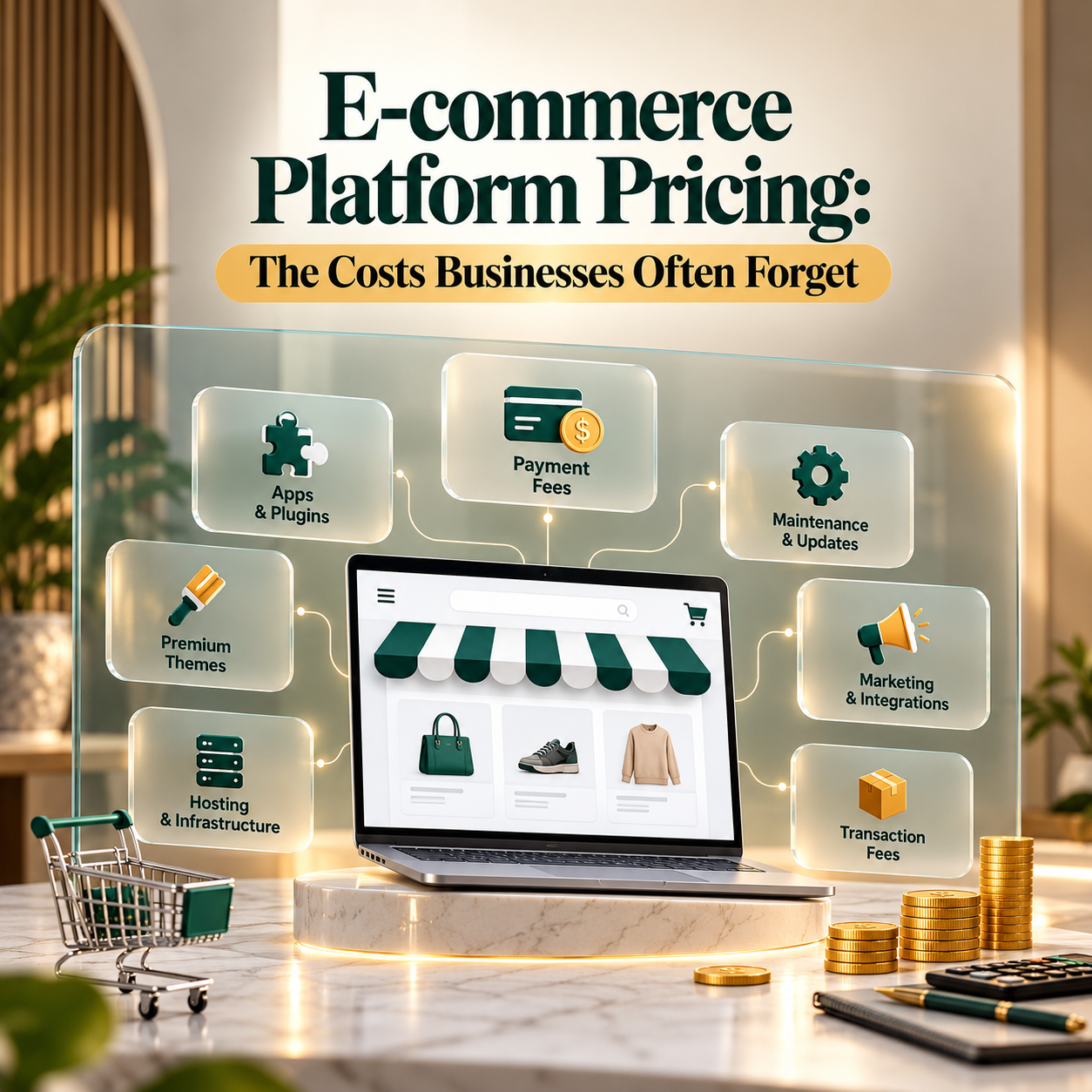
While the monthly fee is indeed an important aspect of overall cost, it is not the only one. Full cost for an e-commerce platform also includes: development, plugins, payment processing, hosting, maintenance, integration, marketing, customer support, etc.
Thus, what starts out as an attractive low-cost option could become a massive expense, whereas expensive options may ultimately provide economies of scale. What companies need to understand when considering different platforms is that mere question of subscription cost is not sufficient. Rather, they should be looking at the whole picture of costs associated with the platform continuum.
More often than not, ecommerce firms start by analyzing monthly or yearly subscription alternatives. It gives only a slight idea of ecommerce platforms pricing, but it fails to demonstrate overall costs of ownership. The subscription may include hosting, checkout options, product management, protection, as well as basic analytics, but it is not enough for businesses most of the time.
As the demands grow higher, the ecommerce costs are growing respectively. The contrast is especially evident when a business requires advanced product filtering, multilingual service, custom checkout process, automation tools, international selling capabilities, B2B tools, or complicated integrations.Thus, it is essential to estimate the platform considering the needs of the business itself, rather than its entry pricing.
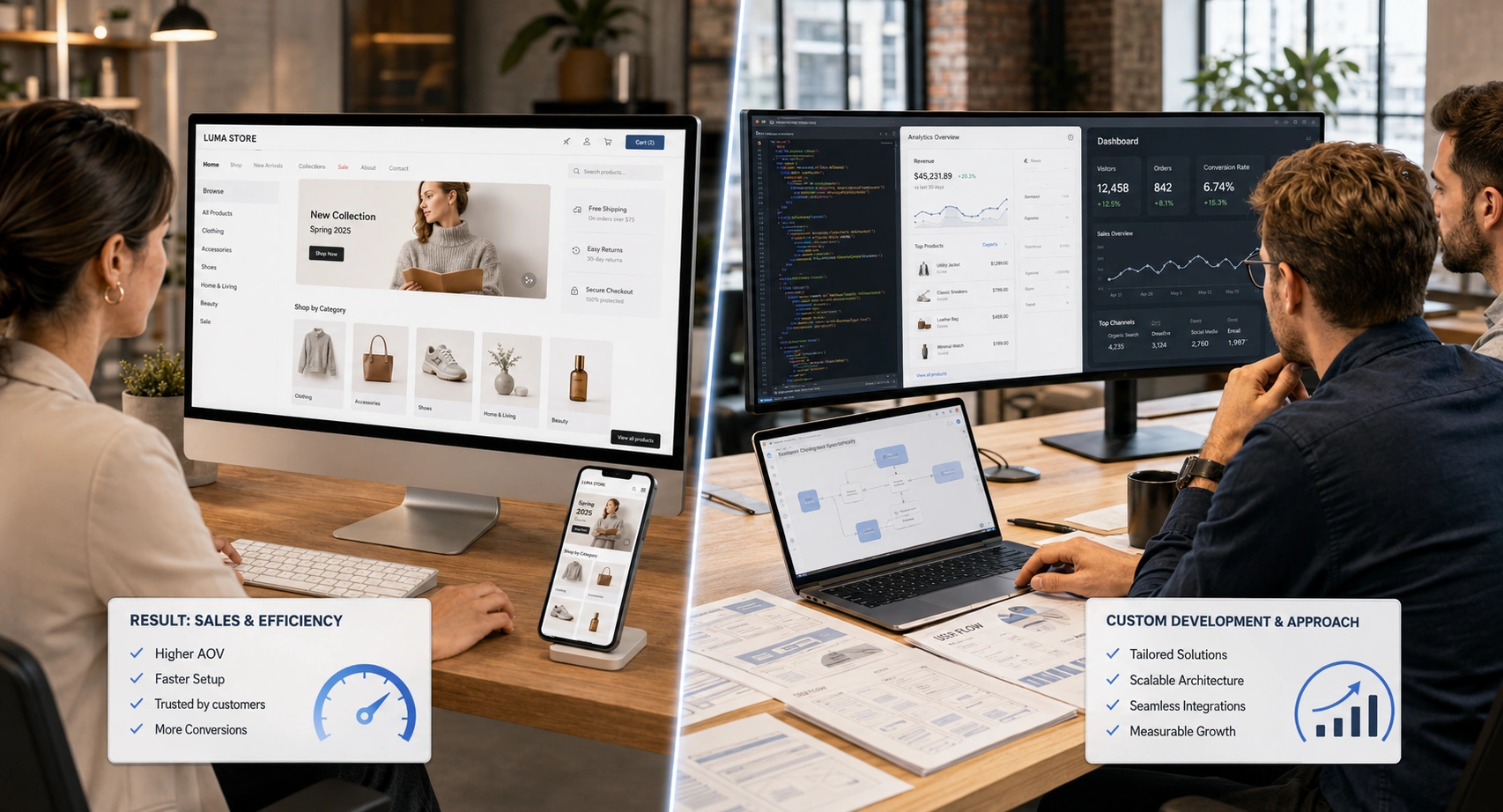
Even an easy of use platform may require some development. Companies often require custom themes, branded interfaces, landing pages, checkouts, API connections, and unique features. It is easy to underestimate these costs.
While a simple store might not require significant customization, a brand that is going to be growing may hire developers often to improve the store features, resolve obstructions or help with seasonal marketing campaigns. Thus, development costs become a key component of expenses of any e-commerce business.
This is why companies should ask themselves what level of customization will be required before choosing a platform type.
The majority of e-commerce companies utilize additional applications. These may be review, email marketing, product recommendations, loyalty program, customer support, subscription, search, filtering, analytic, upselling, return, and inventory tools. One application might look cheap.
Five or ten applications will make a much bigger monthly money outlay on software. The real problem is that some platforms rely heavily on third-party applications to provide functionality that may be a given elsewhere. When comparing the prices of e-commerce platforms, businesses should inquire concerning which features are already included and which require paying for extra software.
Payment-processing fees are an expense that is commonly overlooked by companies. Along with costs that come with gateway services like the use of payment systems, every transaction has its own processing fees, payment fees, currency conversion fees, or other fees depending on what gateway and platform they are using for payments.
In cases of low-volume orders or transactions, payment processing fees do not seem too significant. However, when the sales grow, these costs increase.
This does become important when making a price comparison with other platforms, as the price cut should include not only the cost of the platform itself but also those of payment processing and any other fees related to transactions if there are any. The difference in payment processing fees can be less noticeable, as it doesn’t mean much when a company processes a few transactions a month only.
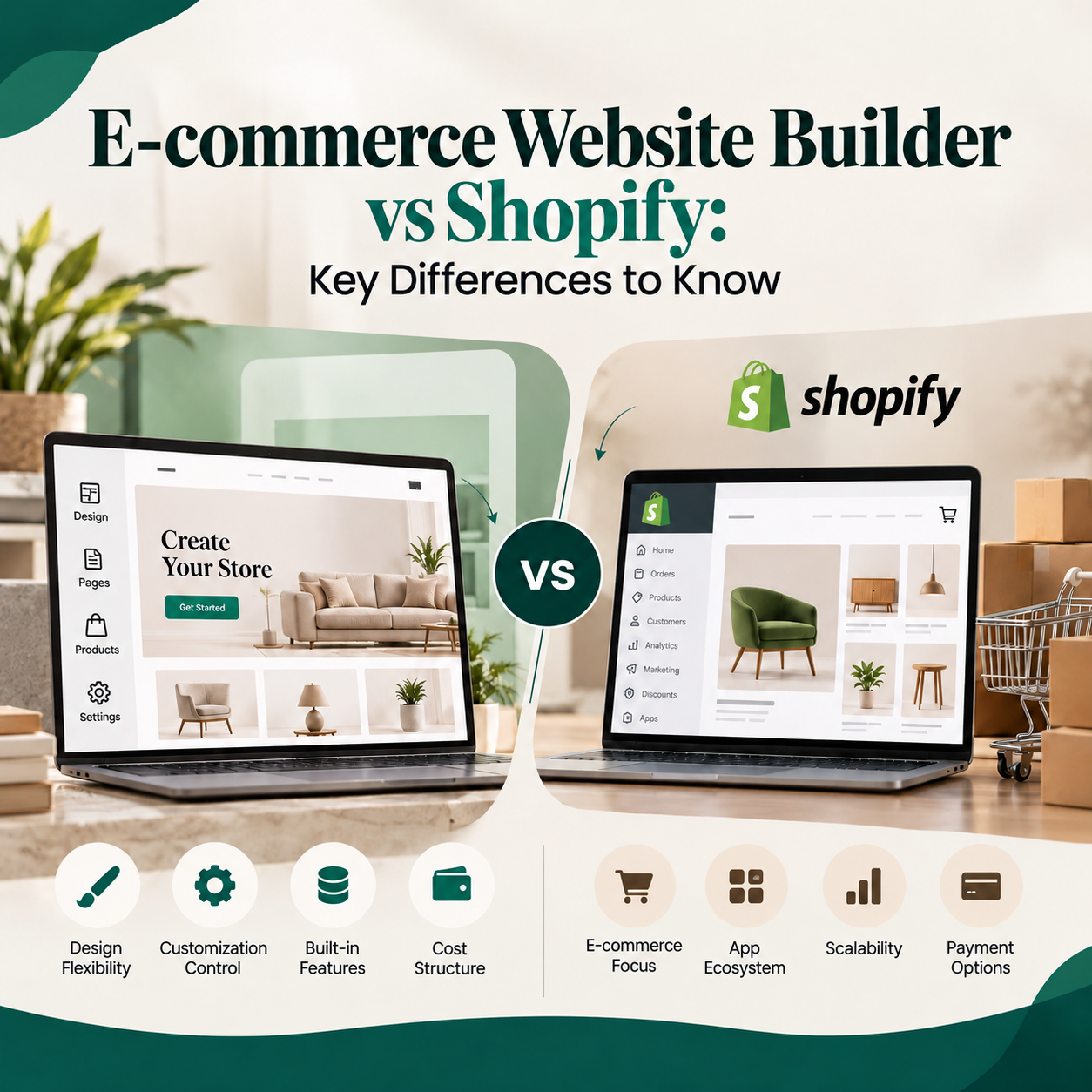
When a startup assesses the features of Shopify, they generally pay attention to the plan rates at the first place.Nonetheless, the overall Shopify price involves additional costs like paid themes, mobile apps, developers, various integrations, payment processing, special options, and proceeds optimization.
Many corporations appreciate Shopify because it provides them with a sufficient ecosystem and allows them not to think about the infrastructure. However, the total costs will depend on how complicated the store will be.
In other words, a basic Shopify store may be easy to operate, while a well-developed and highly personalized store would need numerous paid applications, custom solutions, and many outside systems.
Operating an online business involves not only keeping your website running. Companies also need a variety of systems designed for the capturing, converting, and retaining of customers. Email marketing, SMS marketing, WhatsApp automation, analytics, attribution, customer databases and CRMs are examples of tools that can be added to the service portfolio.
These tools are included into the ecommerce expense as well, even if they are not part of the ecommerce software. Nevertheless, they are important when you are assessing the affordability of an ecommerce software. For instance, ecommerce software could require a number of additional tools or have more functionality built into a single solution.
It is uncommon for an e-commerce company to rely solely on a single system, as there are many systems that should work together. For instance, the e-commerce store may have to unite with the accounting software, the warehouse system, the ERP solutions, the CRM system, the shipping partners, various marketplaces, payment providers, and customer support platforms.
Integration may be pricey not only in terms of implementing it. The initial setup might be only part of the cost of integration. Once established, integration may be affected by changes to any app, API, or business processes. If integration keeps failing or if manual involvement is needed, this will not only mean technical costs but operational inefficiencies as well. That is why the costs of e-commerce should be evaluated at the level of the entire organization and not only the e-commerce store.

Employee time is significant in e-commerce, though it is frequently ignored. When employees perform tasks such as exporting spreadsheets, updating inventories manually, processing returns, entering customer information in systems, generating reports or fixing system problems, the business pays for the inefficiency of the platform.
Where manual operation is possible in the case of a small number of orders, it starts to become costly once order volume is high. Platform facilitating the use of automation may look costly at the beginning, but it reduces operational costs in the long run.
Every ecommerce shop needs continuous care. Companies may have to get help regarding security, updates, technical failures, performance, integrations, plug-ins, custom code, and problems with the checkout. Hosted platforms can alleviate some technical burdens, but the customizing and connecting systems still need attention.
Open source or very customized platforms might require even more management. Before choosing a system, companies need to know who is going to look after it and how much it will cost. One can’t say that a given platform is inexpensive if it has to be interfered with all the time.
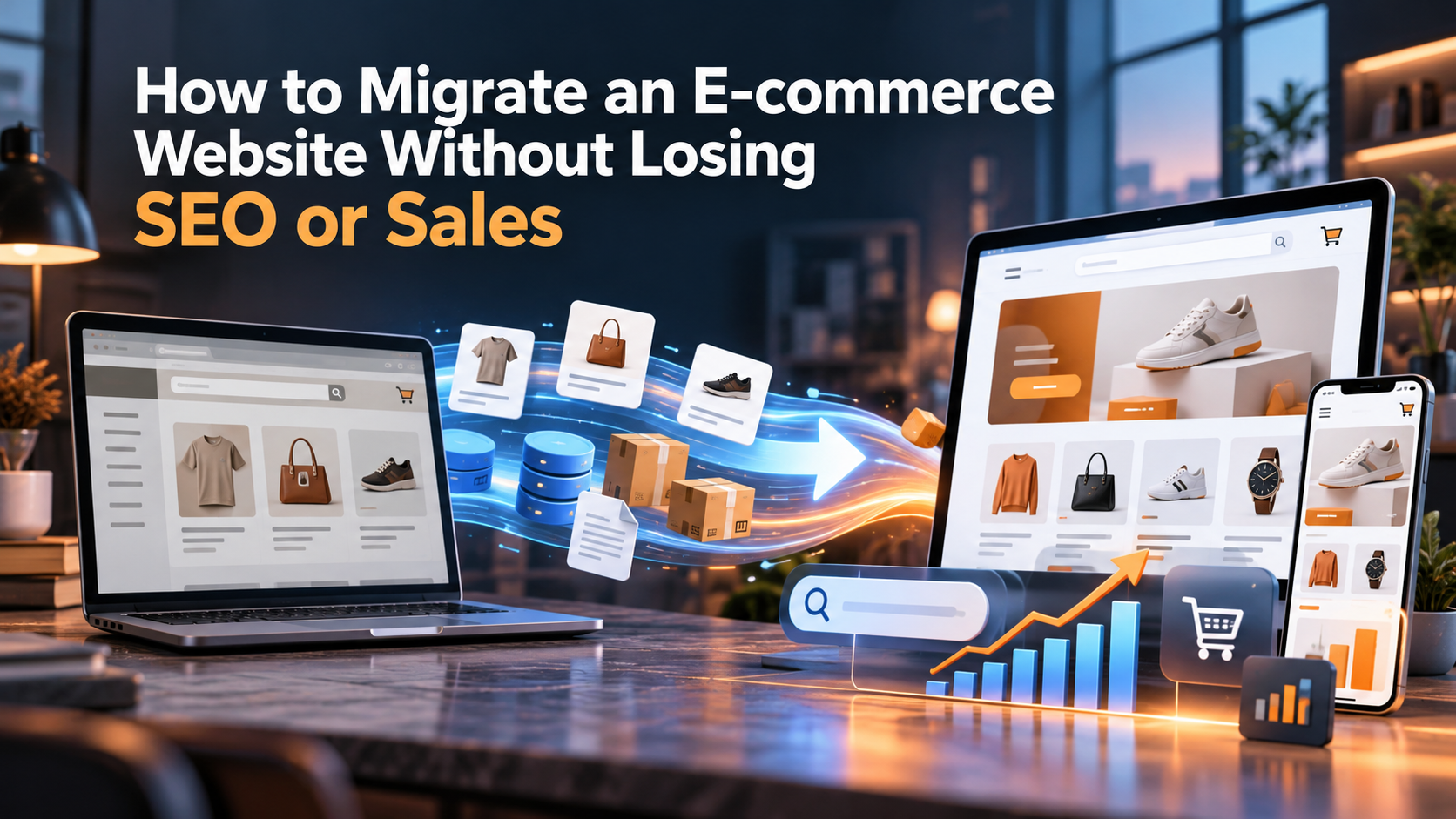
One cost that people often overlook is the expense of moving away from the platform in the future. When an ecommerce operation expands, the process of migration becomes very intricate and complicated. Transferring of products, customers, orders, SEO statistics, links, integrations, data analysis, and processes is essential.
Consequently, it may become costly to migrate to a different platform due to an unfortunate selection made in the beginning. That’s why businesses should think about what they will need in the future before selecting the platform they are going to use. Investing in an advanced platform that can be scaled, companies can avoid unnecessary replatforming expenditures in the future.
To compare e-commerce platforms effectively you need to be able to perform a total cost of ownership calculation. That means starting with the subscription price and then figuring in development costs, app expenses, payment processing fees, integrations, marketing software, and maintenance costs as well as technical support and manpower costs.
Then you should factor in how you expect those costs to change as your business grows. Hence, a platform that seems effective from a financial perspective in the first year of your operation may become unreasonably costly when your business expands and when you start getting more orders. So this is the only way to get a good overview of what each e-commerce platform offers.
The real price of e-commerce solution is much more than just a subscription price. One must take into account many factors, such as development, integrations, applications, payments processing, maintenance, marketing software, technical support, staff time, and the need for migrations in the future.
That’s why e-commerce solutions should always be evaluated based on total ownership costs. The same principle applies to analyzing Shopify costs and expenses of any other e-commerce solution. A service with a low price may become more expensive once all the additional services are added, while a pricier solution may provide better value.
What are the items that form part of the e-commerce platform fee?
Ecommerce platform pricing typically consists of a monthly subscription fee or an annual subscription fee, although the businesses may also incur costs such as those related to development, applications, payment processing, integrations, marketing tools, hosting, maintenance, and technical support.
Which expenses do people usually fail to take into account?
Usually, the cases of ignoring the expenses related to ecommerce include the cost of paid applications, transaction fees, expenses related to maintenance of integrations, the cost of developer support, the price of marketing tools, the cost of the employees’ time, and the costs associated with migration in the future.
Do Shopify costs include only the subscription fee?
No, Shopify costs may also cover applications, themes, developers, payment processing fees, integrations, customizations, and continuous optimizations depending on the needs of the business.
The things to take into account before selecting your ecommerce platform