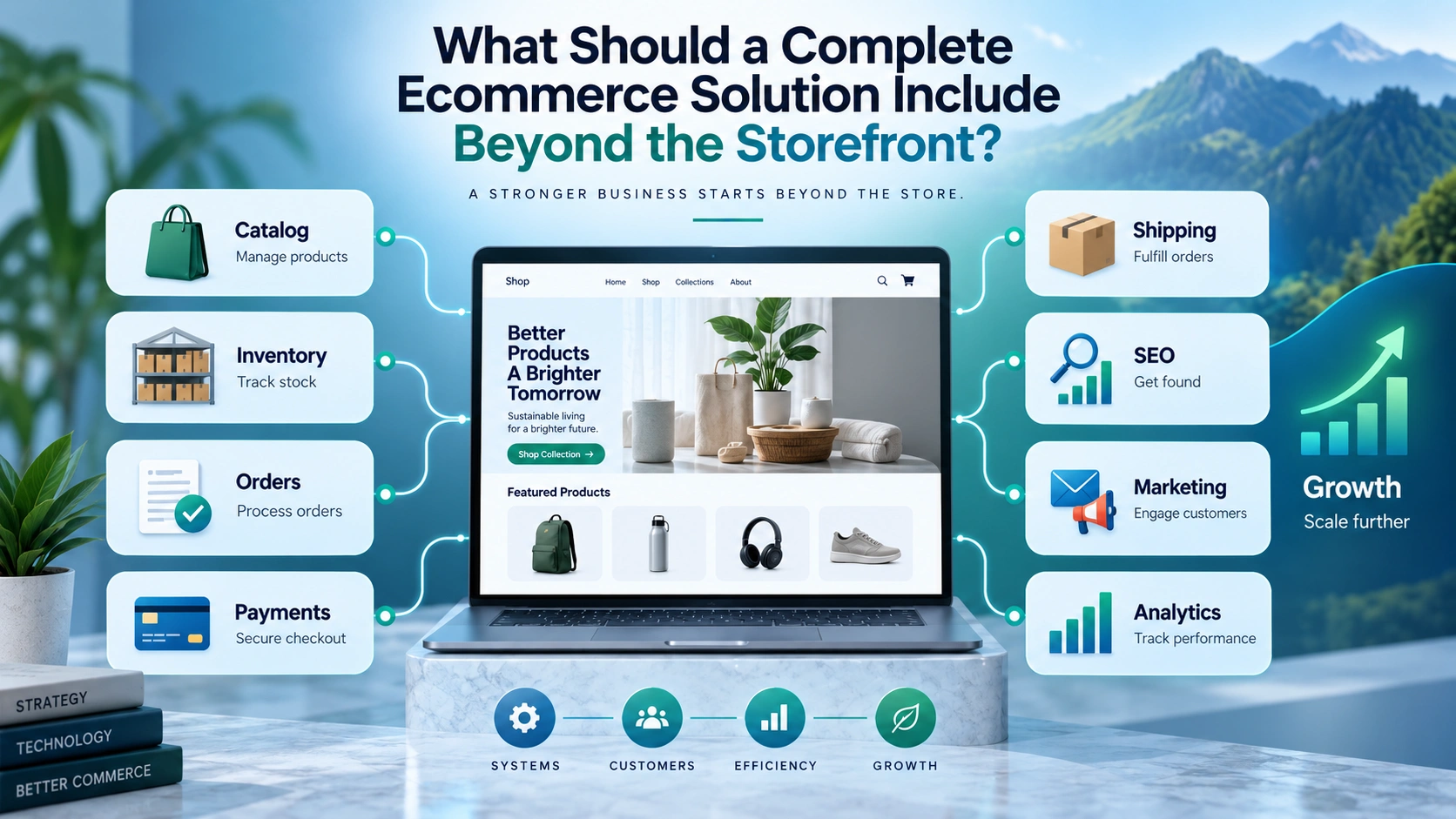
What Should a Complete Ecommerce Solution Include Beyond the Storefront?
September 14, 2026
A storefront is the most visible part of an online business, but it is not the business itself. Strong ecommerce solutions connect product information, customer experience, payments, fulfillment, search visibility, marketing, analytics, and ongoing optimization into one operating system. That distinction matters more as online retail becomes more competitive. U.S. Census Bureau data shows that ecommerce accounted for 17.1% of total U.S. retail sales in the second quarter of 2026, with ecommerce sales up 12.2% year over year. Growth creates opportunity, but it also raises the standard customers expect from every interaction. A fast ecommerce website cannot compensate for inaccurate inventory, weak delivery options, disconnected campaigns, or missing performance data. The practical question for merchants is therefore not “Which store builder should I choose?” but “Which system will help me acquire customers, convert demand, fulfill reliably, learn from performance, and keep improving as the business grows?” That is the standard a complete ecommerce solution should meet.
Many businesses evaluate ecommerce from the front end backward: themes, page builders, templates, then checkout. Those matter, but they are only the customer-facing layer.
A better framework follows the commercial loop: attract demand, help shoppers discover the right product, convert interest into an order, fulfill correctly, retain the customer, measure what happened, and improve. If one layer is disconnected, the cost usually appears elsewhere through manual work, data errors, wasted advertising, weak search visibility, or poor customer experience.
A complete solution should therefore be judged less by feature count and more by how well its systems work together.
The storefront must load quickly, work well on mobile, make navigation intuitive, communicate trust, present products clearly, and minimize checkout friction.
Baymard Institute’s latest aggregation puts the average documented online shopping cart abandonment rate at 70.22%. Its research also found that 17% of U.S. shoppers had abandoned an order because checkout was too long or complicated. Not every abandonment can be prevented, but these findings show why conversion design goes far beyond attractive product pages.
Performance matters too. In a published web.dev case study, Rakuten 24 reported a 33.13% conversion-rate increase in an A/B test after improving Core Web Vitals and related performance metrics. That is a company-specific result rather than a universal benchmark, but it demonstrates why page performance should be monitored as a commercial metric, not only as a technical one.
A scalable store needs a reliable product-information layer. Titles, descriptions, images, SKUs, variants, pricing, availability, categories, attributes, and inventory should be managed consistently rather than rebuilt for every channel.
This becomes critical with large catalogs. A product offered in several sizes, colors, or finishes creates relationships between variants, stock, URLs, feeds, search data, and customer selections.
Google’s ecommerce documentation recommends structured product data and provides specific guidance for product groups and variants so search systems can understand those relationships. The practical lesson is that catalog architecture is both an operational asset and a discoverability asset.
A complete platform should let merchants reuse dependable product data across the storefront, search engines, shopping feeds, marketplaces, and reporting systems without maintaining conflicting copies.
Once an order is placed, ecommerce becomes an operations problem. Payment status, inventory updates, shipping rules, fulfillment, notifications, cancellations, returns, refunds, and customer support need to stay synchronized.
DHL’s global shopper research found that 81% of surveyed shoppers would abandon a purchase if their preferred delivery option was unavailable, while 79% would leave if the returns experience did not meet expectations. DHL’s business research also reported that 96% of ecommerce retailers considered their logistics offering important to securing sales.
Operations therefore influence conversion before purchase and loyalty afterward. Merchants should check whether delivery promises, inventory, tracking, return rules, and customer communications match what the storefront tells shoppers.
A polished interface cannot compensate for an order that is out of stock, ships later than promised, or becomes difficult to return.
An ecommerce website that cannot be discovered efficiently has to depend more heavily on paid or already-owned demand.
A complete solution should support technical SEO, editable metadata, clean URLs, indexable categories, XML sitemaps, redirects, canonical rules, internal linking, product schema, image optimization, and content publishing as the catalog evolves.
Google recommends adding Product structured data to product pages and sharing product information through Google Merchant Center to improve its understanding of products and eligibility for richer shopping experiences. Merchant listing data can communicate information such as price, availability, shipping, and returns directly to Google.
The broader principle is that SEO should sit inside catalog and publishing workflows. When a new product, category, market, or language launches, discoverability should be part of the release process—not a cleanup project several months later.
Customers may discover a brand through organic search, social media, marketplaces, email, paid advertising, creators, or direct traffic and then return through another channel before purchasing.
DHL’s 2025 business research found that 63% of ecommerce businesses surveyed sold on at least three online platforms, while 87% maintained a social media presence. That does not mean every merchant should try to be everywhere. Uncontrolled channel expansion can create duplicated work, inconsistent product information, and fragmented reporting.
The stronger model is coordinated distribution from a dependable core catalog. Marketing tools should connect product feeds, audiences, promotions, email automation, social campaigns, remarketing, and channel-specific content to the same underlying product and customer system.
This is where storefront-only software often becomes limiting. Demand generation becomes much harder when teams are continually copying product information, exporting spreadsheets, and switching between disconnected systems.
Revenue is an outcome. Merchants need visibility into the behaviors that produce it.
Google Analytics 4 recommends ecommerce events including view_item, add_to_cart, begin_checkout, add_shipping_info, add_payment_info, purchase, and refund. Correct implementation allows businesses to understand how shoppers progress through the buying journey rather than measuring only visits and final transactions.
A useful ecommerce dashboard should connect acquisition source, product views, cart activity, checkout progression, conversion, average order value, refunds, repeat purchasing, and product-level performance.
The management question is not simply, “How much traffic did we get?” It is, “Which traffic converted, which products created intent, where did customers leave, and what should we change next?”
That is why analytics implementation belongs in the initial platform setup rather than being treated as an optional reporting add-on after launch.
Launching a store is a project; growing one is a continuous operating discipline.
As order volume, catalog size, markets, channels, and team members increase, a scalable ecommerce platform should absorb more complexity without multiplying manual work. It should support expanding catalogs, integrations, permissions, localization, additional sales channels, and higher transaction volumes while keeping business data consistent.
Technology alone does not solve every growth problem. Businesses may also need ongoing SEO, catalog improvement, campaign execution, content production, conversion optimization, reporting, and operational assistance.
This is where ecommerce management services can create real value, particularly for merchants that do not want to recruit separate developers, SEO specialists, content teams, channel managers, analysts, and ecommerce operators.
The important distinction is between support that fixes software issues and support that improves commercial performance. Mature ecommerce businesses often need both.
Evaluate a platform by following a real order lifecycle rather than relying only on a product demonstration.
Trace how a product is created, published, discovered, promoted, purchased, fulfilled, returned, measured, and optimized. Then identify where data must be entered again, where another tool becomes necessary, and who is responsible when information stops flowing between systems.
A strong evaluation should answer five questions:
This exercise exposes operational friction that feature comparison tables frequently hide.
A platform with 100 separate features may create more work than one with fewer capabilities that share the same product, customer, order, and analytics data.
Idiocom’s current positioning follows this broader commerce model. Its platform combines store creation with catalog and inventory management, orders and shipping, SEO, marketing, analytics, multichannel visibility, and optional managed brand-and-growth support. Idiocom also offers software-only and managed approaches, allowing merchants either to operate their ecommerce environment independently or receive support across store management, SEO, content, marketing, and growth activities.
That changes the relevant comparison from simply “website builder versus website builder” to toolset versus connected operating model.
Businesses should still evaluate integrations, commercial terms, technical fit, and the exact scope of services they require. But the underlying approach reflects how ecommerce increasingly operates in practice: as an interconnected brand, technology, operations, marketing, and growth system rather than a standalone website.
The storefront is where customers see the brand, but sustainable ecommerce performance depends on everything connected behind it. Strong ecommerce solutions combine customer experience, catalog integrity, operations, discoverability, marketing, measurement, and continuous improvement.
For merchants, the buying decision should therefore start with the operating model rather than the homepage template.
Choose a system that can support the complete customer and product lifecycle today while absorbing more products, channels, customers, markets, and operational complexity tomorrow—without forcing the business to rebuild its ecommerce foundation every time it grows.


Growing an online store often comes with a common assumption—you need to spend more on advertising to generate more...

Breaking into the world of online business isn’t easy—especially for e-commerce startups trying ...