Best Ecommerce Automation Strategies for Growing Online Stores
- June 4, 2026
Running a successful online store becomes increasingly complex as sales grow. Managing inventory, customer communication, marketing campaigns, and order fulfillment manually can consume valuable time and resources. This is where ecommerce automation becomes a game changer.
The best ecommerce automation strategies help businesses streamline operations, improve customer experiences, reduce human errors, and increase profitability. By automating repetitive tasks, online stores can focus on growth, innovation, and customer satisfaction.
In this guide, we explore the most effective ecommerce automation strategies that can help growing online stores scale efficiently.
Why Ecommerce Automation Matters
As online stores grow, manual processes often become bottlenecks.
Key benefits of ecommerce automation include:
- Increased operational efficiency
- Reduced manual workload
- Faster customer service
- Improved order accuracy
- Better marketing performance
- Enhanced customer retention
Businesses that implement automation effectively can scale faster while maintaining service quality.
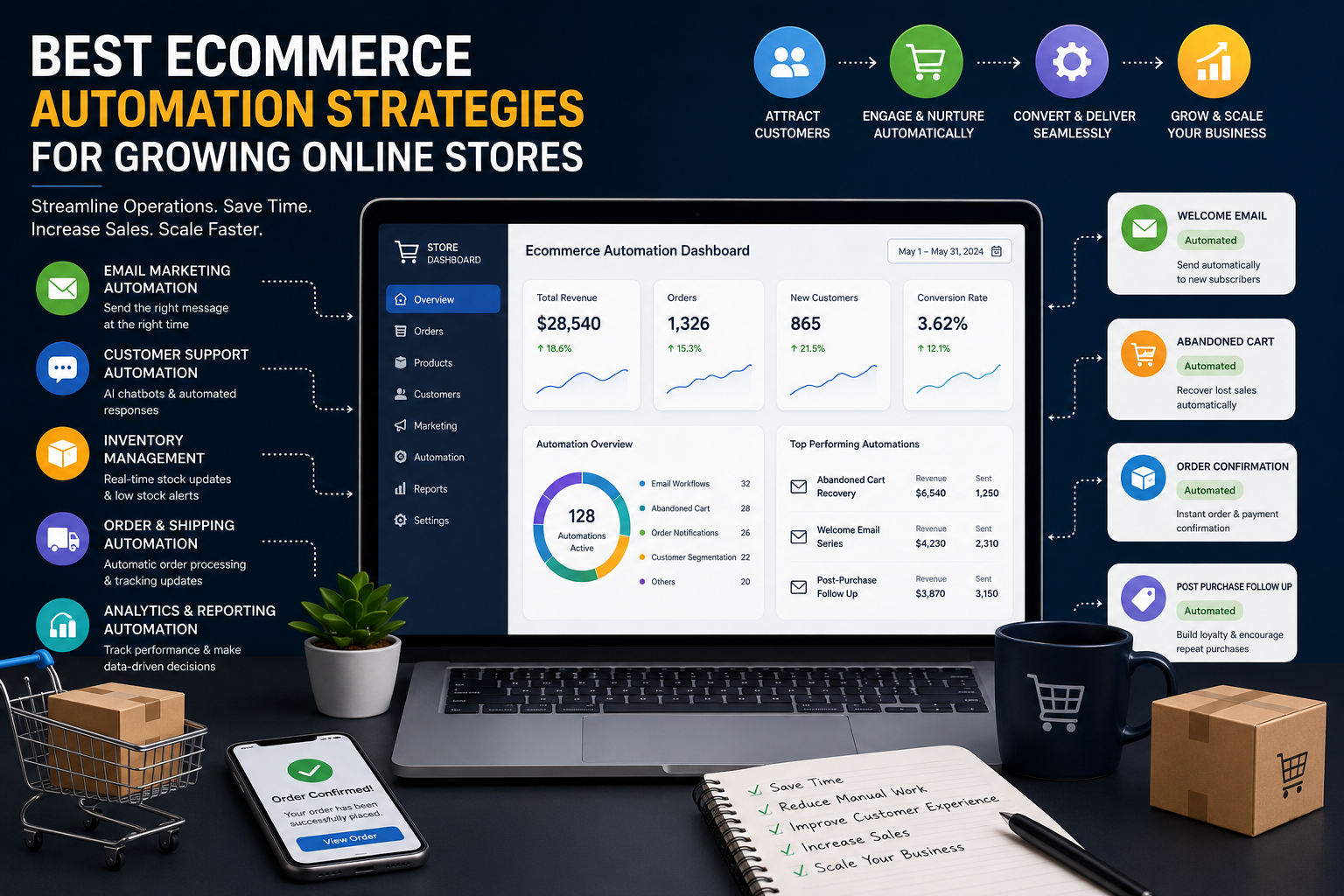
Automate Email Marketing Campaigns
Welcome Email Sequences
First impressions matter. Automated welcome emails help introduce your brand and encourage new customers to make their first purchase.
Benefits include:
- Higher engagement rates
- Improved customer trust
- Increased conversion opportunities
Cart Abandonment Recovery
Many potential customers leave products in their carts without completing purchases.
Automated cart recovery emails can:
- Remind customers about their carts
- Offer incentives when appropriate
- Recover lost revenue
Post-Purchase Automation
After a purchase, automated follow-up emails can:
- Request reviews
- Recommend related products
- Provide helpful product information
- Encourage repeat purchases
Automate Customer Support
AI-Powered Chatbots
Modern chatbots can answer common customer questions instantly.
Common use cases include:
- Order tracking
- Product recommendations
- Shipping information
- FAQ support
This improves response times while reducing support workload.
Automated Help Desks
Help desk systems can automatically:
- Route tickets
- Prioritize urgent requests
- Assign cases to support agents
- Track resolution times
This creates a more organized customer service process.
Inventory Management Automation
Inventory errors can lead to lost sales and dissatisfied customers.
Automation tools help by:
- Monitoring stock levels
- Generating low-stock alerts
- Synchronizing inventory across channels
- Forecasting future demand
Accurate inventory management supports smooth business growth.
Automate Order Processing
Order management automation reduces administrative work and minimizes mistakes.
Order Confirmation Automation
Customers receive immediate confirmation when orders are placed.
Benefits include:
- Increased customer confidence
- Reduced support inquiries
- Better order transparency
Shipping Automation
Shipping automation can:
- Generate shipping labels
- Send tracking updates
- Calculate shipping costs
- Coordinate with fulfillment partners
This helps deliver a seamless customer experience.
Personalize Customer Experiences
Product Recommendation Engines
Automation platforms can analyze customer behavior and suggest relevant products.
Benefits include:
- Higher average order value
- Improved conversion rates
- Better customer satisfaction
Behavioral Segmentation
Automated segmentation allows businesses to target customers based on:
- Purchase history
- Browsing behavior
- Location
- Engagement levels
This enables highly personalized marketing campaigns.
Social Media Automation
Managing multiple social platforms manually can be time-consuming.
Automation tools help by:
- Scheduling posts
- Monitoring engagement
- Publishing content consistently
- Tracking campaign performance
A consistent social media presence supports long-term brand growth.
Automate Analytics and Reporting
Data-driven decisions are critical for ecommerce success.
Automated reporting systems can track:
- Sales performance
- Customer acquisition costs
- Conversion rates
- Marketing ROI
- Customer lifetime value
Real-time insights help business owners identify opportunities and challenges quickly.
Future Trends in Ecommerce Automation
AI-Driven Personalization
Artificial intelligence is enabling deeper personalization through predictive analytics and customer behavior analysis.
Predictive Inventory Management
Advanced automation systems can forecast demand and optimize inventory levels before shortages occur.
Omnichannel Automation
Businesses are increasingly connecting websites, marketplaces, social commerce platforms, and customer support systems into a unified automated ecosystem.
Best Practices for Ecommerce Automation
To maximize results:
- Start with repetitive tasks
- Choose scalable automation tools
- Monitor automation performance regularly
- Maintain human oversight when necessary
- Continuously optimize workflows
Automation should support business growth without sacrificing customer experience.
Conclusion
Implementing the best ecommerce automation strategies can transform how online stores operate. From marketing and customer support to inventory and order management, automation helps businesses improve efficiency, increase revenue, and scale sustainably.
Growing online stores that invest in automation today will be better positioned to compete and succeed in the future.
Ready to Automate and Scale Your Online Store?
Book a Free Consultation today and discover how ecommerce automation can help your business grow faster and smarter.