Ecommerce Growth Strategies for Growing Online Stores
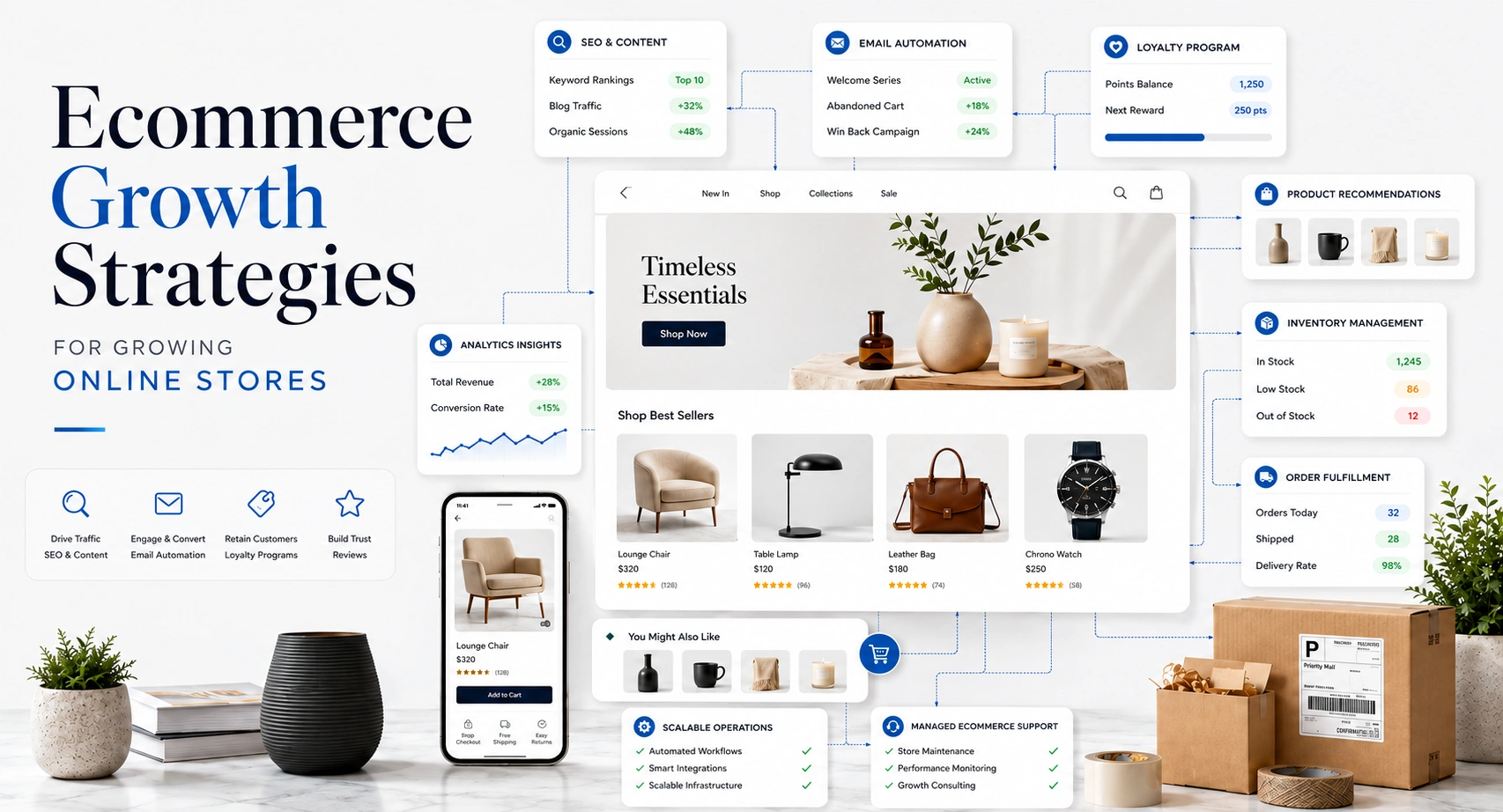
Expanding an online store is not merely about bringing in more visitors. As an ecommerce company matures out of its initial phase, its growth is driven by its ability to convert traffic, retain customers, manage the product catalog and provide a scalable shopping experience. The technology used by the online store becomes crucial when product lines, orders, customer requirements and marketing efforts scale up.
An effective online store builder can help maturing companies create the groundwork for dealing with these issues without having to employ a dedicated technical workforce. By making use of no-code technology, built-in ecommerce capabilities and improving AI capabilities, companies can implement changes more rapidly and concentrate more on customers and revenues.
Consequently, the best ecommerce growth approaches include all of these aspects – customer experience, conversion, retention, content, merchandising, automation and technology scalability.
Determine What Is Restraining Your Progress
Prior to implementing new growth strategies, pinpoint the part of your existing e-commerce experience where you could be missing out on additional revenue.
This could range from a website that has a lot of traffic but no conversions, to one that has great conversions but does not attract repeat business. Your expanding product range might hinder customers from discovering products, while operational inefficiencies could delay your marketing and merchandising efforts.
Consider the entire process of customer acquisition from initial visit, product discovery, checkout, delivery, and repeat purchase. Conversion rates, average order value, repeat purchase behavior, cart abandonment, traffic sources, and product performance are some of the things that could give you an idea about what your next step should be.
Streamline Your Ecommerce Experience
As the number of your products increases, a basic storefront will grow more complex.Your customers must be able to quickly navigate through your product categories, find suitable products, compare the options, and proceed to checkout without any difficulties.
The combination of your navigation menu, search function, filters, collection pages, recommended products, and internal links is what makes the process seamless.
Using a modern ecommerce website builder will simplify the process even further, eliminating the need for developers for every single change.
Optimize Conversion Before Attracting More Visitors
Adding more visitors to the website isn’t always the quickest way to grow. When the store attracts thousands of visitors but only some of them convert, optimizing the current process might be a more lucrative solution than attracting new traffic right away.
Begin with product pages. They should feature good pictures, accurate descriptions, specifications, prices, delivery terms, returns policy, and call to actions.Another crucial aspect is the checkout process that needs to be smooth, free of extra steps, transparent about expenses, offer relevant payment methods, and work well on mobile devices.
Optimizing the conversion process will allow the business to earn more money from traffic that they are currently paying for or getting through organic channels.
How to Increase Average Order Value Through Merchandising
There are other sources of growth which will consist of creating more value through transactions. Product recommendations, bundles, complements, and smartly curated collections can prompt the customers to buy products that are natural add-ons to their existing purchase.
For instance, when a person buys a camera, he/she would also need a memory card or cover. Similarly, while buying a sofa, there may be some interest in cushions or a side table.
It is not about offering customers as much product as possible. It should be about making the experience of shopping more valuable for them through the products that match their purchases.
Formulate a Solid Retention Campaign for Your Ecommerce Store
Customer acquisition is just half the battle; retaining customers is the other half that could see them turning into revenue sources for your ecommerce business. Campaigns such as email marketing, product suggestions, new arrival notifications, reminders, loyalty programs, and educational material could all be used in order to retain customers.
Discounts are not always the way to get customers back. People might come back to your business out of loyalty, trust, or simply because of convenience.
It is important for your business to know what products your customers buy and how often they buy them in order to formulate a solid retention campaign.
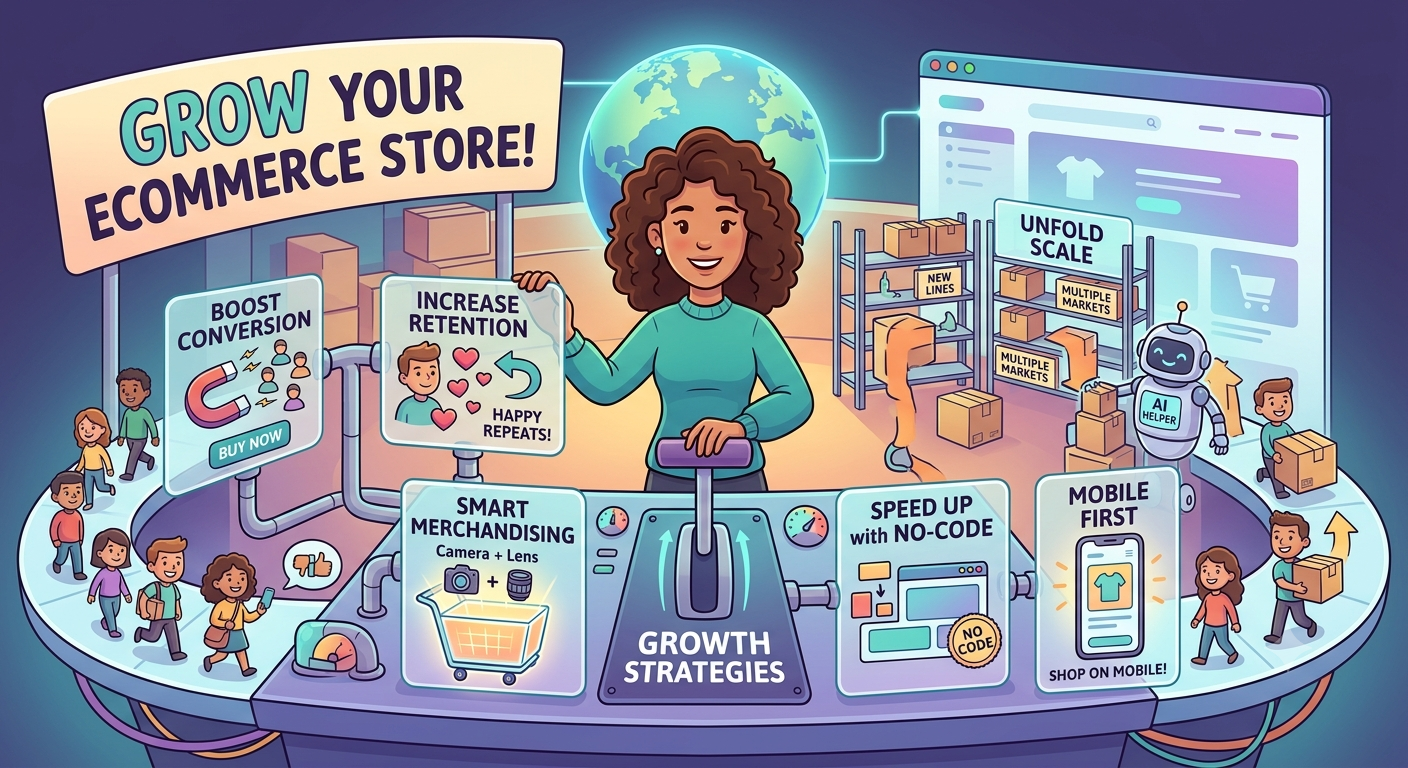
Enhance the Visibility of Your Online Store through Organic Search
Organic search can be an essential source of long-term traffic for an online store.Rather than relying only on writing content about broad keywords, create content based on the concerns that people have prior to buying. Product comparison articles, buying guides, category-related content, FAQs, tutorials, and informational posts will ensure you cover organic search demand for your online store.
It is necessary that your products and categories include informative content that is not duplicated. An adaptive website creation solution can make the process of content and page optimization simpler. It is essential since SEO is a continuous process that involves changes in the range of products offered, consumer concerns, search patterns, and competition.
Utilize No-Code Technology to Speed Things Up
One of the most frequent issues that startups experience is that the website requires constant updates, yet every update cannot become a new development project.
No-code website builders would provide more freedom to manage websites to startup teams. Pages, layouts, content blocks, product collections, and many other elements of the storefront can frequently be modified without any code at all.
Startups that aim to develop ecommerce websites without code can utilize no-code ecommerce website builders and thereby decrease the technical barrier of launching and operating their online stores.
It doesn’t mean that developers are no longer needed. Integration projects and custom applications can still require some specialist’s involvement. However, this helps to speed up ecommerce changes.
Utilize AI to Streamline Ecommerce Functions
AI is becoming increasingly helpful throughout the ecommerce processes.With the use of an AI-based store builder, organizations can leverage artificial intelligence to speed up some website creation and store management steps. In different platforms, AI could help with product information, catalog development, page development, and so forth.
For a rapidly growing company, the greatest benefit would be saving time since the organization will have more time to focus on merchandising, marketing, and other important areas.
AI-generated content must go through human validation prior to publishing. There are several important things that AI cannot take into account.
Create Landing Pages for Different Campaigns
Not all customers or campaigns can be accommodated with one homepage.Create different landing pages for product lines, seasonal promotions, collection launches, customer segments, or different advertising campaigns.
A landing page created specifically for a skincare campaign, for instance, can concentrate solely on a customer need rather than direct the user to a generic homepage.A drag-and-drop visual ecommerce solution can enable easy page building for marketing purposes. With the help of such an approach, marketers won’t have to wait for development resources to build relevant pages.
Mobile First for Your Store
For numerous internet-based companies, the mobile device is part of the customer journey process.The website should be easily navigable, searchable, and shoppable on a mobile screen. Images should render properly, actions should be easily clickable, navigation should be easily visible, and the checkout process should not become more complex.
Mobile optimization should not be seen as a technical problem but should be viewed as one of the components of the entire customer experience.
When choosing an easy ecommerce website builder, look at how well the software helps in creating responsive storefronts and mobile commerce.
Transform Customer Feedback Into Areas for Improvement
The areas where your ecommerce customer experience is lacking will be pointed out to you by your customers.
Feedback in reviews, interactions with your customer service team, issues related to returns, queries about your products, and post-purchase feedback all have potential to show you where changes need to be made.
If your customers frequently ask questions regarding your product sizes, then provide size-related information on your product pages. Similarly, if shipping information is being questioned, then you should make that information more readily available.
Make Online Store E-commerce Operations Automated
With time, manual processes will start to pose a serious operational challenge for an online business. Depending on the technology that has been applied, automation may involve such processes as repetitive customer communication, marketing, product management, order updates, among others.
It should be noted that the goal of automation isn’t to automate all customer interactions. On the contrary, repetitive tasks should be automated in order for your team to handle those that require creative and customer-driven decisions.Such online store builders that combine automation and management functions may prove to be especially effective.
Select Scalable Ecommerce Technology
The ecommerce technology selected needs to be scalable according to the future prospects of the business. There comes a time when the expanding business needs a greater number of products, more payment systems, different marketing channels, improved analytics, better inventory management or even multi-market capability.
While selecting an appropriate platform, it needs to be taken into account that the business will be able to use the same technology as it evolves into a more complex form.For instance, Idiocom integrates ecommerce store building with the management of products, inventory, orders, marketing, analytics, and AI-powered cataloging.
Conclusion
Successful e-commerce expansion cannot be achieved via one marketing campaign or one feature of a website. It requires constant improvement of customer product discovery, selection, purchasing processes and post-purchase interactions with a brand.
For ec-ommerce businesses which aim to scale up, the proper tech will greatly simplify all of these processes. A customizable e-commerce website builder will be able to help businesses adapt their storefronts, while no-code solutions will lower the dependence on coders for regular updates. The use of AI can speed up routine tasks even more, leaving room for strategic activities.
If you are planning to start a new business or expand the already existing one, pick an online store builder that can not only cope with your current needs but also assist your growth in the future. Create a good base, track customer actions, and improve the experience accordingly.
Frequently Asked Questions
What is the optimal way to grow an online store?
There is no one-size-fits-all answer here. In most cases, growing your ecommerce business involves the combination of conversion optimization, retention, better product discovery, organic visibility, merchandising, and operations.
Is a no-code website builder suitable for a growing ecommerce business?
Yes. The right no-code website builder will make it easier to update your storefront without having to know how to code. Businesses need to determine whether it can handle their future catalog, traffic, integrations, and operations.
Can I create an ecommerce website without coding?
Yes. With a no-code ecommerce website builder, businesses can create and manage the majority of aspects of their online store visually and not programmatically.
How does an online store builder assist with ecommerce growth?
The online store builder makes it easy to build a storefront as well as to manage it afterwards. Depending on the builder, it might offer various features related to products, inventory, orders, payments, marketing, analytics, design, and other ecommerce-related areas.