Ecommerce Website Builder for SEO Growth | Idiocom
June 19, 2026
Launching an online store has never been easier. Modern website builders allow businesses to create ecommerce websites quickly, affordably, and with minimal technical expertise. For startups and small businesses, these tools often provide an excellent starting point for entering the digital marketplace.
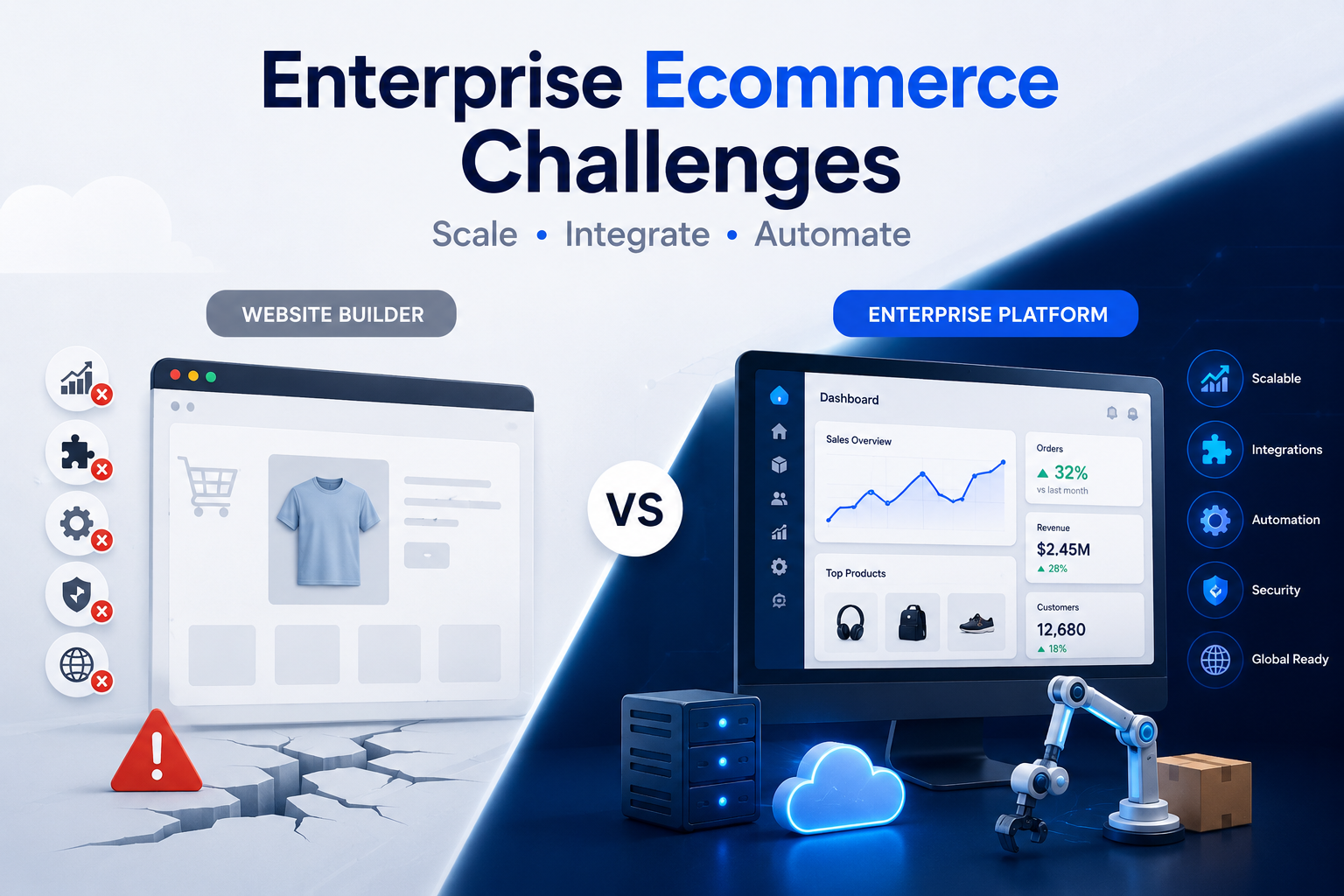
However, as businesses grow, operational demands become increasingly complex. Managing larger product catalogs, multiple sales channels, international customers, advanced integrations, and enterprise-level workflows often exposes the limitations of a basic ecommerce website builder.
This is why many growing organizations eventually transition to an enterprise ecommerce platform that can support scalability, automation, and long-term business growth. While website builders offer convenience, they are rarely designed to solve the challenges faced by modern enterprise businesses.
An ecommerce website builder provides businesses with a fast and affordable way to launch online stores.
Common benefits include:
These advantages make website builders attractive for businesses in the early stages of growth.
However, enterprise organizations operate under very different requirements.
Enterprise ecommerce involves significantly more than managing an online storefront.
Businesses often need to manage:
As these requirements expand, many businesses discover that a basic ecommerce website builder can no longer support their operational needs.
One of the most common challenges businesses face is scalability.
Website builders are typically designed for simplicity rather than enterprise-level growth.
An enterprise ecommerce platform is built to support growing operational demands without compromising performance.
For fast-growing businesses, scalability is essential for maintaining customer satisfaction and business continuity.
Modern ecommerce success depends on connected systems.
Enterprise businesses often rely on:
Many website builders offer basic integrations but lack the flexibility required for complex enterprise workflows.
An advanced enterprise ecommerce platform provides robust APIs and integration capabilities that support seamless business operations.
Customers interact with brands across multiple channels.
These include:
Managing these channels independently creates inefficiencies and operational risks.
An enterprise ecommerce platform centralizes inventory, orders, customer data, and reporting across all sales channels.
This level of control is often difficult to achieve using a standard ecommerce website builder.
Every enterprise business has unique operational requirements.
Unfortunately, website builders often impose restrictions on:
These limitations can prevent businesses from creating differentiated customer experiences.
An enterprise ecommerce platform offers greater flexibility, allowing organizations to tailor functionality around specific business needs.
As order volumes increase, inventory management becomes increasingly complex.
Common challenges include:
Inventory data may become inconsistent across sales channels.
Manual processes can slow order processing and increase errors.
Without advanced tools, businesses struggle to anticipate customer demand accurately.
Enterprise platforms provide intelligent inventory management and automation capabilities that help reduce these operational challenges.
Modern customers expect:
Many website builders offer only basic personalization capabilities.
An enterprise ecommerce platform enables businesses to deliver advanced customer experiences through:
Personalized product suggestions improve engagement and conversions.
Content adapts based on customer behavior and preferences.
Businesses can create highly targeted marketing campaigns.
These capabilities directly impact customer loyalty and revenue growth.
Data-driven decision-making is essential for enterprise growth.
Businesses need visibility into:
Basic website builders often provide limited reporting capabilities.
An enterprise ecommerce platform delivers advanced analytics and business intelligence tools that support strategic decision-making.
Enterprise organizations face increasing cybersecurity and regulatory challenges.
Requirements may include:
While website builders offer standard security measures, enterprise businesses often require more advanced protection.
An enterprise-grade platform provides stronger security frameworks designed for large-scale operations.
Website builders are excellent tools for launching and managing simple ecommerce operations.
However, enterprise businesses require:
These requirements often exceed the capabilities of a traditional ecommerce website builder.
An enterprise ecommerce platform transforms ecommerce from a simple storefront into a strategic growth engine.
The ecommerce industry continues to evolve rapidly.
Key trends include:
AI-driven automation and personalization are becoming standard expectations.
Businesses must create unified customer experiences across channels.
International growth requires multi-language and multi-currency support.
Organizations increasingly rely on predictive analytics for decision-making.
Enterprise platforms are better equipped to support these evolving demands.
An ecommerce website builder can be a valuable solution for startups and small businesses, but it often struggles to meet the complex requirements of enterprise organizations. As businesses scale, challenges related to integrations, customization, inventory management, customer experience, and analytics become more significant.
Investing in an enterprise ecommerce platform provides the flexibility, scalability, and operational efficiency needed to support long-term growth. For businesses planning the next stage of expansion, choosing enterprise-grade ecommerce technology can be a critical competitive advantage.
Ready to overcome enterprise ecommerce challenges? Discover scalable enterprise ecommerce platforms designed to support growth, automation, and exceptional customer experiences.

Idiocom helps you create, manage, and grow your eCommerce business with AI, built-in marketing, and expert support — all in one platform.