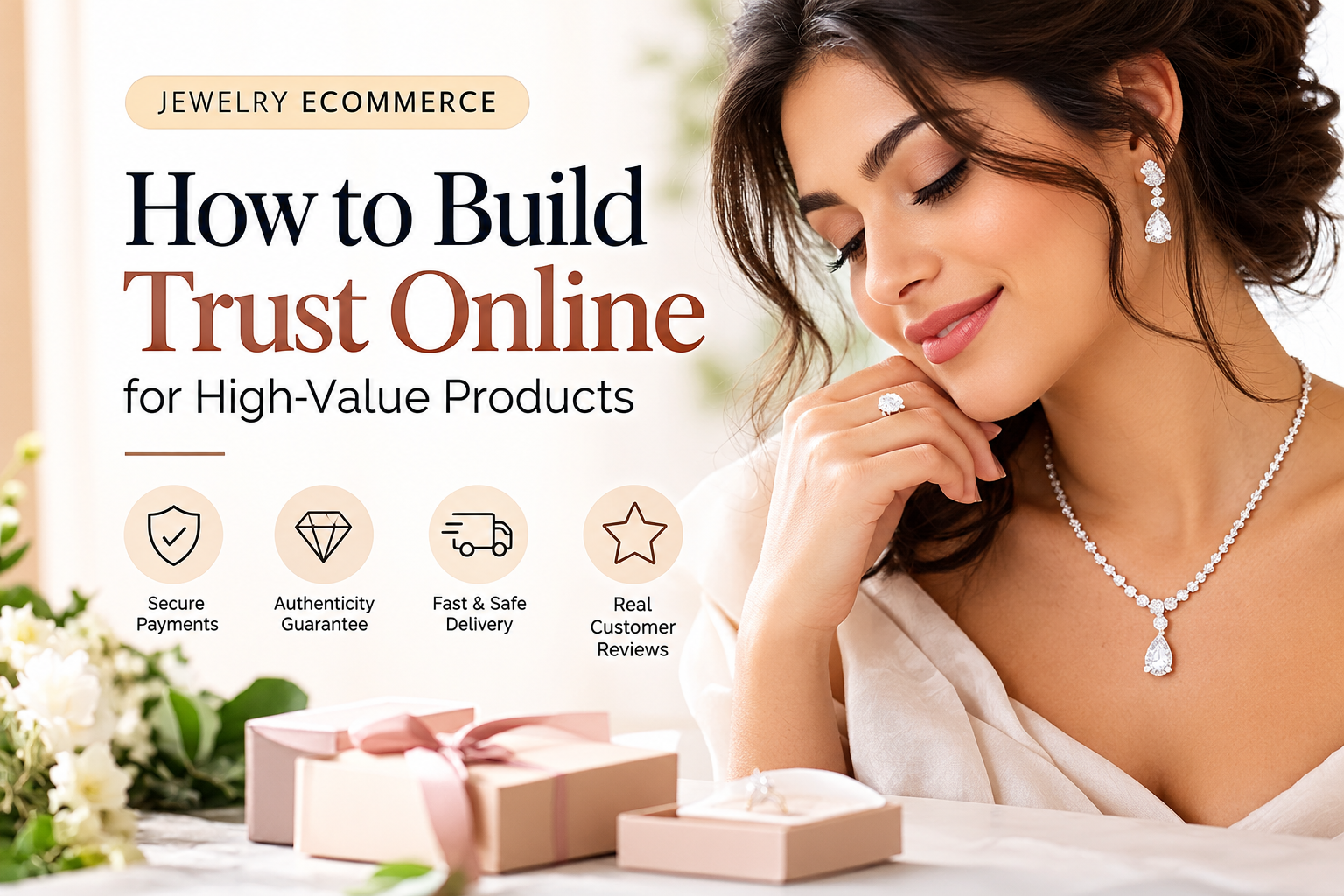
Jewelry Ecommerce: How to Build Trust Online for High-Value Products
September 30, 2026
The concept of jewelry e-commerce has an inconsistency at its core. The jewelry sales revenue has reached $46.1 billion in 2025, with the online sales accounting for one-quarter to one-third of overall jewelry sales all over the world, nevertheless, it shows the lowest conversion rate, 1.19%, in comparison to other retail categories. This situation is hardly due to pricing issues. When one looks into fine jewelry, he/she does not ask himself/herself “Do I like it?” Instead, the question would sound as “Can I trust this seller?” Trust is the result of perception that gets modified when interacting with the salesperson and other elements of the offline shopping environment, but digital shopping lacks any elements contributing to building trust. The present article considers trust as an operational system and not merely an element of designing the website. It deals with the points of hesitation for customers, the most significant trust signals for selling jewelry online, and the way to create jewelry websites where customers will feel trust while fighting with both online and offline stores.
The Measurement of the Trust Gap
Trust is the barrier that most businesses fail to realize. 60% of buyers of online jewelry wait before purchasing when they cannot see it worn as part of an outfit. Among people who have never bought jewelry, but might consider buying gold, 28% say that the absence of trust is stopping them, while 19% claim to be concerned about metal purity.
A specific commentary discusses the issue nicely. In a bricks-and-mortar setting, trust is built through the atmosphere, spoken words, and how credible the seller appears. On the contrary, many of the same signs are lacking in the online world with the exception of feedback left by previous customers.
A Five-Part Framework of Trust in Jewelry E-commerce
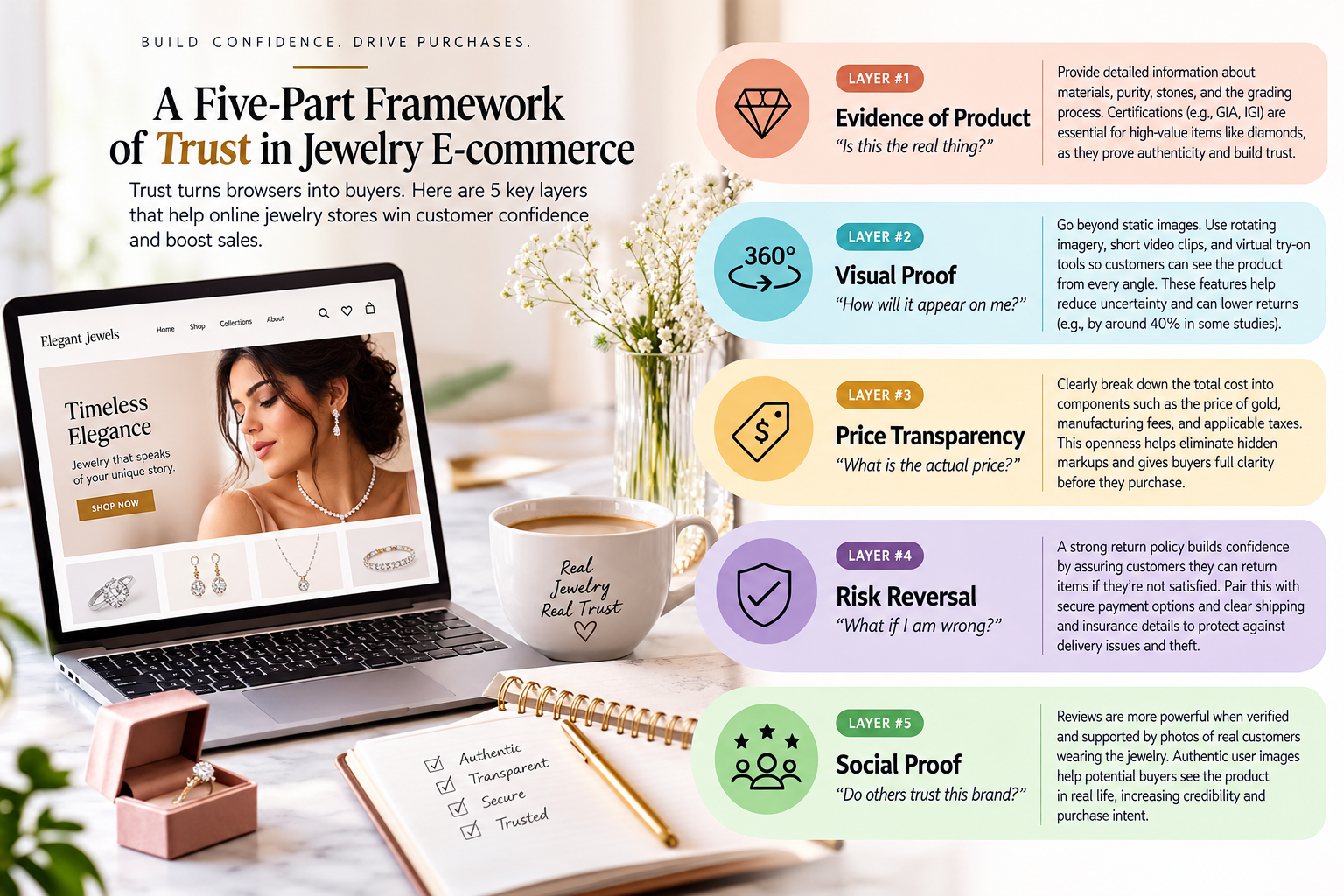
This framework is based on expert analysis and the findings above; it is not based on an accepted standard. Each layer has answers to specific concerns of buyers of expensive jewelry.
Layer #1: Evidence of Product (“Is this the real thing?”). Descriptions must provide information about materials, purity, stones, and the grading process, not just the style. Certifications are especially important for costly items, like diamonds, because they help demonstrate that the seller can be trusted.
Layer #2: Visual proof (“How will it appear on me?”). Static images seldom resolve this query. Using rotating imagery and short video clips allows a glimpse that still images cannot provide. Virtual try-on is also beneficial: one study done by a vendor found it to be responsible for the decrease of returns by approximately 40%, although its results should not be treated as a definitive target figure.
Layer #3: Price transparency (“What is the actual price?”). In the case of gold and jewelry it is especially important to divide the price into the price of gold, manufacturing fee, and taxes. If the information is available to the buyer, the risk of hidden markup is much lower.
Layer #4: Risk reversal (What if I am wrong?). The most convincing guarantee of a store is the existing return policy; just a part of it will inform customers that they will not take the bought goods if it is not what they were expecting. It should be combined, however, with clear signals of secure payments as well as clear shipping and insurance conditions, because delivery and theft are well-known reasons for abandoned cart.
Layer #5: Social proof. Reviews in text are less powerful than before, because customers know about fake ones. Therefore, the better option is to combine verified reviews with photos of real customers wearing those clothes.
What Shifts Occur in Luxury Jewelry Ecommerce Sales
When it comes to luxury products, the five layers of sales still apply, only this time the bar has been raised due to the substantially higher prices. A person willing to spend a few thousand dollars on jewelry will automatically become extremely picky and demanding. Three changes are particularly important:
Jewelry Conversion Metrics
Jewelry conversion numbers are notoriously low. A store measuring itself against average ecommerce figures will likely have an inaccurate impression of its circumstances. For jewelry, the average conversion figures are found somewhere around 0.9-1.5% so someone with a store that is converting at 1.4% might be in fine shape.
Since the sales don’t happen often, don’t forget to pay attention to the partial measures: visitors progressing from product pages to cart, the number of items that are saved to customer’s wishlists, the number of initiated chats, and return rates.
A Real-Life Story
For example, there may be a store that sells handmade jewelry. Their product pages may have wonderful photos but few details about the merchandise sold and the return policy present at the bottom of the page. The store may experience good traffic, however, few people may add the products to their carts. Then the store may decide to show certificates and details of the products on its web page and produce videos for its top twenty items, present itemized pricing, and details of returns right next to the Buy button. Although no changes might be made to the jewelry, all questions that a potential client has already received answers based on the information presented on the web page.
Where Choosing a Platform is Essential
Building trust implies using a platform that provides comprehensive information about products and a secure payment process, without requiring extensive custom building. An example would be Idiocom, which provides theme templates focusing on jewelry and enabling the use of product variants and SKUs; it also supports SSL protection for the payment process and users can track the status of their orders.
Conclusion
In jewelry ecommerce, the primary hurdle is not the prices customers pay. However, many jewelers approach ecommerce in a way that assures customers with the latest proof of their products, including product proof in the form of videos, clear pricing, risk-reversal guarantees, and social proof. Jewelry ecommerce that includes personal consultations and documentation offers customers with the experience they would receive when making expensive purchases in physical stores.
Frequently Asked Questions
Why is the online conversion rate for jewelry so low? There are several reasons, the main one being the absence of trust signals. The shoppers could not see or hold the product and talk to a consultant, which causes them to worry about authenticity, fit, and possible issues in case of a return.
What is a reasonable conversion rate for jewelry? The industry average is around 1.2–1.5%. Therefore, you should measure your success against jewelry stores that provide e-commerce services.
Do certifications matter? Absolutely, especially for expensive products. Certifications enable delivery of third-party verification, which is not possible when the customer holds the product in hand.
Is it necessary for high-end jewelry retailers to create free returns policies? The customer will perceive a return policy as something that minimizes risks. The terms of the policy should consider that the returned products have manageable negative margins and perception repercussions.