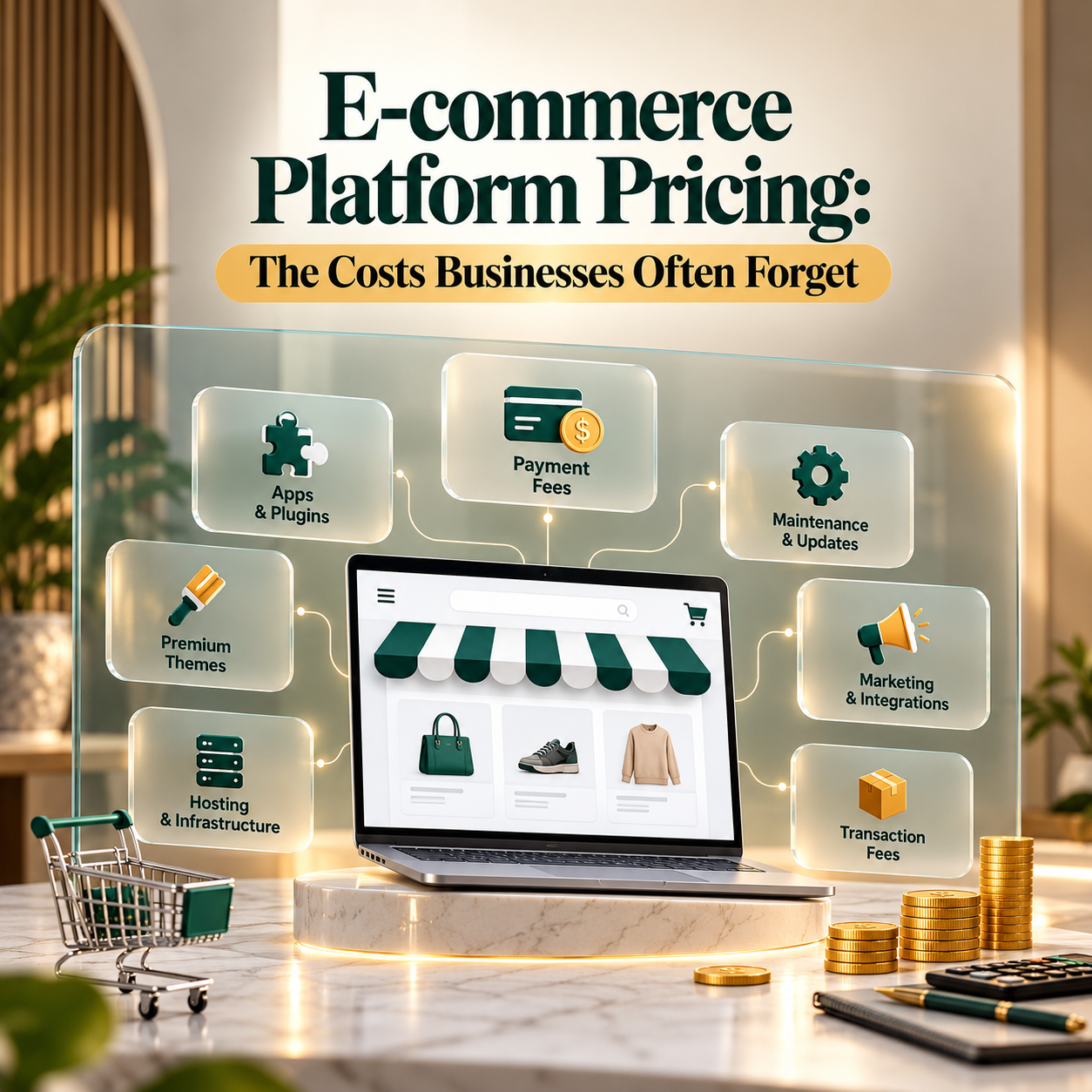
E-commerce Platform Pricing: The Costs Businesses Often Forget
October 29, 2026
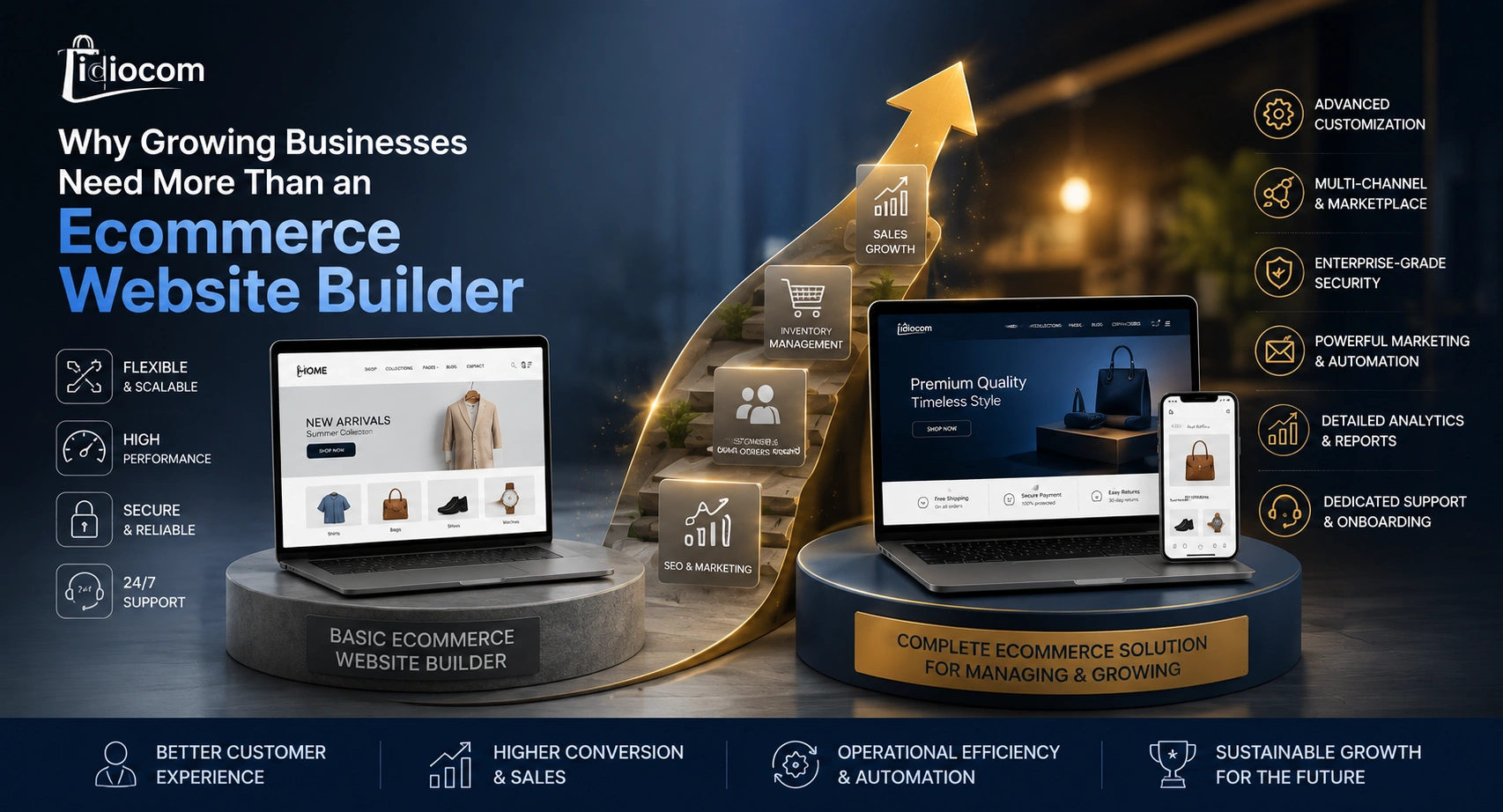
The first and most essential step for creating an e-commerce business is creating an online store. There are e-commerce website builders that help set up the website, products, order processing, and e-commerce operations in general without being an IT expert. However, when an e-commerce business grows and becomes more successful, the needs of the business evolve as well.
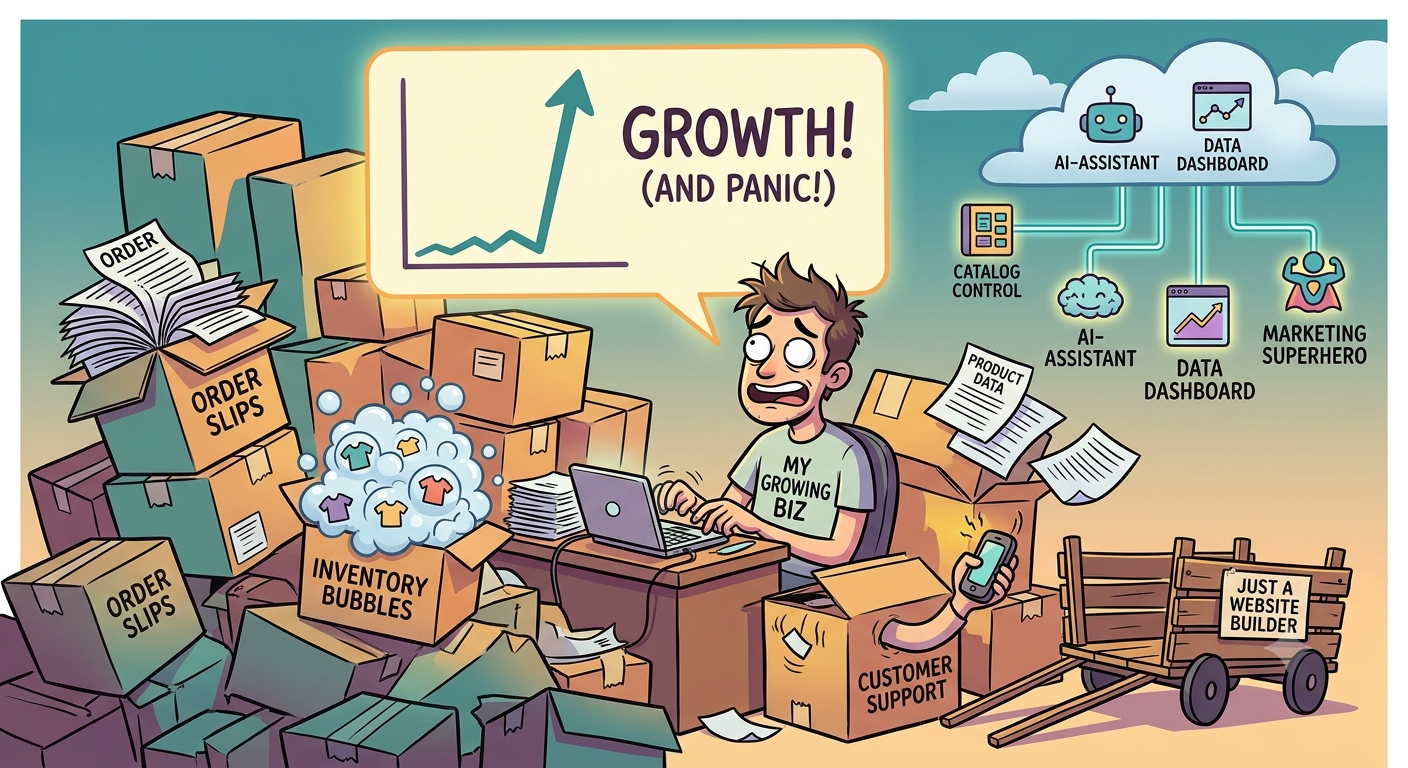
More items mean more product catalog management; more orders mean more processes to handle; more customers mean more demand in marketing, analytics, inventory control, personalization, and customer support. At this point, just having an attractive e-commerce website will not be sufficient.
A growing e-commerce business requires an e-commerce infrastructure capable of managing the whole customer and business cycle.
Your website for e-commerce is the face of your business, but it is not the complete business. Each and every product page and payment process is backed by processes related to inventory, orders, payments, marketing, customer data, fulfillment, analysis, and optimization.
Imagine a fashion brand that begins with 30 products and eventually grows into one that has hundreds of SKUs. Maintaining all the details related to such products might seem easy when it starts out, but becomes quite tough as the product list grows.
The same holds true for orders and marketing as well. Processes that work for a company handling just a few orders every day may become impractical when order volumes increase significantly.A growing e-commerce business thus requires something beyond just a storefront.
The first big thing that happens to companies as a result of growth is operational complexity. A bigger ecommerce business will require the management of:
Various product categories and variants
Increased inventories
Greater number of orders
Discounts and promotions
Customer communication
Marketing campaigns
Sales and performance information
Diverse sales channels
Several markets or currencies
When all these operations are handled by disconnected systems, then teams will have to focus more on transferring information than improving the customer experience.The use of an ecommerce platform can ensure that all these aspects are brought together into one system.
A small collection may be managed without much effort. However, when your collection grows, there will be a need for some form of organization.
The businesses will need to group products, manage product variants and SKUs, manage product pricing, manage product images, and maintain accurate product inventory data.
This is especially crucial for businesses dealing with fashion, jewelry, electronics, home and lifestyle products, and other categories in which customers may have choices.
An ecommerce system should thus offer more than just a page where you display products; it should assist you in managing that collection of products behind the page.
Growth will also mean that visibility into inventory and orders becomes critical.
What if you receive a sudden influx of orders after a great marketing push, only to find out that some of the advertised items aren’t available? Issues like that will have negative impacts on both customers’ satisfaction and the business itself. Order and inventory management must be tightly linked to the storefront.
The ability to know what items are available, what has been ordered, and what needs to be managed will become increasingly important as the order flow grows.
The site builder will provide the tools needed to make a store for your products to sell. Growth will demand that you learn how to attract, convert, and retain customers.Marketing will now become a continuous activity consisting of the following:
The main thing to remember is that marketing must work hand in hand with ecommerce operations. The performance of the campaign, products, and customers’ behavior all need to be analyzed as a whole.
As a business expands, gut feeling alone is becoming less relevant when making ecommerce decisions.Analytics will enable you to answer questions like:
This will allow you to make decisions about merchandising, marketing, product development, and optimization of the website.
For instance, if your product gets lots of traffic but sells relatively few items, the issue might not lie in lack of visibility. Product presentation, price, credibility factors, or checkout flow need to be improved.
Therefore, an ecommerce growth platform needs to be able to give businesses access to data-driven decisions.
With rising competition, customer experience becomes crucial.Customers expect from ecommerce websites an easy-to-navigate site, mobile responsiveness, useful information, and trustworthiness. They need to find products fast and learn more about what they are getting and make purchases without any difficulty.
Moreover, an expanding company needs to maintain consistency at various customer touchpoints.The customer experience you provide through your website, advertising campaigns, product pages, emails, and post-purchase customer engagement must be consistent.
That’s why the technology for ecommerce has to do more than storefront building.
When expanding their ecommerce businesses, companies sometimes come across the problem of extra work that does not correlate with an increase in the number of team members.AI can help to cut down routine work and speed up some aspects of ecommerce work.
For instance, AI-powered catalog management tools can be helpful in preparing product data for businesses. Such an approach might be quite handy when working with a large catalog, as preparing each product manually takes too much time.
Yet, AI should be aimed at helping business teams and not making strategic decisions. Product placement, pricing, relationships with customers, merchandising, and brand strategy remain tasks for humans.The best use of AI can be reducing routine work and focusing on growing work.
While deciding on the best ecommerce solution for your business, you should think about something else besides “Can I start my online store?”
You should ask yourself:“Can this solution scale along with my business?”
The developing company might soon require more products, more customers, more marketing activities, more transparency in operations, and more advanced analysis. Scalability becomes one of the important issues from the very beginning.
The scalable e-commerce platform will give your business an ability to develop its storefront, increase its catalog, deal with growing operational needs, and launch new business initiatives without having to make technological changes from scratch each time the company moves to another level of development.
The advantage of using different tools for each individual ecommerce feature is flexibility, although it might increase the complexity as well.A company may be using one tool for the website, another one for the inventory, yet another one for analytics, yet another one for marketing and even more for other needs.
An integrated solution could decrease the complexity by integrating all of the mentioned ecommerce features into one ecosystem.
That is how Idiocom stands out from the generic ecommerce website builder. Its platform unites the features of website creation along with product management, inventory, order management, marketing, analytics and even artificial intelligence-based cataloging.
The benefit here is not only having another website builder, but building a technological base to help the company grow from setting up an online store to running the ecommerce business.
Not all businesses require a more elaborate platform at a particular stage in their lifecycle. But there are some signs that show you might want to look for something more.
You will require a more sophisticated ecommerce platform when:
It becomes hard to manage the technology at hand.
There is no set-in-stone rule about the right time to upgrade your ecommerce technology stack.
The ecommerce site is the channel through which your customers engage your business, but it is just one part of a developing ecommerce company.
As you scale up sales, inventory, marketing, and even customers, it becomes necessary to have more powerful tools to manage your catalog, inventory, order process, marketing, analytics, and customer engagement. The idea is to develop an ecommerce infrastructure that will grow together with the business rather than continuously changing your technologies because of new demands.
For developing companies, this change will be eventually from creating an online store to creating an ecommerce business. Technology can make this transition much easier.
Is a website builder all that a small business needs?
For smaller catalogs and simpler operations, a website builder can have everything that is required to start. But as the business gets bigger, some features related to inventory, orders, marketing, analytics, and automation may matter more.
What is the difference between a website builder for ecommerce and an ecommerce platform?
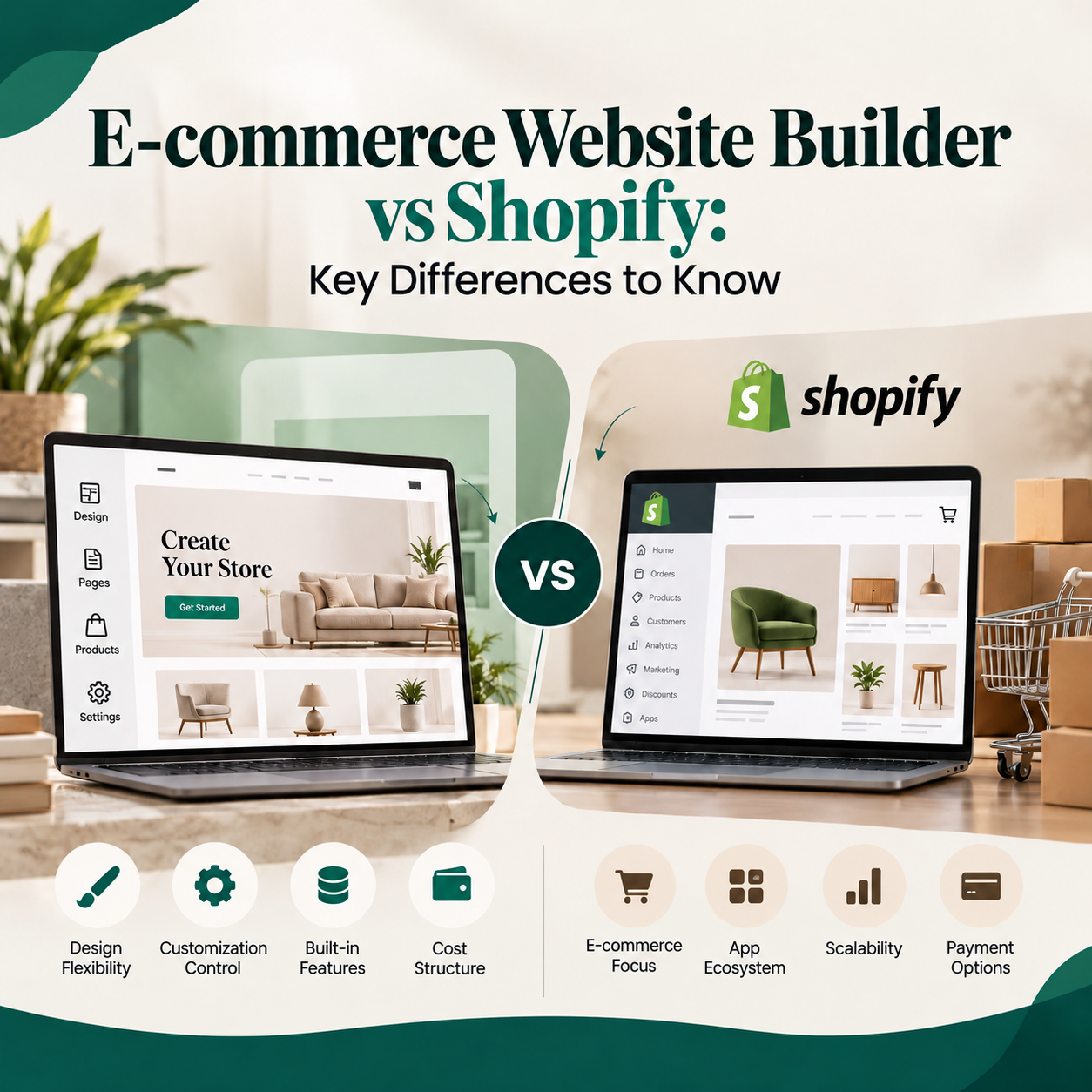
While a website builder for ecommerce deals mostly with building and customizing the online storefront, an ecommerce platform will cover not only the storefront but also all the other ecommerce activities, including products, inventory, orders, marketing, analytics, and many more.
Why is scalability crucial for ecommerce?
With scalability, it becomes possible to expand an ecommerce business by adding new products, more customers, orders, and marketing without rebuilding the whole technical base.
How can AI help growing ecommerce companies?
AI can help growing ecommerce companies with routine tasks of the ecommerce business like building a catalog and content workflow. How useful AI will be in this case depends on integration and utilization of the data collected.
Factors to consider while selecting an e-commerce platform
Think about the size of the catalog, your operational needs, the user experience, marketing considerations, analysis, scalability, manageability, and growth rather than just the look of the website.