AI in Ecommerce: 10 Ways to Save Time and Boost Efficiency
October 7, 2026
Artificial Intelligence revolutionizes the operational processes of ecommerce companies. Where employees once spent hours performing tasks like product content generation, cataloging, behavioral analysis of consumers, or marketing campaigns, rapidly developing AI-based instruments yield much greater efficiency for the ecommerce sector.
For a growing enterprise, the importance of AI lies not simply in achieving more with a smaller number of people. The vast chances it offers lie in making the work routine less monotonous, which allows for better focus on merchandising, user experience, strategy, and development.
At this point, ecommerce management solutions and modern ecommerce technologies have become increasingly intertwined. Organizations can combine automated work processes with people-based expertise in order to achieve greater efficiency as well as retain management over operations that require extensive experience.
Among many processes which help organizations become more profitable, the one of product catalog management fulfills the role of a major contributor in making ecommerce companies more profitable.
When an ecommerce store has hundreds or thousands of products, writing product descriptions can sometimes become quite labor-intensive. This is where AI can generate first drafts using product information in structured format such as product name, specifications, materials, features, and target customer.
Instead of writing every description from scratch, members of the ecommerce team can have AI create consistent drafts and thereafter edit them for accuracy, tone, and alignment with the brand’s identity. This becomes extremely useful in the case of management services for e-commerce stores where large catalogs need to be updated regularly.
The critical distinction lies in that while AI should assist in content production, it should not be an excuse for posting inaccurate or generic descriptions.
Many product catalogs have several product categories, attributes, variants, and SKUs. AI can assist teams in grouping products, flagging missing content, recommending categories, and sorting product information according to rules.
As an example, using AI-related processes, an online clothing shop can effortlessly determine if a specific product refers to men’s clothing, women’s clothing, shoes, accessories, or other type of product. Nonetheless, human validation is significant, ranging from product classification to various subjects affecting product SEO.
The ecommerce team needs product images and image-description, filenames, captions, and other relevant content. AI helps carry out repetitive tasks involving product images such as creating descriptions and maintaining content standards.
There are also many products that need to be added or updated. It is not intended to achieve 100% automation of creative work but automate background work so that creative teams can devote themselves to campaign materials.
Each customer has different needs and wants. Artificial Intelligence can evaluate customer data and transaction data and identify the segments of customers according to behavior and purchasing pattern, preferences for certain products and frequency of orders.
Based on those results, businesses can tell who their customers are:
This information can be used to ensure better communication with the customers. This is how AI can help with ecommerce development – moving from general communication with customers to targeted ones.
As the ecommerce catalog gets more extensive, discovering products can become significantly harder for users. Recommendation systems that utilize AI technology can track customer behavior and show items that are compatible with what customers might be searching for.
For example, if the customer is browsing through a camcorder, they can get recommendations for accessories like complementary lenses or memory card readers.When making recommendations, it is essential to ensure that they align with the specific customers’ needs rather than just be something to show off.
Effective personalization will assist customers in finding goods they actually need and allow businesses to increase their average overall sales.
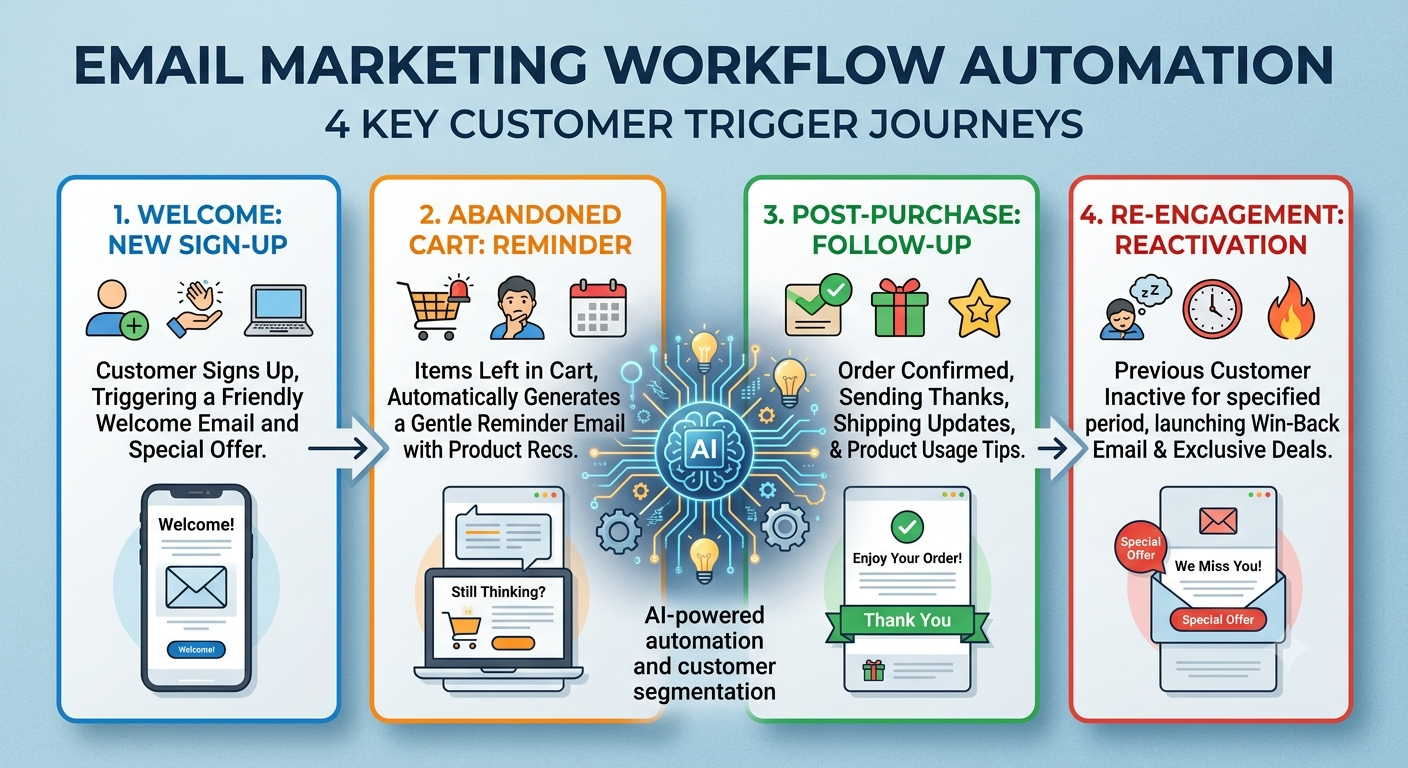
Email marketing comprises several repetitive functions that can be made automatic. AI can help in segmenting audiences and generating ideas for subject lines, variations of content, recommending products to customers, and analyzing the effectiveness of the campaigns. Automation can also trigger messages based on customer behavior.
Welcome: The case when a customer signs up an account.
Abandoned Cart: The case when a customer adds products to the cart but does not finalize an order.
Post Purchase: The case when a customer places an order.
Re-engagement: The case of a previously loyal customer who has not bought anything for a certain period.
These workflows can be a significant element of e-commerce marketing and management process, especially when an enterprise has a huge customer base. However, human monitoring is desirable in terms of brand voice and marketing decisions.
Another facet in which automation could be useful is inventory management. AI-based solutions have the capability of assessing stock details and determining if certain products have reached a certain threshold, created spikes in sales volumes, or displayed recurrent operating trends.
For instance, a business could be alerted whenever a best-selling product lags close to the low-stock threshold. AI system is not required to make the purchasing choice on its own, but it can highlight useful information for staff whenever needed.
Thus, ecommerce activities can become more proactive as the number of products increases.
Ecommerce firms gather a great deal of information related to sales, products, customers, promotions, and website activities. Converting this info into relevant data may take a lot of time.
AI can contribute to making a summary of performance data and discovering trends that should be researched. The reporting sequence may demonstrate the following:
Changes in sales activities
Items that gained or lost popularity
Customer retention tendencies
Advertising activities
Changes in conversion
Sudden changes in demand for certain products
This is important that automated reporting is a source of information for a decision but not a decision itself.
Manually drawing variations of marketing content can be tedious and time-consuming. AI can provide ecommerce teams with a draft promotional copy, product campaign messages, social media concepts, email variations, and landing-page content.
For instance, one product campaign may require the business to reach new customers, existing customers, and customers interested in a particular category with differing messages. While the drafting is on, in an ideal world, the marketer would have control over commercial positioning or benefits and tone, offers, and the final approval of the document.
AI shines here, especially for companies looking for broader ecommerce growth services without excessive manual labor.
The automation aspect of e-commerce is another vital component where AI technologies can be used to automate repetitive processes.
Depending on the type of computer systems and tools used, automation can help to identify missing products, detect strange order requests, process queries from customers, prepare reports, and determine priorities for ecommerce team tasks.
In most cases, the major benefits of automation may come from connecting a series of small automated processes together (as opposed to finding one system that automates everything).
Product added → Different aspect of product information checked → Content prepared → Product published → Product inventory controlled → Marketing process initiated → Efficacy measured.
Automated workflows, when implemented effectively, allow organizations to minimize manual transfers between their different teams and systems.
When business operations are distinguished between repetitive functions and strategic decisions, the efficiency of AI automation can be maximized. Only those tasks which include repetitive patterns can be applied for automation according to the statement.
However, strategic decision-making usually relies on human reasoning. A company should be careful while implementing automation in such areas as:
The primary goal of AI is not to replace people in e-commerce. Instead, it diminishes the amount of work e-commerce teams do, allowing them to perform more valuable tasks that require human judgment.
When ecommerce operations become more complicated, companies require more coordination of processes associated with technology, catalog management, marketing, analytics, and overall customer experience. That is where the services related to ecommerce management become useful.
When cooperating with an ecommerce management agency, a company can get an expert’s opinion on which of the automated processes may be advantageous, which of them require specialization, or which need to be retained internally.
In addition, instead of blindly using AI tools, companies can apply a systematic approach and identify particular bottleneck operations first and then use automation to solve the problem. Thus, the company involves technology into ecommerce services instead of separating them.
The platform is known as a solution for assisting in setting up an online store and supporting shopping cart and catalog management, inventory control, and orders processing, as well as sales and data analytics.
It creates a whole ecosystem in which the enterprises can connect all their processes together rather than resorting to different programs for managing every process separately.
For organizations dealing with e-commerce solutions, the effect of AI should be judged according to the issues it helps address. Whether businesses want to achieve faster catalog construction, better organization of products, improve workflows of marketing processes, or make operations more transparent, it is necessary to automate processes.
AI is an integral part of today’s ecommerce management. However, its true value lies in its ability to solve certain operational challenges. Thanks to AI, organizations can automate product descriptions, manage catalogs, use customer segmentation, offer personalized recommendations, simplify email campaigns, track inventory, produce reports, and speed up marketing operations.
Nevertheless, we shouldn’t forget that automation may not replace human intelligence that ecommerce operations, in particular, need.
One of the best approaches is the one when ecommerce solutions, technology, automation, and human intellect are used together. Businesses can automate the most time-consuming operations while ensuring strategic decisions and customer relations remain in human hands.
Such a combination makes ecommerce activities work more efficiently for all growing stores and keep the necessary intelligence for running a successful brand.
What processes can be enhanced with AI in ecommerce?
Various processes can benefit when AI comes into play – from product description creation, catalog management, and consumer segmentation to email workflows, inventory tracking, and reporting.
Is it realistic for AI to replace ecommerce management services?
It is hardly feasible to replace ecommerce management services with AI, as it still needs lots of things that machines cannot handle – strategies, merchandising, customer service, creativity, and management.
How to incorporate AI into the work of ecommerce businesses?
Using AI, ecommerce businesses can speed up the generation of different types of content, create analytical reports, launch marketing campaigns, and provide impressive management support.
Can AI be beneficial for small ecommerce companies?
Certainly. By automating repetitive processes or performing some functions of a smaller team, AI will reduce the workload of small businesses, allowing them to focus on their improvement.