The transition from first-time buyer to repeat buyer is an important process in the e-commerce sector

The ecommerce industry normally defines the success of a store with the help of metrics like revenue, conversion rates, and cost of acquisition. Those metrics describe only the situation when the first sale is made but give no information about the further processes that are essential for a company’s profitability. The e-commerce customer lifecycle understands the first sale as a beginning of a new relationship with a client rather than the last step in the transaction line. Unfortunately, the figure shows that the average ecommerce store experiences a high annual churn rate which amounts to 70 %–77%. Thus, most first-time buyers do not visit the store for a second time. While the cost of acquiring a customer is significantly higher than the cost of keeping one, it’s important for ecommerce to implement the full-funnel retention processes that allow achieving more informed results.
Why the Lifecycle Is More Effective Than the Funnel
A funnel stops with the purchase, whereas a lifecycle continues beyond it, thus altering the picture as far as the relevant metrics are concerned. Even the data available from the public sources proves that it is worth changing the focus: repeat clients make up 48% of the total e-commerce sales, and it costs 5-25 times more to attract a customer than to retain one.
Another reason to consider lifecycles is fragility. Loyalty is not guaranteed by satisfied clients since 60% of them left their loyal brand due to price concerns in 2025. Retention must be earned all the time and not assumed after one successful purchase.
The second purchase signifies the key moment of change.
If you have only one takeaway from this article, it’s the realization that the first-second purchase gap is where much of the life cycle can be lost or won. Different sources provide somewhat different numbers, but the general pattern remains the same. After the first purchase, the likelihood of a repeat purchase stands at 27%, after the second purchase it rises to around 49-54%, and at around 62% after the third one. Some estimates show the second-to-third ratio closer to 45%, hence the best approach is to treat the figures as uncertain.
Timing is as critical as likelihood. According to benchmark information, roughly half of repeat customers place another order within 30 days, while 76% repeat it within 90 days. Expectation levels also differ depending on the category, which shows that blended benchmarking can be misleading.
| Vertical |
Typical 90-day repeat rate |
| Consumables |
30–45% |
| Beauty |
25–40% |
| Apparel |
20–32% |
| Home and durable goods |
Under 18% |
Source: 90-day repeat purchase benchmarks by category. Compare your store against your own vertical, never against the overall average of 28.2%.
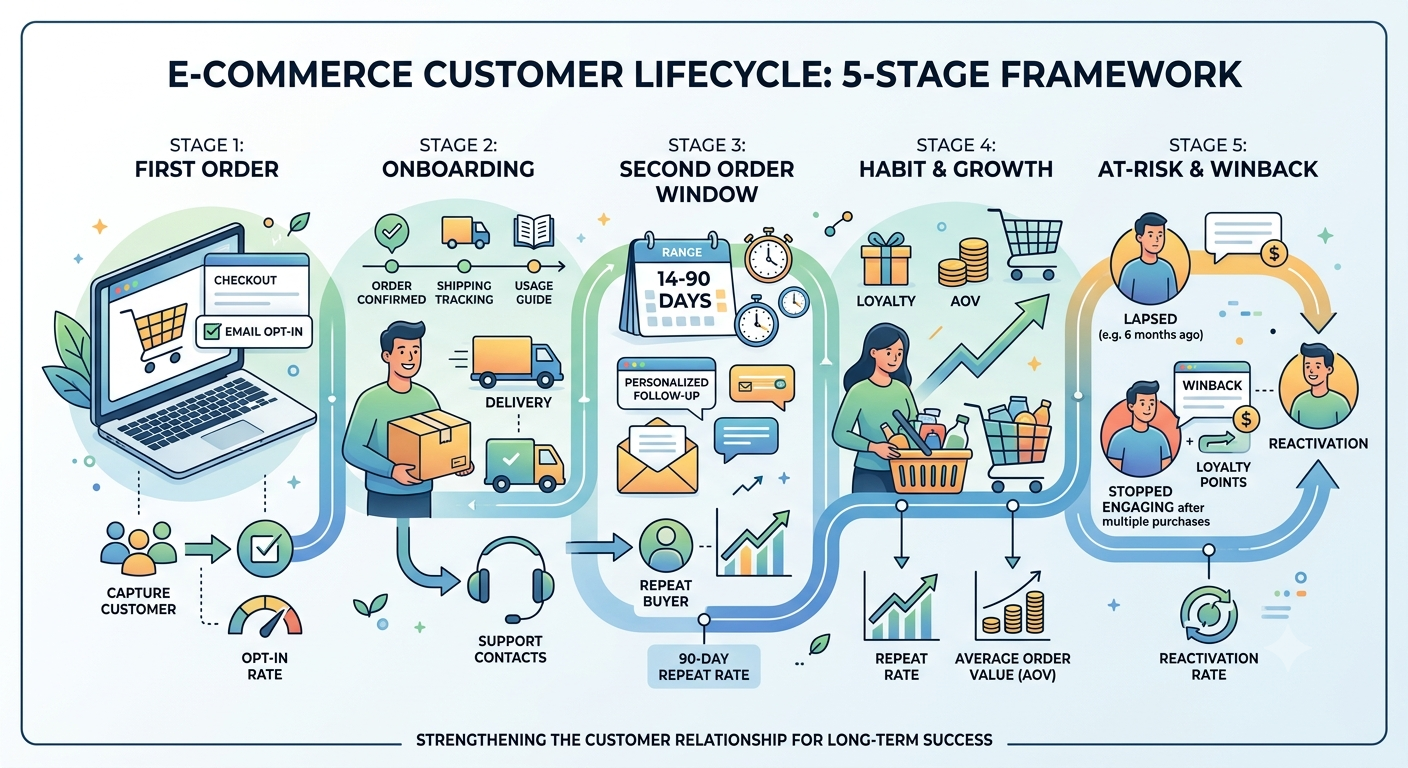
Lifecycle Framework of Five Stages
The subsequent framework is an expert analysis based on the information mentioned above and is not a standard by any given source. Each of the five stages includes one job, lever, and metric.
| Stage |
Goal |
Primary lever |
Metric to watch |
| 1. First order |
Capture a reachable customer |
Email consent at checkout |
Opt-in rate |
| 2. Onboarding (days 0–14) |
Make the first purchase go well |
Confirmation, tracking, usage guidance |
Delivery-related support contacts |
| 3. Second-order window (days 14–90) |
Trigger the second purchase |
Timed, relevant follow-up |
90-day repeat rate |
| 4. Habit and growth |
Increase frequency and basket size |
Cross-sell, loyalty mechanics |
Repeat rate, AOV |
| 5. At-risk and winback |
Recover lapsed buyers |
Segmented winback flow |
Reactivation rate |
Phase 1: Record the relationship. Lifecycle marketing is only possible on customers you can access. Whether you obtain consent for email or phone during checkout will drastically affect every subsequent stage.
Phase 2: Use delivery as marketing. This is the moment of greatest focus after the customer has made their purchase. The confirmation of the order, shipment, and delivery communication either encourage the customer to buy again or ruin the success of every later marketing effort.
Phase 3: Construct around the re-order time frame. This requires juggling data. Instead of following the same re-order schedule month by month, establish a “due date” for each product type depending on how long the item lasts or how often it gets bought again. For example, the time frame needs for a skincare purchaser and a furniture purchaser are totally different. Again, the benchmark numbers provide the right threshold. Any group that hasn’t placed a second order after 90 days should be considered inactive.
Phase 4: Increase value without causing customers to anticipate discounts. Since price competition is so dominant, widespread discounting campaigns can be counterproductive, as clients learn to shop only when they receive a discount code. Instead, personalized offers, early access to products, and loyalty programs based on customers’ activities are more efficient in building relevant habits.
Phase 5: Differentiate between different customer types when reaching out to win again lapsed customers. Not all lapsed customers belong to one category. A customer who bought something six months ago requires a different approach compared to someone who bought three products and stopped communicating with the company. Although winback campaigns are less profitable in terms of earnings per message in comparison to other automated campaigns, they are still beneficial.
Why the Standard Retention Formula Misleads Stores
Stores often make the mistake of using subscription-style retention math. It works for SaaS, where a customer is either active or gone. Retail is different: someone may buy a jacket in March, then place no order until November. They haven’t churned; they just weren’t due to buy. For most stores, better measures are repeat purchase rate, the time from first order to second, and the share of customers who make a third purchase. Track those by cohort to see whether the lifecycle is actually working.
A Concrete Example
Imagine a home fragrance company that has a good first-order volume but a low rate of repeat purchases. The company sets up a system that takes into account the average usage time of the candles. The system sends tracking messages as soon as an order is placed, an explanation of care and use two weeks later, and a reminder before the product runs out. Customers who do not place a second order in three months are classified as a winback. There is nothing unique about any of these initiatives. What is innovative about the strategy is the timing of the communication that takes into account the product usage.
How Platform Features Fit
Lifecycle functions are based on a store’s ability to send communications, monitor orders, and analyze performance data without having to combine multiple tools. Solutions like Idiocom have email marketing, automated marketing workflows, order tracking for shoppers, and analytics, all in one ecosystem, which is helpful in the onboarding and follow-up order stages when time and data must sync with each other. Regardless of the solution, the model mentioned previously relies on clear customer data, not accurate tool use.
Turning a first-time buyer into a repeat customer is not a single retention tactic—it is a continuous process that begins the moment an order is placed. The first purchase establishes the relationship; the second purchase reveals whether the experience was relevant, timely, and frictionless enough to continue it. From post-purchase communication and product discovery to personalized offers, replenishment opportunities, and smoother reordering, every interaction can influence what happens next. That makes the customer lifecycle less about pushing another sale and more about consistently creating reasons for customers to return.
This is where the right ecommerce infrastructure becomes important. Idiocom brings store management, customer engagement, marketing automation, analytics, and growth tools into one connected ecosystem, helping businesses manage the journey beyond the initial transaction. With better visibility into customer activity and the ability to act on that information, brands can build more relevant experiences at each stage of the lifecycle. Ultimately, the goal is not simply to move customers from purchase one to purchase two—it is to create a commerce journey where every purchase naturally builds momentum for the next.
Common Inquiries
Ecommerce customer lifecycle? It refers to the entire sequence of stages that a buyer goes through, beginning with their first purchase and continuing with onboarding, repeat purchases, loyalty, and eventual lapse. Each stage has its own defined goal and way of communicating with the customer.
What is considered a good repeat customer rate? In general, the average reaches a total of 28.2%. However, this number can considerably vary depending on the industry of the company.
How exactly does e-commerce CRM promote lifecycle marketing? The idea behind CRM is that it keeps a consolidated record of the customer’s purchase history and preferences. This allows for the activation of relevant messages at appropriate stages rather than sending out the same marketing campaign to all customers.
When is it correct to refer to a customer as a lapsed customer?
The practical benchmark for most industries is a timeframe of 90 days without a subsequent order. However, if the product has a longer usage cycle, the timeframe could be adjusted.