Google Shopping vs Meta Ads: Which Is Better for Ecommerce Growth?
October 10, 2026
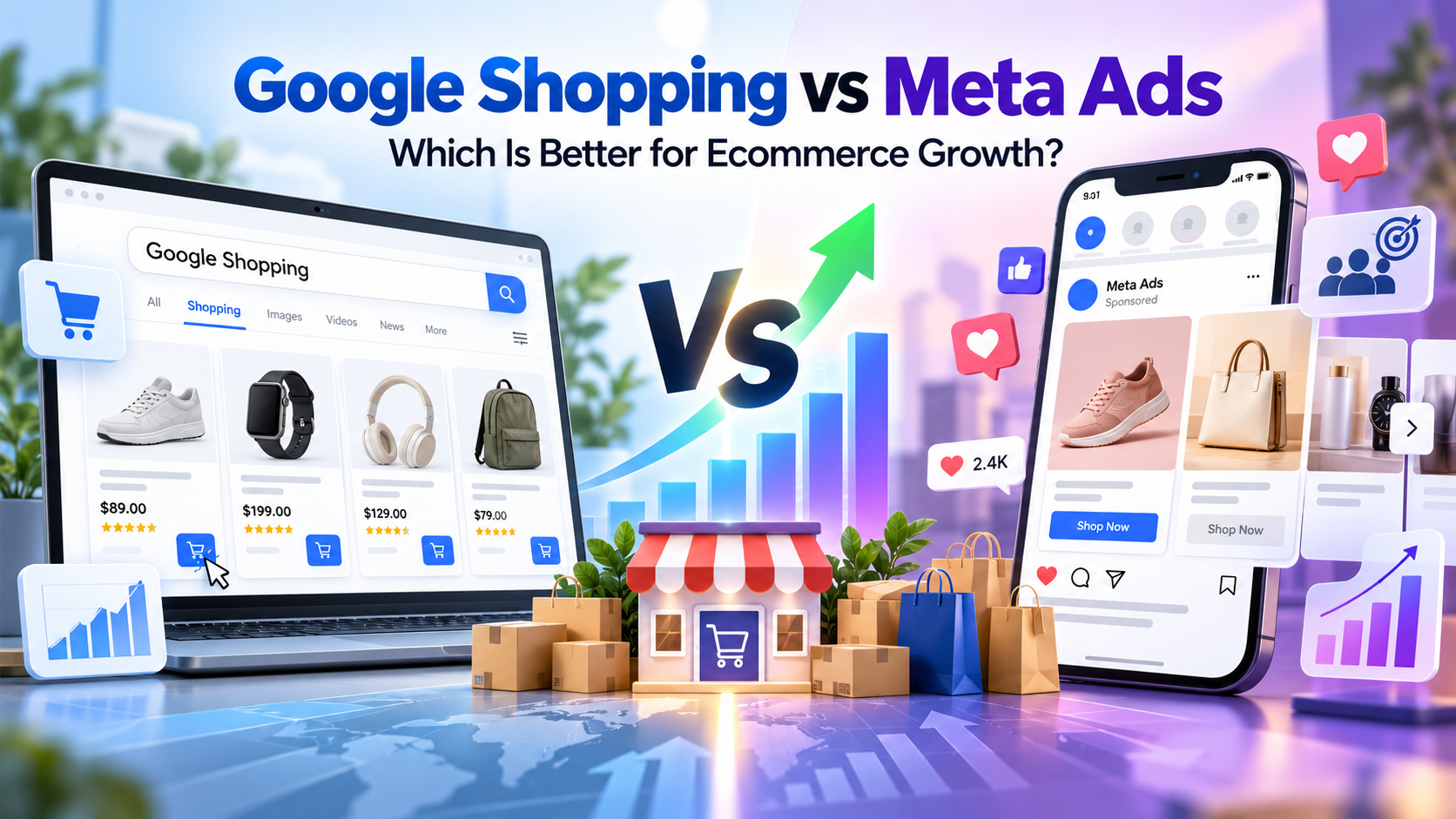
Choosing between Google Shopping and Meta Ads is a challenge faced by e-commerce companies striving to increase their client base and sales. Although both advertising platforms help retailers get in touch with potential customers, each works using different principles. Google Shopping enables retailers to make their products visible to customers making relevant searches while Meta Ads allow retailers to promote their products visually through advertising that relies on users’ interests and behavior.
Using Google Shopping is more beneficial for those e-commerce businesses that promote fast-moving consumer goods because they will reach customers who are ready to make a purchase. However, using Meta Ads makes sense for emerging fashion brands since the latter need to convince potential buyers with help of visuals.
Instead of choosing one of these platforms, e-commerce businesses should analyze how both channels influence the customer journey. It is essential to know how each of them should be used to make use of its benefits, overcome its drawbacks, and implement a successful e-commerce advertising strategy.
Google Shopping ads feature product details like images, titles, prices, and store names. Retailers typically utilize product data from the Google Merchant Center in Google Ads campaigns to allow their product line to be shown. Product data allows Google to tell what products match customers’ queries.
This type of advertising is particularly useful when people already have a specific purchase in mind. For instance, a consumer looking up “ladies running shoes for less than ₹3,000” has already made up his or her mind and is merely comparing various options.
However, achieving success requires more than just placing bids. Factors like product titles, pictures, prices, availability, website content, and competitors also affect the effectiveness of campaigns.
Meta Ads target consumers through advertising placements on various Meta platforms such as Facebook and Instagram. To promote and sell products, advertisers can use visuals, videos, carousel ads, catalog-style ads, and targeting features in a campaign.
Meta Ads can be highly beneficial for ecommerce ads when customers are not looking for a specific product but will take interest once they see a good ad. For example, in the case of a new range of skincare products, showing a demo video or a simple message presenting the benefits of the new range can be effective. Meta supports catalog ads as well, which allows adding relevant ads on the basis of audience interaction and audience profile analyses.
|
Evaluation factor |
Google Shopping |
Meta Ads |
| Primary opportunity | Capture product-related search demand | Create awareness and stimulate product discovery |
| Typical user behavior | Searching for or comparing products | Browsing content and discovering products |
| Main creative inputs | Product feed, images, titles, prices | Images, videos, copy, audience and catalog assets |
| Strong use cases | Products with clear search demand | Visually appealing or discovery-led products |
| Retargeting role | Re-engage eligible audiences through suitable campaign types | Re-engage visitors and product viewers through suitable campaigns |
| Key optimization priorities | Feed quality, product relevance, bids and landing pages | Creative quality, audience strategy, offers and conversion experience |
These are patterns instead of strict norms. Google may reach some new audiences through some formats such as Performance Max, while Meta has the potential to convert people who already know what they want. The structure and objectives of the campaigns are important.
The use of Google Shopping can be beneficial if there is a known search interest for your product and shoppers typically do price comparison, look for specs, or check availability beforehand. This makes it a good option for categories like electronics, appliances, home goods, accessories, and some standardized products that have clear search terms.
However, category alone should not dictate your budget. Make sure to assess whether buyers are actually searching for the specific products you carry and how competitive your offering is. Google Shopping may be a good choice if:
For instance, a shop specializing in ergonomic office chairs can create campaigns by product type and price point. Good titles, nice product images, clear delivery information, and competitive pricing will help buyers analyze the offered items.
Meta Ads should be used when there is a need for customers to learn about products before being able to make purchases. This happens often with new brands, lifestyle products, fashion and beauty products, home decor, gifting and anything else that is visually attractive but difficult to present through search queries.
Meta allows businesses to test different messages and creative approaches to find out the benefits that will attract potential customers. It is a suitable option when:
Important limitation: Gaining attention does not mean that the profit will be made. Attractive ads may bring clicks, but it may not be enough to make costs reasonable.
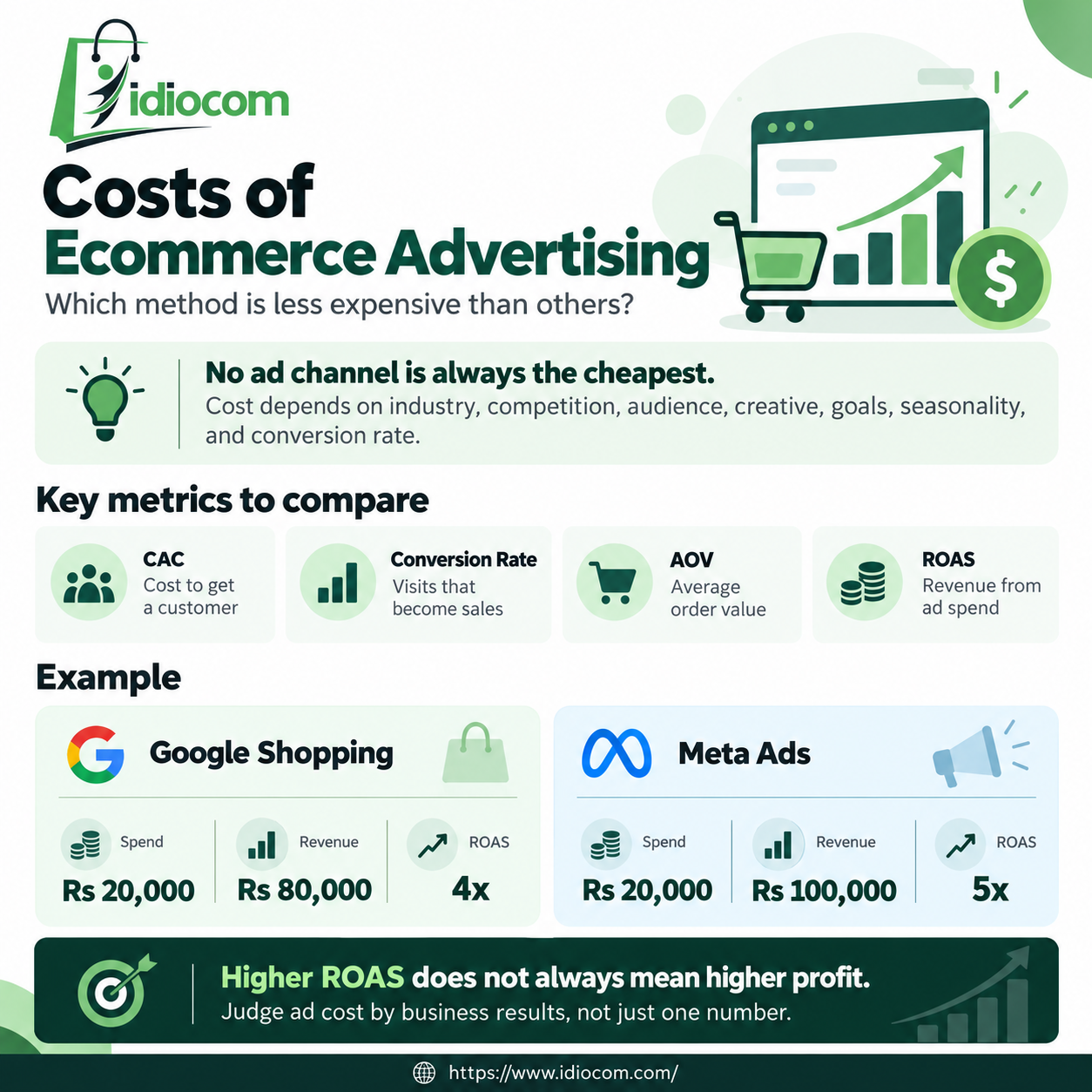
It is impossible to say which channel is usually the cheapest. The costs differ from industry to industry and depends on competition, audience, creative quality, campaign aim, seasonality, and conversion rates. When comparing different advertising options should use performance indicators that connect the advertisement spending with the results achieved by the business:
– Customer acquisition cost (CAC) – how much does the business invest in a new client?
– Conversion rate – how many relevant visits are transformed into sales?
– Average order value (AOV) – how much does the client spend in one order?
– Return on ad spend (ROAS) – what revenue was generated due to every unit of advertisement spending?
Let’s consider the following example: two campaigns spent rupees Rs 20,000 each. The campaign through Google Shopping resulted in rupees Rs 80,000 attributed revenue, while the advertisement with the help of Meta Ads resulted in rupees Rs 100,000.
The total ROAS of the two campaigns would be equal to 4x and 5x respectively. However, the fact of the higher ROAS of the Meta advertisement does not guarantee that the advertisement is more profitable.
Instead of starting off with an arbitrary division of funds, make sure that the allocated budget reflects the state of business.
|
Business situation |
Initial strategic priority |
| Established products with strong search demand | Test Google Shopping first |
| New brand with limited search demand | Test Meta creative and demand generation |
| Strong sales but weak repeat purchasing | Assess retention before scaling acquisition |
| High traffic but low conversion rate | Improve product pages and checkout before increasing spend |
| Profitable campaigns on both channels | Scale based on marginal profitability and available demand |
These are only the guidelines but not the exact rules of action. Start with a budget that can be tested, define success criteria, and wait for enough time and conversion indicators to make comparisons. If your results are unsatisfactory, identify the root of the problem before increasing your spending. The issue may be a poorly fitted product, the ineffectiveness of advertisements, faulty tracking system, unattractive offer, or complicated checkout process.
Paid advertising is effective in attracting interested customers but the ecommerce platform influences the next steps. Product pages must have the right data, product images, prices, and descriptions. The inventory must be up-to-date, the checkout process must run smoothly on mobile devices, and the analytics must allow you to track how many visitors are coming to your site.
An e-commerce platform that provides storefront management solutions, product catalog support, inventory management, order management, marketing services, and analytics can ease the management of your dependencies.
At Idiocom, we offer an ecommerce growth platform that gives you tools for store creation and support, product catalog management, marketing services, and analytics. Our functionality can create a solid foundation for paid purchasing; however, your marketing campaign results depend on your initiative and efforts. Make sure to get your store ready for more customers before investing extra funds in advertising.
In the end, deciding between Google Shopping and Meta Ads depends on how you figure out how your consumer base finds and buys products.
Google Shopping allows accessing consumers who are looking for desired items. Meta ads provide the opportunity for consumers to see your products, understand their benefits, and help them in product identification and re-targeting. Both channels can result in market growth if used appropriately and with proper objectives and measurements.
Your starting point should be to determine your product demand, margins, creativity, and conversion ratio. Assign specific functions to each channel, measure results in business terms, and enhance the customer experience and marketing campaigns simultaneously.
The ultimate objective of e-commerce advertising is not merely increasing the number of clicks or ROAS. It is about attracting the right customers at a reasonable cost and implementing a long-term growth plan for a business.
Which is better for eCommerce: Google Shopping or Meta Ads?
Google Shopping appears to be more appropriate for meeting already existing demand through searches, whereas Meta Ads could better serve visual searches and demand creation. The choice between the two will depend upon products, audience, margins, and the performance of the campaigns.
Can both options be used by small eCommerce companies?
Yes, if budget constraints and available resources allow for meaningful experiments. A small firm can either start with the option that best suits the buying behavior of their clients, and proceed to the second one only after the objectives have been clearly set.
Should ROAS be used to evaluate Google Shopping and Meta Ads?
While ROAS is a good metric, it should not be used as the only criterion. It is advisable to look at the contribution margin, customer acquisition cost as well as average order value, returns, the number of new clients acquired, and repeat purchases to learn how productively the business works in general.
What platform will work best for an ecommerce startup?
Startup businesses that do not have high search demand can consider using Meta Ads to advertise their brands. If a product category has enough existing demand, Google Shopping may prove to be a good option. It is always a good idea to check the effectiveness of both approaches through tests.
How much time do I need to test ecommerce advertising?
It is difficult to determine the amount of time spent on testing. The duration of the testing process varies depending on sales volume, traffic, and the advertising budget. It is crucial to analyze the test data using appropriate criteria.