Shipping is no longer merely the last task after a consumer makes an order. Shipping becomes important in an online business because it affects customer satisfaction level, cost of operation, cash flow, frequency of purchasing again, and reputation of the brand. This is one of the key issues for India where ecommerce companies offer their services to customers in metros, Tier-2 cities, Tier-3 locations and places with different conditions of delivery. The number of online shoppers in India is expected to reach 290 to 300 million by 2025 with Tier-2 and lower cities making up nearly 65% of the new customers.
In order to overcome the problems of shipping for ecommerce companies in India, it is not enough to just find an affordable courier. There are many factors influencing successful shipping such as the presence of complete order info, effective fulfilling process, full information about shipping, and the use of the data to make decision. Below there are 11 recommendations for making shipping successful.
1.Refrain from Handling Shipments Similarly
A shipping company that does an admirable job in Mumbai will not necessarily dispatch a package successfully in other regions. Different factors affect its performance in different places, including delivery area, capabilities of its couriers, their routes and logistics, and factors affecting deliveries in that area.
It is important to segment shipments by:
Location of delivery
Type of product
Size of the order
If the shipment is sent by fast shipping
How much time the delivery can take based on the history of the courier’s work.
As a result, it will be possible for a company to create more effective shipping regulations.
2. Make Addresses Precise before Delivery
Inaccurate or inadequate addresses are among the leading causes of delayed and unsuccessful deliveries. The checkout process must gather important details like:
Complete address
Pin code
Mobile number
Landmark if necessary
City and state
It is imperative for an ecommerce website designer to facilitate an effective checkout process that captures accurate delivery information in an uncomplicated manner.
3. Minimize COD Delivery Challenges
COD is still important for the Indian ecommerce industry; however, COD failures result in higher return to origin (RTO) expenses. Companies can minimize unnecessary RTO expenses through:
Validating COD orders
Providing prepayment incentives
Communicating delivery schedules clearly
Ensuring accurate customer contact information
Analyzing location-specific COD performance
Recent examples from the industry demonstrate how risk assessment through technology and selective management of COD can lead to lower RTO rates without entirely abandoning COD.
ecommerce-shipping-challenges-tips-delivery
4.Give Customers Clear Delivery Expectations
“Fast delivery” is vague. Customers want to know when their order will arrive. Display realistic delivery estimates during checkout and provide updates after dispatch. Useful notifications include:
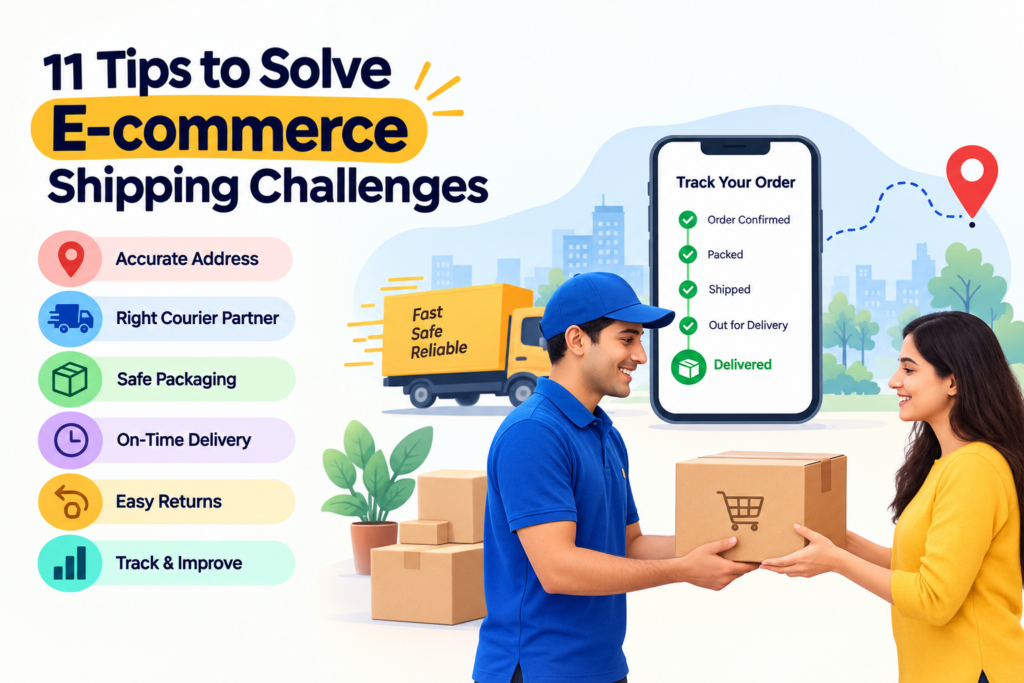
Order confirmed → Packed → Shipped → Out for delivery → Delivered
Clear communication can also reduce “Where is my order?” support queries.
5. Create a More Efficient Packaging Process
Transportation problems may not always come from the courier company. The packaging process may lead to damaged items, customer complaints, and costly replacements. Create packaging guidelines based on item categories.
For instance:
Fragile items → packaging with cushioning materials
Clothes → water-resistant packaging
Furniture → reinforced packaging
Cosmetics → leak-proof packaging
When starting out, remember that packaging is part of the quality of your product.
6. Detecting NDRs Before They Turn into RTOs
Non-Delivery Report means there is an issue with the delivery of the package. If business is unable to act in time, then the package will start moving towards return to origin.
To monitor:
Failure reason
Attempts made
Customer response
Pincode
Courier’s efficiency
The motive is easy, try to act before the package reaches its RTO stage.
7. Utilize Multiple Courier Providers as Needed
Reliance on a single logistics partner is risky. Using multiple carriers allows firms to evaluate:
Coverage
Fees
Speed
RTOs (Returned to Origin)
Pincode reliability
Customer experience
Courier providers now offer central management of multiple shipping partners, tracking, RTOs, and COD processes.
8. Incorporate Returns into Your Shipping Plan
Returns are not a separate issue for ecommerce. They are part of your customer experience. Your reverse logistics system should address: How returns are requested by the customer, How a pick-up is arranged, Where returns are taken to, The inspection of the product, Refund/Replacement process
A good return experience can save your company’s reputation even if the customer has a problem with the original order.
9. Link Inventory to Order Processing
Think about selling something online that you don’t have in your inventory. You will inevitably end up with a canceled order, creating an unnecessary customer issue.
An ecommerce platform should link:
Product catalog → Inventory → Orders → Order processing
This is why an ecommerce platform for Indian businesses needs to be more than just a store front builder.
10. Measure Shipping Performance With the Right Metrics
Shipping cannot be improved if it is not measured.
Track metrics such as:
Metric
What it tells you
Delivery success rate
How reliably orders reach customers
RTO rate
How many shipments return undelivered
NDR rate
Where delivery attempts fail
Average delivery time
Actual fulfillment speed
Shipping cost per order
Logistics efficiency
Return rate
Post-purchase product/customer issues
Courier performance
Which partners perform consistently
An e-commerce growth platform can bring operational and sales data together, helping businesses identify patterns rather than making decisions based only on individual complaints.
11. Go for Technology Which Can Grow with You
The more orders you have, variety of products, or geographical extent, the more complex your shipping process gets. Instead of creating a collection of separate systems, companies must focus on ecommerce solutions India that link up storefronts, products, inventory, orders, payments, marketing, and analytics.
One ecommerce technology company can be of much help in this context as far as it offers the necessary infrastructure that is needed for ecommerce processes to be managed with growth of business. For instance, there are platforms like Idiocom, which combine storefront management with product, inventory, order, marketing, analytics, and AI-driven ecommerce services.
Conclusion
Ultimately, ecommerce shipping comes down to a question of customer experience and business efficiency. The answer to this is not about finding the cheapest courier service. Companies require accurate information, effective fulfillment processes, efficient NDR and RTO management, customer communication, and technology capable of handling growing numbers of orders.
For companies seeking a technology for an ecommerce solution in India, the technology will provide connectivity between the store front and the back end systems managing each order. Once companies have more control over shipping operations, they can use more time on developing a sustainable ecommerce business.
FAQs
What is the biggest ecommerce shipping challenge?
Common challenges include high shipping costs, delayed deliveries, incorrect addresses, COD-related RTOs, damaged products, failed delivery attempts, and inefficient returns.
How can ecommerce businesses reduce RTO?
Businesses can improve address accuracy, verify selected COD orders, communicate delivery expectations, monitor NDRs, and evaluate courier performance by location.
Why is inventory management important for shipping?
Accurate inventory data helps prevent overselling, fulfillment delays, cancellations, and unnecessary customer service issues.
Should an ecommerce business use multiple courier partners?
For many growing businesses, multiple courier options can provide greater flexibility. Performance should be evaluated using factors such as cost, coverage, delivery success, and RTO rates.
Can an ecommerce platform help solve shipping problems?
Yes. While the platform does not replace a logistics provider, an integrated ecommerce system can connect inventory, orders, payments, customer communication, and analytics to make shipping operations easier to manage.