
AI in Ecommerce: 10 Ways to Save Time and Boost Efficiency
October 7, 2026

Customers who shop online do not get to see, feel, or interact with the products they purchase. Therefore, product photography must perform the function of showing details, accuracy, and relevance of the product. Whitepapers by the Baymard Institute indicate that 56% of users begin their product experience with looking at photos, proving the power of visual information in product evaluation.
The good news is that you do not need highly expensive professional equipment to take good e-commerce photos. You can use a smartphone, have good lighting, simple background, and right strategy to achieve satisfying results. For companies working towards creating a strong online confidence, it is even more important to combine the above principles with e-commerce tools which guarantee strong online presence.
Online consumers rely on visual representations in order to make informed purchases. Pictures can provide details about the product, illustrate its dimensions, or reveal the quality associated with the brand, thereby providing certainty.
On the other hand, bad pictures can result in the opposite outcome. If images are blurry, colors are inconsistent, there are extra things in the background, or the product is not viewable from all angles, customers will likely double-guess.
According to the research done by Baymard, not having images with sufficient resolution and not allowing consumers to zoom in on them makes it impossible for them to determine how good the product is.
Think of your photo gallery as a salesperson – each image must answer some questions the target audience might have before making a purchase.
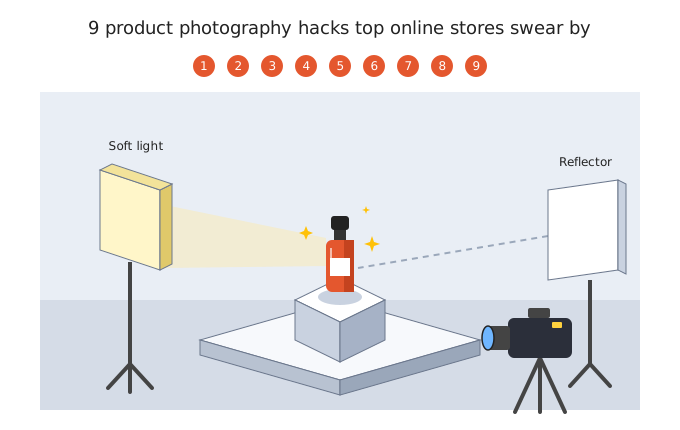
1. Keep Lighting Soft and Steady
In product photography, lighting ranks among the primary factors that contribute to its quality. Shining light directly produces hard shadows and reflections, while inconsistent light may showcase products in different ways from one image to another.
For a simple setup:
Take photos in front of a big window.
Keep direct sunshine away from the shooting spot.
Put white foam board close to your window to serve as a reflector.
Maintain a steady lighting position.
If photography is going to be your regular occupation, you can consider getting a softbox.
2. Select a Suitable Background for the Product
A simple background keeps the focus of attention on the product. Clean and neutral backgrounds are beneficial when it comes to standard product photography because they reduce distractions and help maintain visual consistency in catalogs. However, don’t limit your photo collection only to separate products in isolation.
There are two techniques that can be very successful regarding product photography:
For instance, when selling a chair, a brand may present it on a neutral background and later in a modern living room. Such an approach gives a customer both the information about the product itself and the context in which it may be used.
3. Offer Various Perspectives
Generally, each single image is inadequate in informing customers about the product. Provide potential buyers with the opportunity of seeing the product from various angles:
The front view
The rear view
The side view
The top view
Macro photography
Tactile pictures
Pictures showing usage scenarios
According to Baymard, product images are considered to be one of the impactful components of product assessment, which is supported by Shopify’s recommendation of showing the product from different angles.
In the case of complex products like jewelry, shoes, electronic devices, furniture, or accessories, close-up photography can be especially valuable.
4. Ensure the Product Details Are Clear to Inspect
There’s no need for customers to guess about the appearance of any product.Here’s a list of product details that affect customers’ decision to buy the product:
Materials
Texture
Stitching
Finishing
Buttons or controls used
Labels of the product
Packaging for the item
Size of the product
Other attributes of the item
A detailed close-up image can convey information that a regular picture can’t. For example, a fashion retailer can show the texture of fabrics through close-up shooting, while the jeweler will showcase the finish and stone setting.
The goal is clear: to ‘replace’ the physical experience of inspecting a product with visual information as much as possible.
5. Demonstrate Scale and Proportion
A product image by itself does not fully convey how big or small the item actually is and it doesn’t allow online users to infer the dimensions of the object. For example, a coffee table can seem huge, while a handbag can turn out to be much bigger than an online shopper anticipates.
According to Baymard, 42% of website visitors try to define the size of a product by examining product imagery. In order to establish the context for online readers, they can be given the following illustrations of tangible objects:
6. Consistency Should Be a Priority in Your Image Creation
Visualize an online store that presents every product with a specific background, shot method, cropping size, and photographic style. As a result, the catalogue may look unprofessional even if the pictures are beautiful. To make things easier for yourself in terms of consistent image creation, you can Work with specific backgrounds.
Generalize distance from the camera.
Work with the same product proportions.
Use a one and the same lighting setting.
Use the same editing settings.
Work with same image sizes.
It is extremely important to maintain consistency when making a catalogue on ecommerce sites, since customers will definitely compare products displayed together in the collection.
7. Employ Lifestyle Photography to Narrate the Story of the Product
Standard product photography delivers the message: “What does it appear like?”. In contrast, lifestyle photography can provide the answer to the question: “What is it going to feel like to use it?”
Travel backpacks can be photographed against a plain background, and also while they are used in the course of a trip. Sofas can be shot separately and then displayed as a part of a decorated living room. Cosmetics can be presented as products and as essentials of the daily routine as well.
Baymard brings attention to the usefulness of “usage inspiration” and contextual images for the shopper’s understanding of how the product is utilized and is going to be used. This information is of great help for D2C brands, since high-class lifestyle photography can help with showing the nature and personality of the manufacturer.
8. Proofread for Accuracy Rather than Perfection
Image processing changes ecommerce pictures to some extent; however, the changes should never result in customers receiving something other than what they might expect.
Some of the useful measures that can help are:
Exposure
Brightness
Contrast
White balance
Cropping
Backdrop cleaning up
Minor dusting
The important thing is to refrain from changing the colour, size, texture, and characteristics of the product only for the purpose of making it look more appealing.
Real trust is much more valuable than a perfectly edited photo.
9.Optimize Images For Your Ecommerce Website
Superb imagery becomes unusable if the huge size of the images slows down the online store. Keep the following points in mind when preparing photos before uploading:
Picture size
File type
Compression
Display on mobile devices
Zoom options
Proportions
Image quality
A modern AI ecommerce website builder or ecommerce platform can greatly ease the process of product media management, although it’s still necessary to prepare pictures properly before publishing.
Why Using an All-in-One Ecommerce System Is Important? As your product range expands, it becomes challenging to manage photos, products, variants, inventory, marketing and customer experience across multiple platforms.
For D2C brands, it enables you to have a seamless transition from presentation to purchasing stage. The ecommerce platform for D2C brands should clarify the product benefits and provide the business with capabilities necessary for maintaining and growing the store.
The same rule applies to larger companies which require scalable ecommerce solutions. Your platform should be able to cope with the current needs of your catalogue but should not prevent you from expanding it in the future.
Keep in mind that product photography doesn’t only provide aesthetic beauty to an online store. It is also part of the information customers rely on when decided on whether to purchase a product.
Make sure to pay attention to clear lighting, effective angles, true colours, visible details, realistic size, and coherent presentation. Then, complement standard product photography with lifestyle images that will help customers imagine the product in their daily life.
Last, but not least—good photography will do its job only if the rest of the e-commerce infrastructure supports it. A good e-commerce platform should help with the management of products, presentation, improvement of the shopping process, and growth of the business.
Making sure that the photography is right and the e-commerce solution is good will help ensure that product photos will do more than just fill in the product page—they will assist customers in making the right decision about the purchase.
A combination of clean product images, multiple angles, close-up details and lifestyle photography generally provides a more complete visual experience. The right mix depends on the product category.
Not necessarily. A modern smartphone can produce strong product images when combined with good lighting, a stable setup and careful composition. Shopify also notes that businesses can create quality product photography without professional-level equipment.
There is no universal number. Include enough images to answer the customer’s key questions about appearance, details, size, features and usage.
White or neutral backgrounds work well for standard catalogue images because they minimize distractions. Lifestyle images can then add context and demonstrate the product in use.
An AI-powered ecommerce platform can help with broader product and store management workflows, but photography quality still depends on the source images and how they are prepared. AI should support the ecommerce workflow rather than replace accurate product representation.