AI in Ecommerce: 10 Ways to Save Time and Boost Efficiency
October 7, 2026
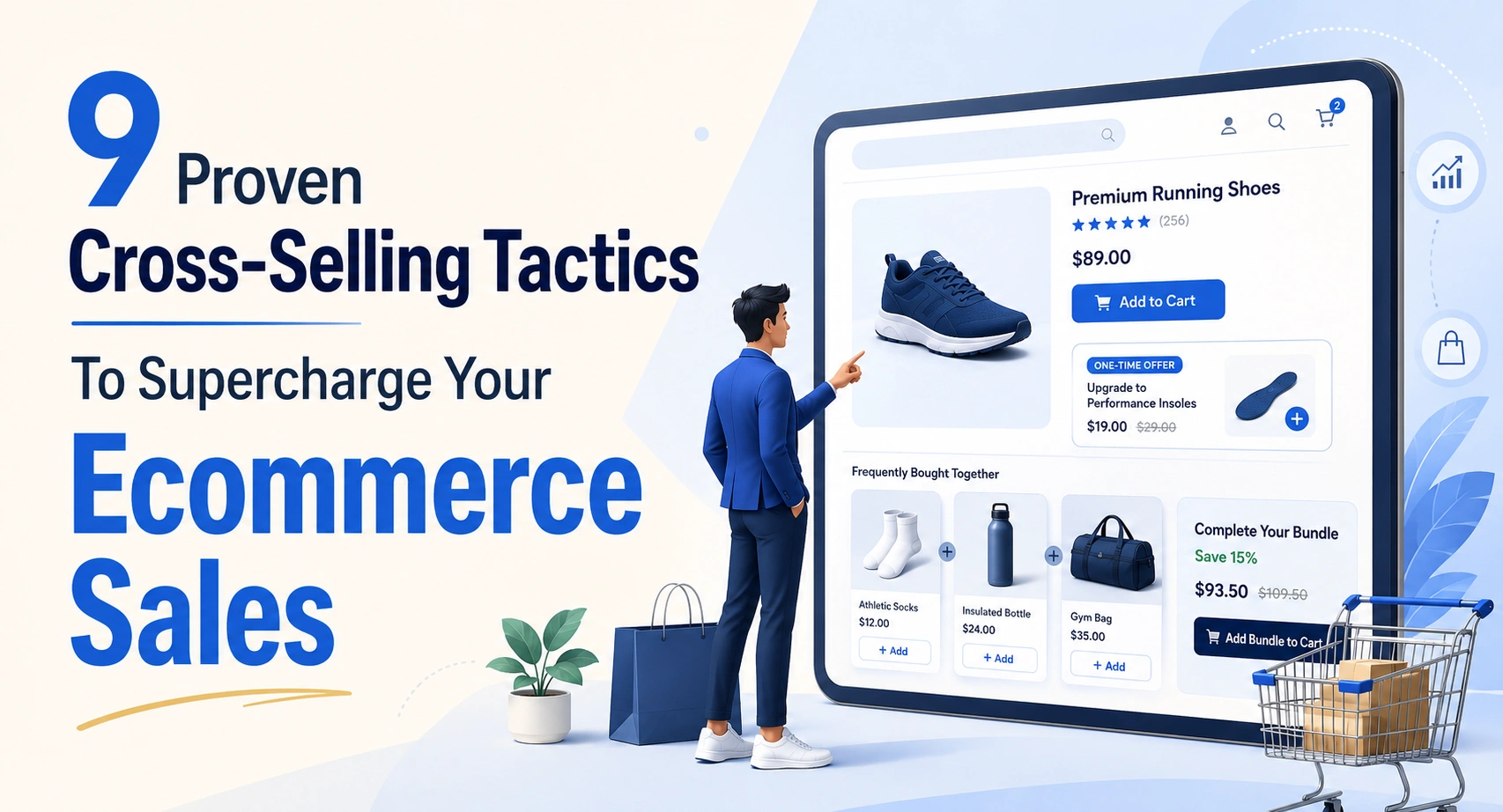
The science of cross selling online goes beyond a row of “recommended products” that you see beneath a product page. When executed correctly, it allows shoppers to find items that complement with laser-like precision what they want to purchase next—and in the process gives your ecommerce store a new opportunity to raise average order value (AOV). For example, someone buying a camera would require a memory card. A guy who orders a sofa might also have to buy cushions. If a shopper is selecting a dress, they might also be interested to see shoes or accessories that go well with it. This is why cross-selling works — because the recommendation addresses a related need, as opposed to interrupting the buying journey. Baymard Institute’s findings also support the relevance—if cross-sells don’t establish a relevant connection with what shoppers already plan to buy, they’ll be ignored. So, for ecommerce brands, the equation is extremely straightforward: offer the proper complementary product in real-time with enough contextualization for the customer to ascertain the worth of that product.
Cross-selling refers to recommending an additional product that would be useful with the product they are considering or purchasing.
For example:
Laptop → laptop bag
Smartphone → protective case
Running shoes → sports socks
Coffee machine → coffee beans
Sofa → cushions
Camera → memory card
The key difference here is that cross-selling expands the initial purchase, while upselling pushes the customer to buy a more expensive version of the product.
What you could think is a way useful is:
Upsell = “So, you want to upgrade?
Cross-sell = “What else will make this purchase useful?
That set of history is what allows ecommerce teams to create better recommendations, rather than just posting whatever they can get their hands on without any correlation to the customer.
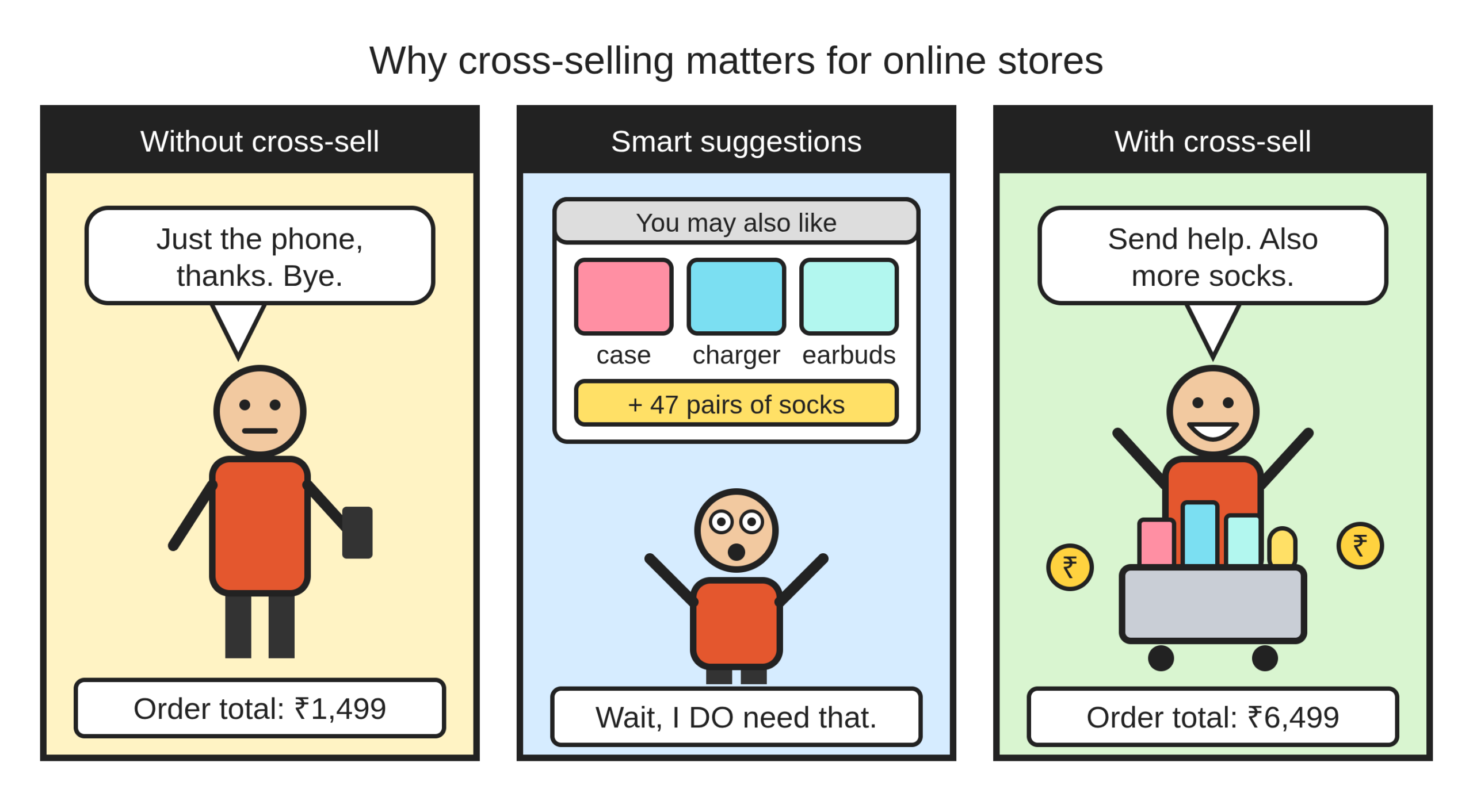 Stores can raise average order value without bringing in more customers. Often, the chance is already there in a shopper’s session. When someone has chosen a product, suggesting items that go with it may point them to something they were likely to need anyway. That can lift the order value and make shopping easier. Bundles offer another way to do this. Shopify says they can raise AOV, give shoppers a set of useful products, offer discounts, and help merchants move inventory.
Personalized suggestions can be more helpful, too. McKinsey research finds that consumers expect more personal interactions. Companies that do well at personalization also earn more from it than slower-growing peers. That doesn’t mean every shopper needs a long list of tailored suggestions.
Relevance matters more than volume.
1.Let’s begin with the most straightforward cross-selling technique: identifying goods that fulfill interconnected problems.
For example, when a shopper adds a camera to the cart, offering another type of camera as a recommendation may not be effective. However, recommending a memory card, a camera bag, an extra battery, or a cleaning kit instead seems to be more reasonable.
The recommendations can be made based on:
a.Compatibility
b.Usage of the product
c.Needs of the customers
d. Type of product
e.Purchase history
f.Pairs of goods that are purchased together
The stronger the connection between the product and the one that complements it, the easier it is for the customers to understand the recommendation.
For example, instead of saying, “You may also like” under the blender, you may say “Complete Your Kitchen” and include reusable containers or smoothie cups as an example of recommended goods.
2.Create “Complete the Look” Shopping Experiences: Fashion, jewelry, accessories, and home décor brands can make use of cross-selling as part of visual merchandising. Instead of providing customers with unrelated pieces of advice, show them how the different products can be combined with one another.
Let us take an example: Summer dress, Statement earrings, Handbag, Sandals
This method gives customers the chance to picture their entire purchase instead of treating each element in isolation. This idea can be applied not only in the fashion industry, but also in other domains:
Furniture + cushions + side tables;
Bathroom fixtures + accessories;
Home décor + decorative pieces;
Electronics + accessories.
3. Utilize “Frequently Purchased Alongside” Information: Utilizing existing order information may highlight suggestions for successful cross-selling which may not be apparent simply due to product categories.Keep an eye out for things like:
Once you locate these links, convert them into recommendation
An example could show:
Often bought together with it: Wireless Keyboard + Mouse + Desktop Mat
Meanwhile, avoid looking at past customer behaviour as the only sign to rely on. Baymard’s ecommerce UX guiding principles demonstrate that usage of recommendations might lead to failure if these recommendations aren’t matched to what users need now.
4.Timing Matters in Cross-Selling: The location of your cross-sell is equally important as the recommendation itself. Places to consider:
On the product page Provide- the recommendations of complementary items when the customer is assessing the chosen product.
At the add-to-cart confirmation- Provide one or two recommendations right after the customer has bought the product.
On the cart page-Present relevant accessories or complementary items prior to checkout.
After the purchase- Offer complementary items based on the original purchase.
Baymard research shows that cart cross-selling can yield better order results, but irrelevant suggestions can lead people to ignore these recommendations. Therefore, the same suggestion module cannot be used everywhere.
5.Create Intelligent Product Bundles :Bundling products facilitates the cross-selling process, as customers do not have to combine items by themselves. For instance:
Work-from-home bundle- Laptop stand, Wireless keyboard, Wireless mouse
You could put together the bundle at a lower rate or just introduce it to consumers as a ready-made set.
Bundling works especially well when the products provide value for some common purpose. It is reported that product bundles lead to AOV growth, enhanced product selection, and improved inventory management, among other benefits.
Then again, you should not bundle a product simply because it should be sold. Well-thought-out bundles include: “Purchase these three items as they are discounted.”
An effective bundle will say: “Everything you require for starting.”
In this instance, the value offered changes from being good for purchasing to being useful for getting.
6. Customizing Recommendations Using Customer Actions: We should not recommend the same cross-selling product to all customers.Besides, we can utilize available ecommerce signals such as:
For instance, a customer who bought a camera body may be offered lenses or relevant camera accessories instead of standard camera products.Personalization may go beyond risk selection.
We can in fact personalize the text: “Finish your setup”, “Goes well with your choice”,”Perfect for making your next order”,“Purchases similar to yours also included…”
Thus creating an adequate context for the recommendation and helping the customers understand its essence.
7. Ensure Compatibility Is Noticeable: This maxim is true especially in the case of electronics, home appliances, spare parts, cosmetics and any reference where compatibility is key. When a customer buys a smartphone, the recommended package must make the appropriate model of the smartphone clear.
When someone buys a printer, the recommended cartridge has to specify the printer series it supports. You do not want to make the customers search for the information whether the accessory can be used or not.
As research has shown by Baymard Institute, customers need sufficient information to figure out whether the cross-sell is acceptable. A good cross-selling card must therefore provide enough information to answer the question: Will it work for me?
8. Utilize Cross-Selling After Purchase: The journey of a buyer is not over once he or she has made a purchase.One can find out which steps he or she needs to take next after making a purchase.
For instance:
Buyer buys: New phone
Following recommendation: Phone case + power bank + screen protection
Another example:
Buyer buys: Hiking boots
Following recommendation: Hiking socks + backpack + recovery products
Post-purchase recommendations can be communicated through: Emails, Client accounts,Tracking order pages, Educational content about product,Personal offers.
It is important when to make these suggestions. Avoid sending irrelevant advertisements right after.
9. Analyze, Assess, and Enhance Your Cross-Selling Rates: Cross-sells should never be a case of “plug it in and leave it.” Gauge what happens after recommendations are made actually.
Some metrics to track include- a. Average order value, b. Cross sell click-through rates,c. Add to cart rates, d. Conversion rates, e. Revenue per visitor, f. Revenue generated by the recommendations, g. Bundle sales, h. Post-purchase conversion, i. Cart abandonment
The point is that more recommendations do not automatically translate into better results. According to research conducted by Baymard, irrelevant cross-sells will be ignored, and the relevance of the recommendation is key for effective e-commerce user experience.
For growing online stores, choosing the right ecommerce solutions can make it easier to manage product discovery, promotions, customer journeys, and conversion opportunities.
Turn Each Recommendation into a More Relevant One. The essence of efficient cross-selling is not about convincing people to buy something they do not want. It simply means understanding what could be the subsequent step in the customer journey and helping customers find it with ease.
Cross-selling success begins with complementary products. With the help of purchase data, one can perceive useful connections. Smart product bundles are also one of the keys to success in cross-selling. Another step is personalizing offers when it is relevant. As always, testing different placements and messages is critical.
Yes. Idiocom provides ecommerce capabilities such as product and inventory management, storefront customization, marketing automation, analytics and conversion optimization. These capabilities can support a broader cross-selling strategy designed to increase product discovery and average order value.
Idiocom’s storefront and product-management capabilities provide the foundation for presenting complementary products to shoppers. Merchants can organize related products and create relevant merchandising sections based on their catalog and customer needs.
Yes. Idiocom specifically highlights conversion optimization and increasing average order value (AOV) as part of its ecommerce growth capabilities. Cross-selling complementary products can be incorporated into this broader conversion strategy.
Idiocom supports product and category-based promotions and coupon management, which can be used to create promotional offers around complementary products. The exact bundle functionality available may depend on your store setup and selected features.