How to Find the Real Reason Your E-commerce Sales Dropped
October 20, 2026
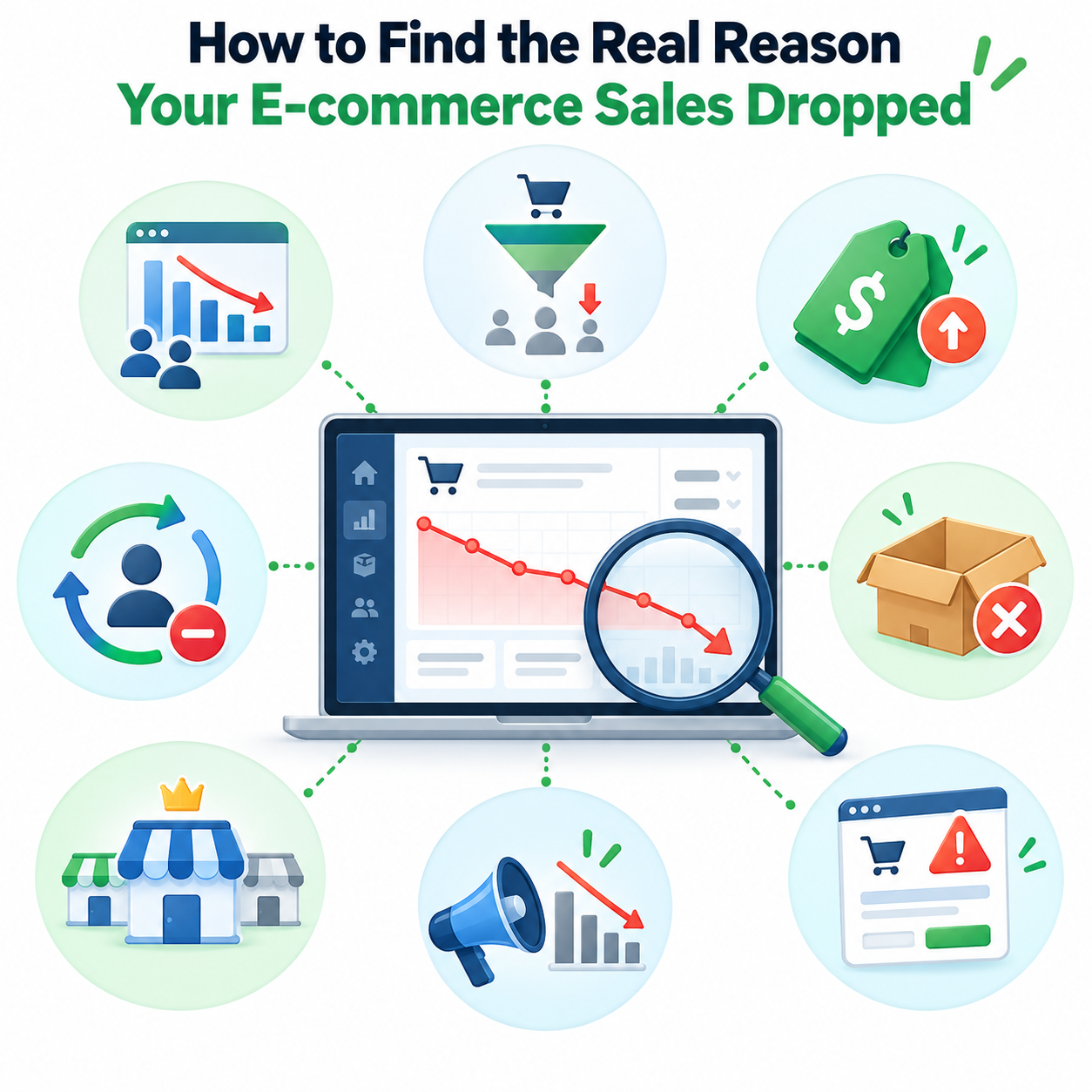
When e-commerce sales are declining, one usually begins by increasing ads and discounts, or attributing the decrease to the season.However, declining sales almost never stem from just one reason.In reality, it could be from decreasing traffic, lower conversion rates, higher costs of acquisition, hindrances during checkout, stock issues, bad retention, errors with tracking, and changes in customers’ preferences.
That’s why being reactive may worsen the situation.The right way of tackling the problem is carrying out a structured e-commerce performance analysis.
Before coming up with appropriate answers, you should find out what caused the changes early on. Rise in revenue can be brought into action by:
The correct approach is that e-commerce diagnostics starts with distinguishing between the aforementioned possibilities. For instance, it’s obvious that if traffic still remains the same while the number of orders has decreased, then acquisition is not what should be analyzed in the first place. At the same time if a number of customers is stable and revenue fails, it may be the average order value issue.
1.Verify if the Traffic of the Website has Decreased
E-commerce analytics assessment should begin with the traffic.Compare the current sessions/users with previous ones.Take a look at the traffic according to the incoming channel:
If the traffic has decreased, determine what channel can cause this decline. For example, if organic traffic drops, it may depend on changes in the ranking. If the paid traffic drops down, this may be caused by stopped campaigns or budget cuts. If social traffic drops down, this may be caused by failure in creative performance of ads.Do not come to the conclusion that every traffic decrease is the result of poor marketing.
2. Analyze Conversion Rates
If your traffic numbers are good and sales are declining, your next point of focus should be conversion rates. So, conversion rates tell you how successful your site is in converting visitors into buyers. When assessing eCommerce performance, you have to compare conversion rates:
– for the website as a whole
– for different devices (mobile and desktop)
– for different traffic channels
– for different landing pages
– for different product categories
– for new and returning customers
A decrease in conversion rates can happen due to changes in pricing, poor quality of product pages, reduced trust, technical mistakes, slow load time, stock levels, or problems with checking out. An obvious drop in conversion rates on mobile but not on desktop would suggest a mobile usability issue rather than a marketing one.

3. Conduct a thorough analysis of the E-commerce Funnel
Analyze the funnel with care.Break down the customer journey into a sequence of stages:
From product view → add to cart → begin checkout → payment → purchase
Then compare these stages to the previous time period. This analysis is one of the most beneficial strategies of navigating through ecommerce since you get to know precisely where the customers drop off. If the number of product views stays constant but the add-to-cart decreases, you might want to double-check pricing, product positioning, reviews, stock, or product page modifications.If you have the situation when your customers add products to carts but fail to proceed to checkout, you should check shipping conditions, the least amount of order, or cart usability. In case of stable stages of the checkout process, but falling purchases, you need to investigate problems with the payment system, checkout failures, or hidden charges.
4. Evaluate the Performance of Paid Campaigns
When sales in the e-commerce platform fall, one of the things that is often blamed is the failure of paid advertising campaigns. However, campaign effectiveness needs to be examined in detail. The following figures will be of interest:
If ad impressions and ad clicks do well but buying fails, it must be kept in mind that the problem may not lie with advertising. In this case, the problem exists after ad click-through.On the other hand, if the growth of the cost per customer acquisition rate is observed at the same time as the decline in traffic quality, the company would need to reconsider targeting, the content of its ads, etc.
5. Evaluate Average Order Value
The sales revenue could go down even if the amount of orders equals the previous amount. That’s why Average Order Value needs to be assessed.Look into whether the customers are purchasing fewer goods, buying cheaper products or acting differently with the promotions and bundles.Average Order Value drops could stem from:
Product discounts
Changes in the product mix
Decreased upselling
Low size of baskets
Disappearance of premium products
Changes in the free-shipping threshold.
If there is no drop in the order count, but revenue is down, Average Order Value may be the reason.Ecommerce performance analysis is effective if combined with website analytics data rather than separated from it.
6. Inspect Product Availability
Inventory challenges may adversely affect ecommerce performance. An excellent merchandise that is unavailable could cause conversions and sales to slump. Look at your most successful items or best-sellers to check stock availability in the period. Also check:
Availability of product sizes
Availability of variants or colors
Inventory feed mistakes
Delay in restocking
Products being mistakenly unpublished
When browsing through the e-commerce analytics, there may be high category traffic while revenue decreases due to unavailability of certain products.
7.Look into Website and Checkout Issues
Technical difficulties can produce abrupt sales drops. Check for:
If the decline happened all of a sudden or suddenly, technical difficulties should be checked out rapidly. Test the entire purchasing process yourself with all devices and payment tools. Minor checkout problems can lead to big-time monetary issues.
8.Investigate Customer Retention
Not every ecommerce downturn may arise from gaining new customers.Sometimes the repetitive buyers simply abandon doing business with a company. The following metrics should be assessed:
– Repeat Purchase Rate
– Returning Customer Revenue
– Customer Lifetime Value
– Purchase Frequency
– Email Revenue
– Loyalty Programme Activity
Weak customer retention can serve as a signal of product quality and service issues, delivery delays, lack of sufficient communication with buyers as well as increased competition. The strong diagnostics of ecommerce should be made regarding both new and repeat customers.If the acquisition is the same but margins from returning customers decrease, it would be ineffective to spend money on marketing campaigns.
9.Investigate Changes Preceding Sales Drop
One of the simplest ways to find out the problem is to inquire:What changed immediately preceding the drop in performance?
Look into the latest changes such as:
If a considerable drop in sales happens just after making an important change in the web, one should consider that change instead of looking for more general explanations in the market.
10. Ensure That the Drop Is Real
In some cases, the drop might be coming from the business itself, but not from the analytics.The tracking issues can lead to a false drop in sales.Check your analytics platform with regard to:
Ecommerce backend orders
Payment gateway transactions
CRM records
Marketplace orders
Accounting information
If your store has 500 orders but the analytics shows only 350 purchases, then it is likely a measurement issue and not the lack of revenue.Ecommerce analytics are a must before any important decision.
When there’s a drop in sales, go through this process for analysing your business.
Ask yourself one question per step.
And finally, are there any tracking issues?
Never do any of the following straight away:
It might actually be more difficult for you to locate the root of the problem when you change too many things all at once.Just fix a proven bottleneck, measure the effect, and then proceed.
When sales from e-commerce declined, the right way forward is not fear but diagnosis.Begin with data. Use e-commerce performance analysis to determine the source of the problem – is it traffic, conversion, average order value, retention, stock, checkout or analytics? From there, employ e-commerce diagnostic to figure out what changed about consumer behavior.
Where was it that the revenue stream went off track?
After discovering that point, everything else will fall into place.Ecommerce winners don’t blindly increase advertising budgets whenever they experience a drop in their sales. They discover the bottleneck and then solve it.This is how sales drops turn from a signal into a problem.
Why my ecommerce sales have plummeted?
The possible causes may be website-related issues, payment-related issues, change in campaign, tracking issues, lack of inventory, price issues, and reduction in traffic. Check the current performance and compare it with the period right before the plunge.
What should be checked at first, if ecommerce sales plummeted?
Check traffic, conversion rate, average order value, repeat customers, and checkout rate. This will help you find out if there were any issues before the purchase, during it, or after it.
What is the ecommerce performance analysis?
Ecommerce performance analysis is the process of checking traffic, conversion, revenue, customer behaviour, acquisition, retention, and operational data in order to know how your online store performs.
How can ecommerce diagnostics help increase sales?
Ecommerce diagnostics allows identifying the specific moment where your performance gets worse so that you can solve specific problems.
Which ecommerce analytics metrics should be watched?
There are some ecommerce analytics metrics you need to keep an eye on such as sessions, conversion rate, add-to-cart rate, checkout completion rate, average order value, customer acquisition cost, repeat purchase rate, customer lifetime value, and revenue by channel.