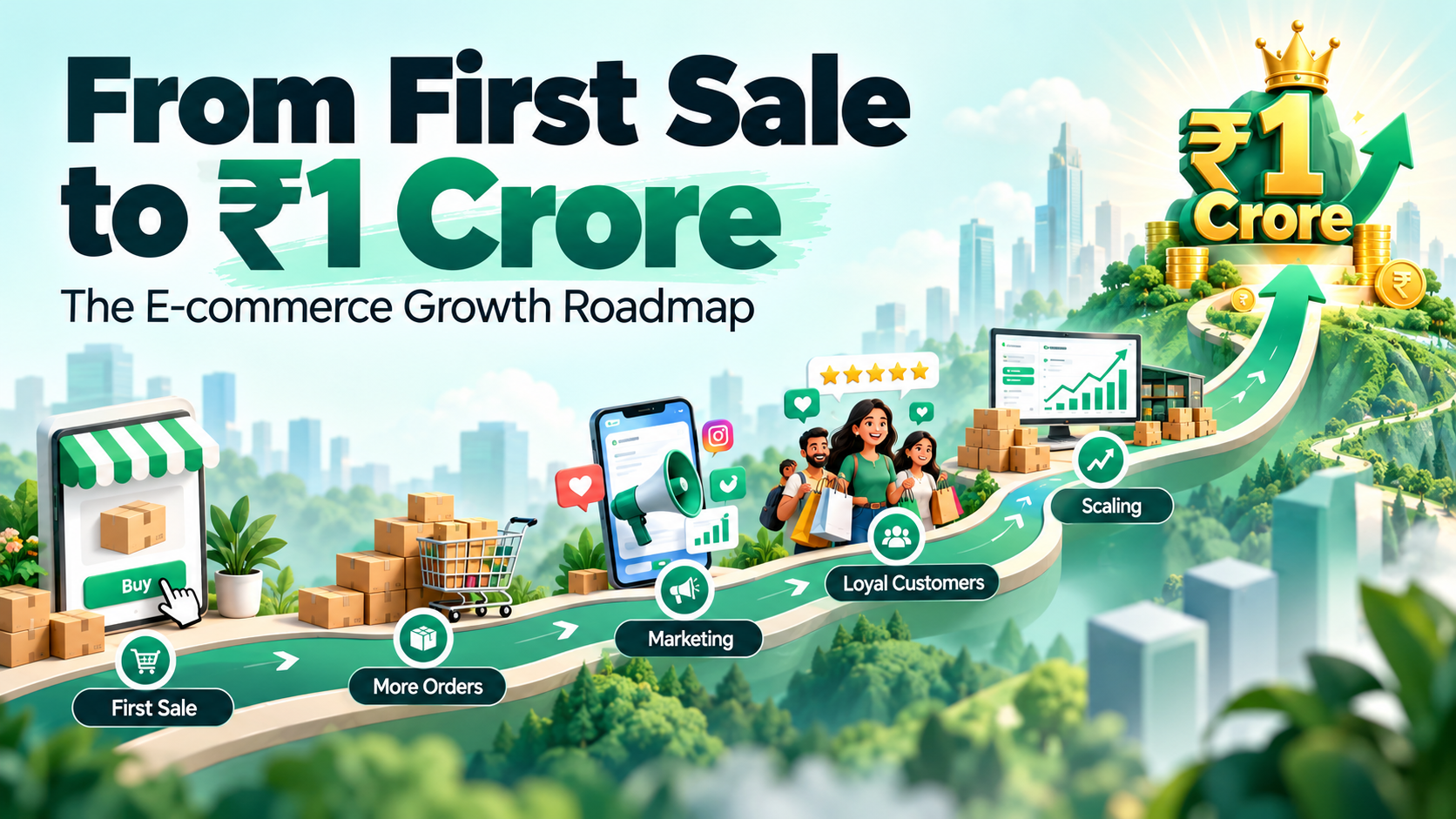
From First Sale to ₹1 Crore: The E-commerce Growth Roadmap
October 15, 2026
It is thrilling to have the first ecommerce transaction. Earning ₹1 lakh a month indicates success in business, but it is a different ball game to grow the revenue to ₹10 lakh, ₹50 lakh, or ₹1 crore. At every level, the challenge of growth brings in new problems.
Advertising becomes expensive, conversion rates stop improving, and repeat purchases remains low. Also, operations cannot deal with increasing order volumes.That’s why brands need carefully thought out e-commerce growth plan instead of just spending more on marketing.
The point is to locate which part of the business is blocking the growth – customer acquisition cost (CAC), conversion rate (CVR), retention or operations.
In the initial stages, there is no need for perfection. Proof is far more important.Your main focus should be in proving to yourself that there are potential customers willing to pay for your product.Target a specific group of customers, a clear value proposition, a working e-commerce website, and minimal number of reliable channels.
Do not waste marketing budget across every possible platform at this stage.Focus on the following three questions instead:
Who is the potential customer?
Why does the customer choose your product?
What is the most efficient channel for acquiring the needed customers?
By getting early customer acquisition data, you will start determining your future steps. If there are lots of visitors coming to your page but no customer orders, traffic may not be the issue. The issue may lie with your pricing, product description, marketing strategy, etc.
Thus, the first step in the e-commerce roadmap is to find product-market-channel fit.
Once demand has been validated, growth typically hinges on making acquisition sustainable.While paid social, Google Ads, SEO, influencer marketing, affiliate marketing, marketplaces, and email can all help, businesses should evaluate them based on profitability, not only on the level of traffic they generated.
One of the key figures is CAC.Customer Acquisition Cost. CAC indicates how much it costs to acquire a new customer.If you spend ₹2 lakh on advertising and get 400 customers, your CAC would equal ₹500. This figure is relevant if compared with the average order value, gross margin, and customer lifetime value.
One can create a perception that business is growing fast while the profitability is decreasing for every new customer.This is one of the most common issues in ecommerce.
Before increasing advertising budgets, you should check whether your unit economics can sustain this increase.
E-commerce platforms arrive at a stage where increasing traffic no longer results in increased revenue.That’s where CVR is important.Consider an example where a website has 100,000 visitors every month. At 1 percent CVR, that equals 1,000 purchases.Doubling the conversion to 2 percent could simply result in doubling the orders without increasing the number of visitors to the website. Conversion optimization can include making better:
The main point is to find out where customers drop off. If the product pages have traffic but few add-to-carts, the product offer could be weak.If the products are in the shopping cart but the customer does not complete the purchase, the problems might be payment, delivery, trust, or checkout friction. Good scalability in e-commerce comes as a result of efficient traffic before endlessly buying traffic.
As companies grow, customer acquisition becomes costlier.Ultimately, acquiring customers continuously is not feasible. Hence, companies must prioritize retention.A customer who makes three or four purchases is much more valuable than a single-purchase customer.Businesses should measure their repeat purchase rate, frequency of purchase, lifetime value, and time between purchases.
Retention practices can include automated emails, WhatsApp messages, appointment reminders, loyalty programs, personalized recommendations, limited-time offers, and education after the purchase. Nevertheless, it is not possible to achieve retention just through marketing automation.
Customers repeat purchases only when they really like the product and service.Fast shipping, precise information about the product, responsive customer service, solid packaging, and consistent quality lead to repeated purchases. To sum up, retention is a marketing metric as well as an operational metric.
Expansion reveals failure within operations.When the scale is small, teams can deal with the problems manually. But at scale, manual operation gets costly and unpredictable.Delays in order processing arise. Inventories become incorrect. Customer support can no longer shoulder the burden. Returns increase. Stockouts lead to lost sales.
Even when the marketing function is running smoothly, these ecommerce bottlenecks can kill growth.Businesses reaching extraordinary revenues should take a look at :
True e-commerce scalability implies that revenue growth does not involve the rise in complexity and costs.

In case you are experiencing stagnation in growth, do not think that all you need to do is bring in new traffic.
Investigate where the actual limitations exist.
When CAC Is Going Up
Take into consideration factors such as the following: targeting, creatives, the mix of channels, positioning, average order value, and lifetime value.
When CVR Is Low
Take a close look at such elements as customer-facing pages, product pages, mobile experience, pricing, trust signals, shipping policy, and checkout pages.
When You Have Retention Issues
Study product satisfaction, delivery experience, customer service, lifecycle communication, and the reasons for non-repeat customers.
Bottom Line
Some improvements can be made in planning inventory, fulfilment, automation, internal processes, and customer support. This is why this diagnostic approach is more successful than simply increasing your ad spend.
It is essential for successful ecommerce organizations to keep track of the following four areas:
CAC – Are we able to acquire customers profitably?
CVR – Do we have enough visitors turning into customers?
Retention – Are customers coming back and increasing their lifetime value?
Operations – Are our systems ready to accept more orders than before?
Usually, the weakest of these four areas becomes a growth limit. For instance, it can happen that great acquisition cannot overcome poor retention forever. The same way, good retention alone cannot save a company if fulfillment fails to meet demand.
The road to making ₹1 crore is never easy. Each stage of an e-commerce business comes with its own hurdles and these hurdles cannot be surmounted by just pouring in money into advertising. A brand should be able to analyze its CAC, CVR, customer retention, and operations continuously for its business to grow.
Brands at the initial stage must ensure that they have a product that sells and an effective customer acquisition strategy. Business that are at the developing stage must find ways to convert leads into customers and ensure repeat purchases. Established businesses must have the right workflow structure in place so as to make e-commerce scalable.
It is the brands that are able to figure their bottlenecks out before they turn it into a costliest inhibitor that are successful in e-commerce. Your focus should be on determining what is causing the limitation in your business and resolving it, followed by scaling your business further from thereon.
What is e-commerce growth map?
Ecommerce growth map is a structured plan for scaling online business by determining sales factors and optimizing them like acquisition, conversion rates, customer retention, operations and others.
What are the most common bottlenecks in e-commerce?
Some of the bottlenecks in ecommerce are increasing customer acquisition costs, low website conversion rates, bad customer retention, problems with inventory, issues with fulfillment and ineffective processes.
How to boost e-commerce scalability?
Scalability in ecommerce can be improved through having successful customer acquisition channels, raising conversion rates, ensuring repeat purchases, automating repetitive procedures, enhancing inventory planning and implementing efficient operations that would help manage higher volume of orders.
Why is it more challenging to attract new customers when e-commerce business is getting bigger?
Due to higher advertising costs brands reach broader audience for their promotions leading to their main target consumers becoming less and less interested in buying products.
Is it better for ecommerce companies to focus on CAC or conversion rate first?
In this case, it will highly depend on the growth-spending weakness that is being addressed. If the cost of acquiring qualified customers is high, then CAC might be prioritized. However, if the website attracts decent traffic, then working on CVR will be more impactful.
How can e-commerce brands determine the point at which they cannot grow any more?
There is usually a ceiling to this growth beyond which additional marketing investments do not generate significant income. Increasing CAC, decreasing CVR, small amounts of repeated purchases, empty shelves, issues with delivery, or a drop in customer service can usually be used as red flags.