Ecommerce Management Services: What Should You Manage In-House and What Can You Delegate?
Running an ecommerce business involves far more than maintaining an online store builder. As sales grow, merchants must manage products, inventory, orders, customer experience, SEO, content, advertising channels, analytics, integrations and technical maintenance—often with the same small team responsible for growth. This creates an important question: which responsibilities should remain inside the business, and which can be handled through ecommerce management services?
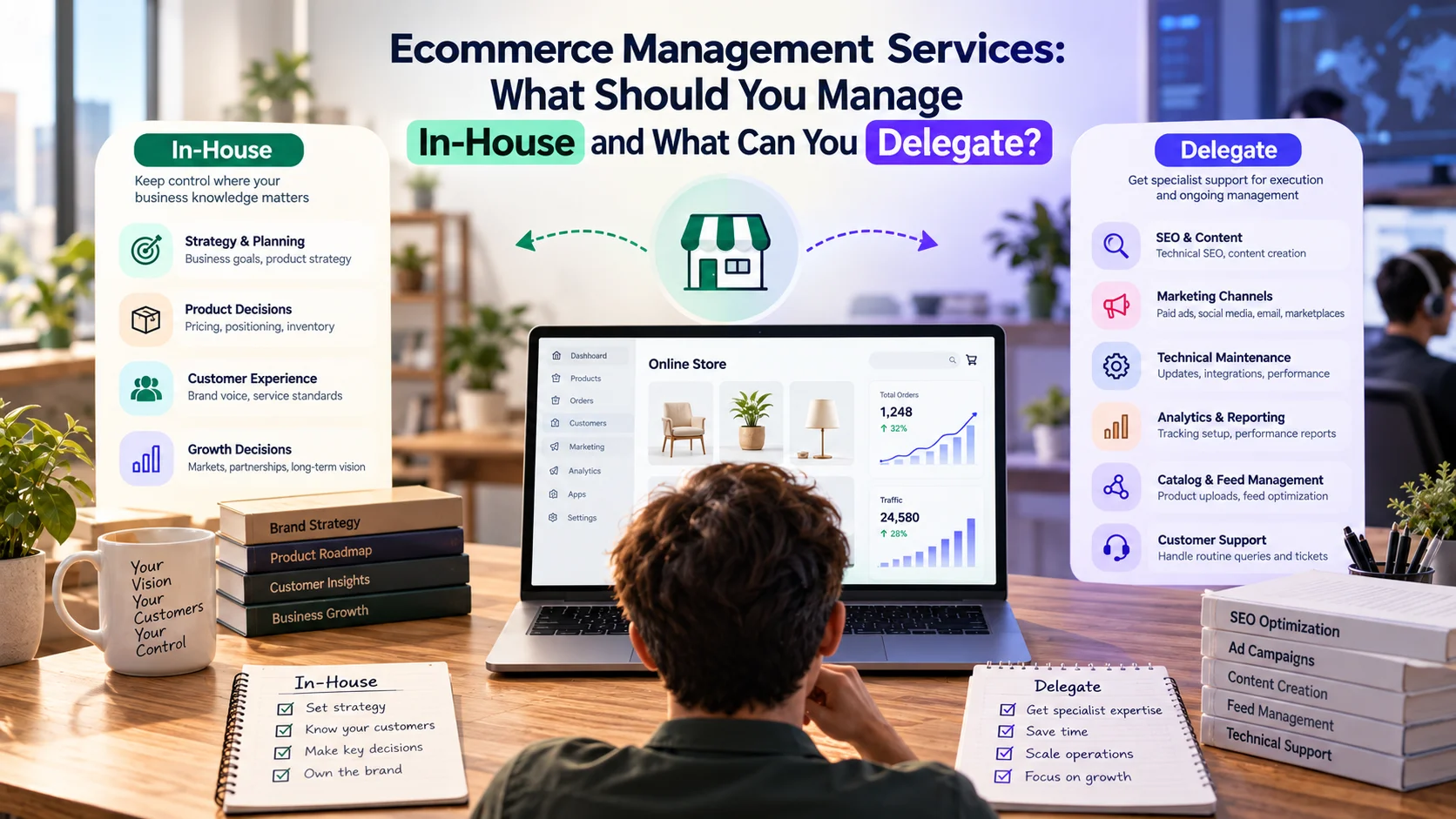
The answer is rarely “outsource everything” or “do everything yourself.” A more practical approach is to protect activities that require direct knowledge of your customers, products and commercial strategy while delegating repeatable, specialist or resource-intensive work when an external team can execute it efficiently. The goal is not simply to reduce workload. It is to create an operating model where internal expertise, technology and external specialists work together without losing control of the customer experience.
Why Ecommerce Management Gets Harder as You Grow
An ecommerce website can look simple from the customer’s perspective.
There may be a homepage, product pages, categories, a shopping cart and checkout. Behind those elements, however, dozens of processes may be operating every day.
A growing merchant could simultaneously need to:
- Add and update products
- Maintain inventory information
- Process orders
- Create content
- Improve organic visibility
- Manage advertising
- Update product feeds
- Monitor analytics
- Resolve customer issues
- Maintain integrations
- Launch promotions
- Test website functionality
- Optimize conversion rates
The challenge is rarely that one individual task is impossible. The problem is that all of these tasks compete for the same limited time and expertise.
This is where an ecommerce agency or managed service can add value. But delegation works best when responsibilities are divided intentionally instead of simply giving an external provider responsibility for everything.
The key distinction is ownership versus execution.
A merchant can delegate execution while retaining ownership of the decisions that matter most.
The Core Rule: Keep Decisions Close, Delegate Repeatable Execution
Before deciding whether a task should be outsourced, ask five questions:
Does it require deep knowledge of our customers?
Does it directly influence our brand or commercial strategy?
Does it require specialist expertise we do not have internally?
Is it repetitive enough to be standardized?
Can its performance be measured objectively?
The first two questions often indicate that the responsibility should remain close to the business.
The last three can indicate an opportunity for managed support.
For example, a furniture brand should probably retain control over product positioning, pricing and brand voice. An external specialist, however, could manage technical SEO audits, product-feed maintenance or repetitive catalog formatting.
This approach allows a business to retain strategic control without requiring its internal team to perform every operational task.
1. Store Operations: Keep Strategic Control, Delegate Routine Work
Store operations cover the everyday activities required to keep an ecommerce business functioning.
These can include:
- Product updates
- Collection management
- Order monitoring
- Inventory coordination
- Promotions
- Content updates
- Customer communication
Some decisions should remain internal because they depend on immediate business knowledge.
For example, if a popular product becomes unavailable, the business needs to decide whether to remove it, promote an alternative or adjust its inventory strategy.
Other activities are highly repeatable.
Routine product updates, data entry, feed maintenance and recurring reports may not require senior employees to handle them manually every day.
A modern ecommerce platform can centralize many of these workflows, while managed support can provide additional execution capacity.
Keep in-house
- Pricing strategy
- Product priorities
- Promotional decisions
- Customer experience standards
- Business-critical operational decisions
Consider delegating
- Routine catalog updates
- Data entry
- Feed maintenance
- Recurring reports
- Administrative store tasks
The objective is simple: let internal teams spend more time making decisions and less time repeating processes.
2. Product Catalog: Keep Ownership of the Information
Product catalog management is one area where delegation requires clear controls.
An external team can help upload, format and maintain product information, but the business should remain responsible for whether the information is accurate.
Google’s Merchant Center documentation emphasizes the importance of accurate product information, including attributes such as titles, descriptions, price and availability. Google also provides tools for monitoring product status and identifying product-data issues.
Consider a retailer with 5,000 products.
A catalog team could efficiently handle:
- Bulk product uploads
- Product formatting
- Image organization
- Category assignment
- Attribute completion
- Feed preparation
But the merchant should retain responsibility for:
- Product specifications
- Pricing
- Availability
- Product claims
- Positioning
A strong workflow is:
Business verifies source data → managed team executes → business reviews exceptions.
This creates scale without removing accountability.
3. SEO: Keep the Strategy, Supplement the Execution
SEO is one of the areas where businesses sometimes expect an external provider to operate independently.
That can create problems.
The merchant understands its products, margins, customers and commercial priorities. An SEO specialist understands search behavior, technical optimization, content structures and search performance.
Both perspectives are valuable.
Keep in-house
- Target markets
- Priority products
- Commercial objectives
- Brand positioning
- Key customer segments
Delegate or supplement
- Technical SEO audits
- Keyword research
- Structured-data implementation
- Internal-link audits
- SEO content production
- Search-performance reporting
- Technical issue monitoring
Google’s guidance emphasizes creating useful, reliable, people-first content rather than content produced primarily to manipulate search rankings.
That makes collaboration important.
An external team should understand why a product or topic matters rather than simply producing large quantities of pages containing keywords.
4. Content: Keep Brand Direction Close to the Business
Content includes far more than blog posts.
An ecommerce business may need product descriptions, category content, buying guides, email campaigns, social posts, landing pages and promotional copy.
A useful division is:
Business owns
- Brand voice
- Product claims
- Differentiation
- Customer messaging
- Core brand stories
Specialists assist with
- Content research
- Drafting
- Editing
- SEO optimization
- Product-copy production
- Content calendars
This becomes particularly important when automation or AI is used.
AI can accelerate first drafts and repetitive content work, but important product information still requires human review.
For example, if the source data confirms that a product uses solid wood, an automated system can turn that information into polished copy. It should not independently add claims about origin, sustainability or manufacturing processes without supporting evidence.
Automation should reduce writing workload, not reduce factual control.
5. Marketing Channels: Decide Internally, Execute Selectively
Paid advertising, social media, email marketing and marketplace promotion can require continuous attention.
An ecommerce agency can provide specialist execution when an internal team does not have the capacity to manage every channel effectively.
However, channel activity should still begin with an internal commercial objective.
For example:
“We want to increase visibility for our premium outdoor furniture collection in Germany.”
The external team can then translate that objective into campaign structures, audiences, creative testing and reporting.
This is generally more useful than simply telling an agency to “run our marketing.”
Internal responsibility
What are we trying to achieve?
Specialist responsibility
How can we execute that objective efficiently?
This division keeps the business in control of the outcome while allowing specialists to contribute their expertise.
6. Product Feeds: A Strong Candidate for Managed Support
Product-feed management is particularly suitable for specialist support because it combines technical requirements with ongoing maintenance.
Google provides several ways for merchants to submit product information to Merchant Center, including automatic synchronization from an online store, data files, Google Sheets and the Merchant API.
Product information also needs to remain accurate as the store changes.
If a product’s price or availability changes on the website, corresponding product data may need to be updated across connected channels.
Managed support can help with:
- Feed generation
- Attribute mapping
- Feed diagnostics
- Product-disapproval monitoring
- Price synchronization
- Availability synchronization
- Channel-specific formatting
The merchant should still own the underlying product information.
The specialist manages the technical pathway through which that information is distributed.
7. Analytics: Keep the Questions In-House, Get Help With Implementation
Analytics become increasingly important as an ecommerce business grows.
A founder managing 20 products may understand sales patterns from direct observation. At 2,000 or 20,000 products, decisions increasingly depend on structured data.
Google Analytics supports ecommerce events such as product views, cart actions, checkout activity, purchases, refunds and promotions.
The internal team should decide which questions matter:
- Which products generate the most revenue?
- Which channels produce valuable customers?
- Where are shoppers abandoning the journey?
- Which categories are growing?
- Which campaigns are producing purchases?
- Which products attract attention but fail to convert?
A specialist can then help implement and validate the tracking required to answer those questions.
The division becomes:
Business: What do we need to know?
Specialist: How do we measure it reliably?
Without the first question, analytics becomes a collection of dashboards. Without the second, strategic decisions may be based on incomplete information.
8. Technical Maintenance: Often Worth Delegating
Technical maintenance is one of the clearest areas for specialist support.
It may include:
- Broken-link monitoring
- Performance checks
- Integration monitoring
- Tracking verification
- Security maintenance
- Technical troubleshooting
- Compatibility testing
Not every merchant needs a full-time technical ecommerce specialist.
If technical work is occasional but requires specialist knowledge, managed support may be more practical than maintaining that expertise internally.
The same principle applies to website performance. Google’s Core Web Vitals framework provides standardized measures for loading performance, responsiveness and visual stability.
The important question is not whether the internal team performs every technical task.
It is whether someone is clearly accountable for technical health.
9. Customer Experience: Keep Ownership Close to the Customer
Customer support can be delegated, but customer experience should remain a business responsibility.
External teams can handle first-line questions, support tickets and common requests. But recurring customer problems often reveal deeper issues.
Suppose customers repeatedly ask:
- “When will my order arrive?”
- “What size should I choose?”
- “Can I return this?”
- “Why can’t I use this payment method?”
These may not simply be support problems.
They could indicate:
- Poor product information
- Unclear shipping details
- Weak return-policy communication
- Limited payment options
- Confusing website navigation
This is why customer support data should flow back into the business.
Support should not only close tickets; it should reveal opportunities to improve the store.
10. Conversion Optimization: A Shared Responsibility
Conversion optimization sits between business strategy and specialist execution.
An external team can analyze:
- Product-page behavior
- Cart abandonment
- Checkout activity
- Landing-page performance
- User journeys
- A/B tests
Baymard’s latest research puts the average documented online shopping cart abandonment rate at 70.22% across 50 studies. Its research also identifies issues such as unexpected additional costs, complicated checkout processes and website errors among reasons shoppers abandon purchases.
But analytics alone cannot determine the right commercial solution.
Suppose a premium product receives significant traffic but few purchases.
The problem could be:
- Pricing uncertainty
- Weak product photography
- Missing specifications
- Unclear delivery information
- Insufficient trust signals
A specialist can identify patterns in the data. The merchant’s knowledge of the product and customer helps determine what should change.
That makes conversion optimization a strong candidate for collaboration rather than complete outsourcing.
The Ecommerce Responsibility Matrix
| Responsibility |
Keep Ownership In-House |
Delegate / Supplement |
| Brand positioning |
✓ |
|
| Product strategy |
✓ |
|
| Pricing decisions |
✓ |
|
| Customer experience standards |
✓ |
|
| Routine catalog updates |
|
✓ |
| Technical SEO |
|
✓ |
| SEO content |
✓ |
✓ |
| Product-feed management |
|
✓ |
| Paid campaign execution |
✓ |
✓ |
| Analytics strategy |
✓ |
✓ |
| Analytics implementation |
|
✓ |
| Technical maintenance |
|
✓ |
| Store administration |
✓ |
✓ |
| Conversion optimization |
✓ |
✓ |
| Strategic growth decisions |
✓ |
|
The key point is that delegation does not have to be binary.
A business can retain ownership while outsourcing execution.
When Should You Consider Ecommerce Management Services?
Managed support becomes increasingly useful when one or more of these situations appears.
Your team spends too much time on repetitive work
If skilled employees spend significant time performing tasks that can be standardized, external support or automation may improve efficiency.
You need specialist expertise
Technical SEO, analytics implementation, feed management and certain technical tasks may require expertise that does not justify a full-time internal hire.
Growth is creating operational bottlenecks
If adding products, markets or channels creates disproportionately more administration, managed support can provide additional capacity.
Marketing execution is inconsistent
An external team can help maintain publishing, optimization and reporting schedules when internal resources are stretched.
You want to scale without losing strategic control
This is one of the strongest reasons to use managed support. The business retains decision-making while specialists extend its execution capacity.
When Should You Keep More Work In-House?
Outsourcing is not automatically the right answer.
Greater internal ownership is generally appropriate for responsibilities involving:
- Proprietary business knowledge
- Product strategy
- Sensitive information
- Major pricing decisions
- Brand positioning
- Customer experience standards
- Strategic partnerships
- Long-term growth direction
If an external provider is making fundamental commercial decisions simply because the internal team is unavailable, the business may be outsourcing strategy rather than execution.
That can create dependency and make it harder for the company to build its own knowledge.
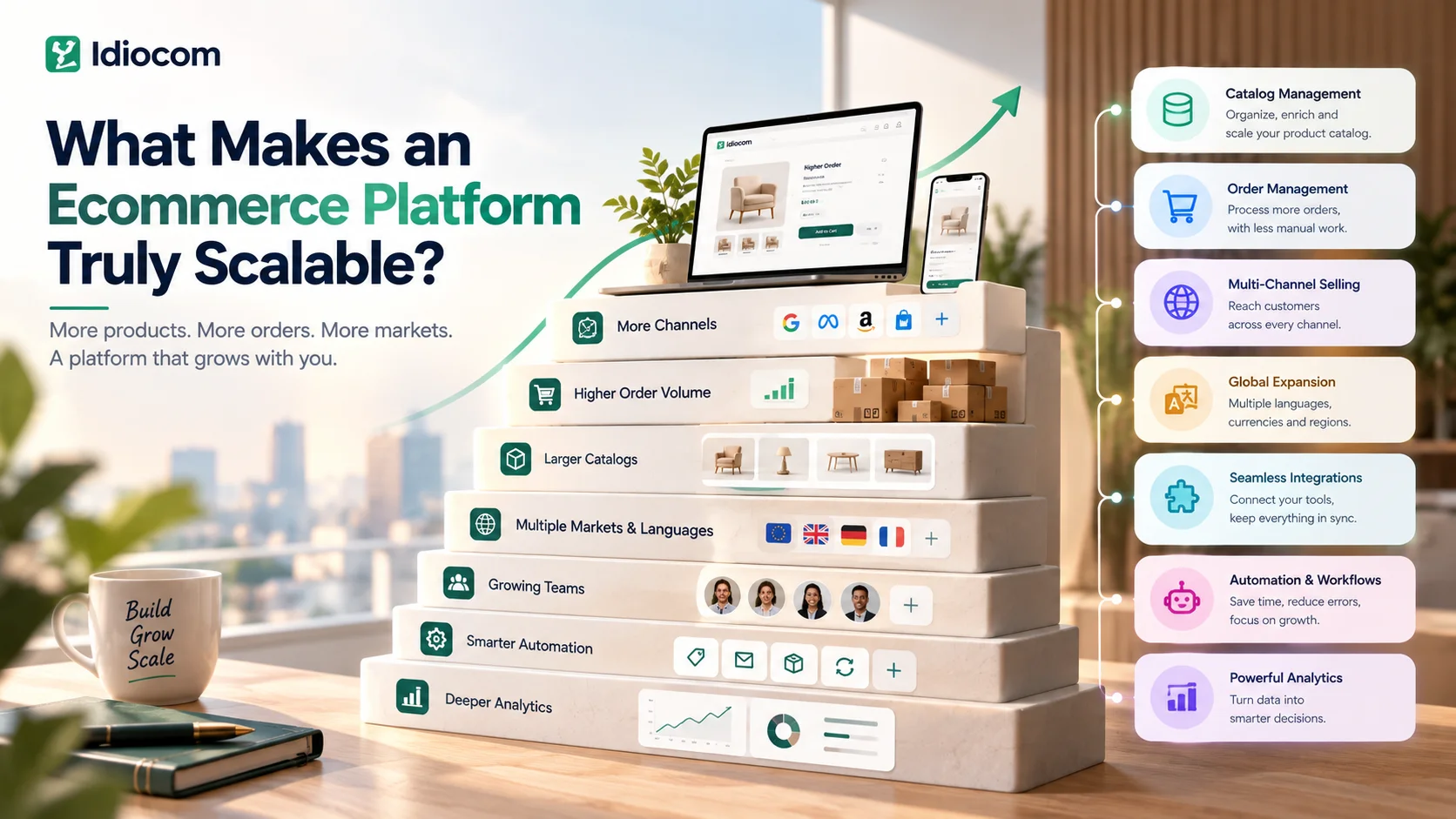
How Your Ecommerce Platform Changes the Equation
The platform itself affects how much ongoing management your business requires.
A capable online store builder or broader ecommerce platform can centralize products, orders, payments, shipping, analytics and other workflows.
This can reduce the number of disconnected systems that employees and external providers have to maintain.
For example, if product and order management are already centralized, a specialist team can focus on optimization rather than manually moving information between different systems.
This is why platform selection should be evaluated alongside staffing and management strategy.
Instead of asking only:
“What features does this platform provide?”
also ask:
“How much ongoing work will this platform create for our team?”
A platform that saves development time but creates significant administrative complexity may simply move the workload somewhere else.
A Simple Framework Before You Delegate
Before assigning a responsibility to an external provider, evaluate it across five dimensions:
Strategic
Does this task determine the direction of the business?
Sensitive
Does it involve information or decisions that require close internal control?
Specialized
Does it require expertise your team does not currently have?
Repeatable
Can the process be documented and standardized?
Measurable
Can success be evaluated using clear metrics?
Tasks that are highly strategic and sensitive usually deserve internal ownership.
Tasks that are specialized, repeatable and measurable are often stronger candidates for delegation.
This framework is more useful than simply asking whether a task is difficult.
The Best Model Is Usually Hybrid
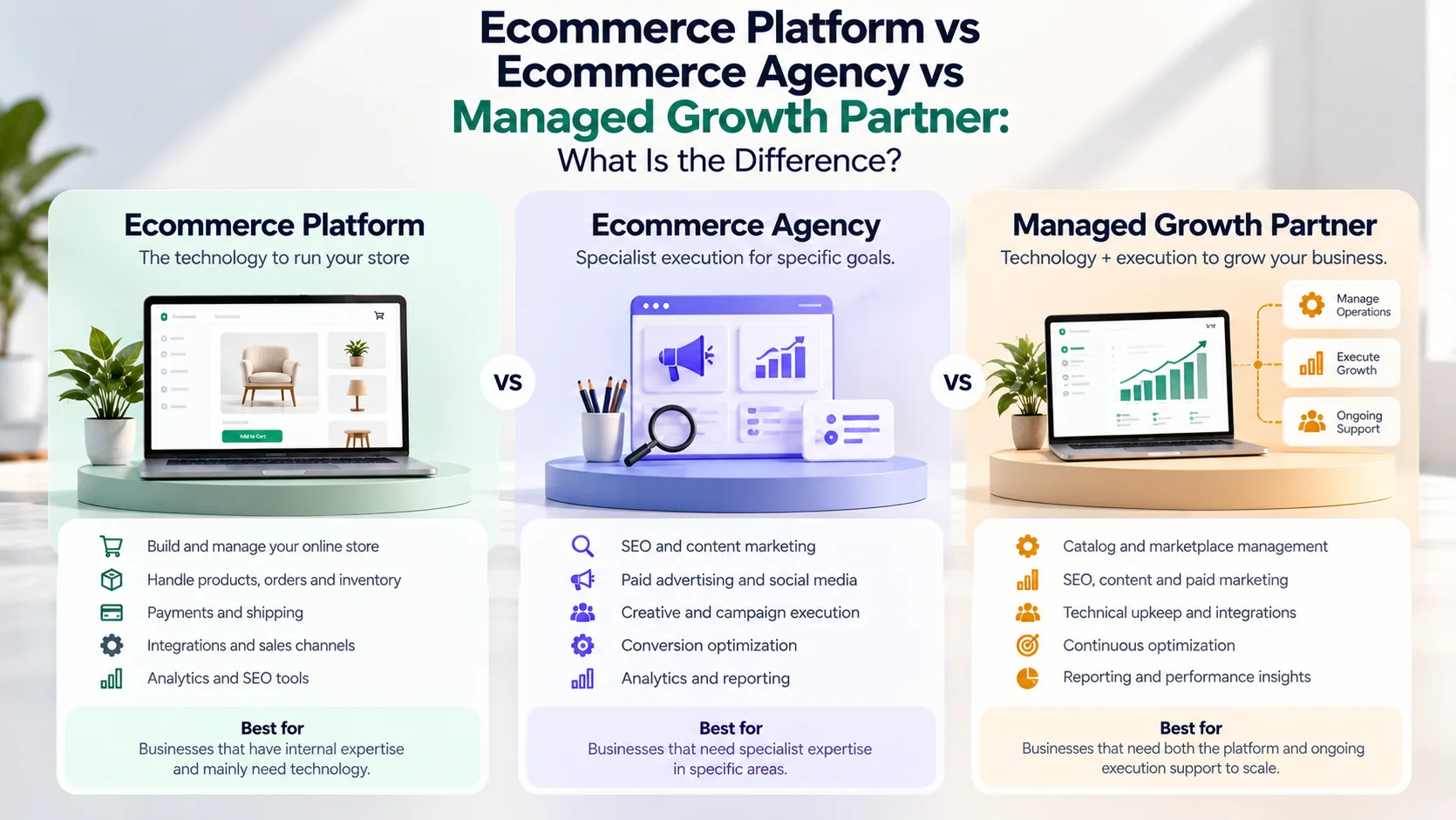
For many growing ecommerce businesses, the practical answer is neither complete in-house management nor complete outsourcing.
A hybrid model can divide responsibilities into three layers:
Internal team: Strategy, brand, products, customers and major commercial decisions.
Platform: Store infrastructure, routine workflows, product management and operational tools.
Specialists: Technical expertise, execution capacity, optimization and ongoing support.
This creates a clearer operating model where each layer has a defined role.
Idiocom follows this broader approach by combining ecommerce software with optional managed growth support. The platform brings together core activities such as store creation, product and order management, payments, shipping, SEO-related workflows and multi-channel capabilities, while additional support can be applied where merchants need help with visibility, content, catalog work or growth execution.
The important consideration is not whether support is internal or external.
It is whether responsibility is clearly assigned and connected to measurable business objectives.
Final Takeaway
Ecommerce management services are most useful when they remove operational friction without taking strategic control away from the merchant.
Keep product knowledge, customer understanding, brand direction and major commercial decisions close to the business. Consider delegating specialist or repeatable responsibilities such as technical SEO, product-feed management, catalog administration, analytics implementation, technical maintenance and selected marketing execution.
The right operating model will change as the business grows. A company with 50 products and one employee may need a very different structure from a retailer with thousands of products, multiple markets and several sales channels.
The objective is therefore not to outsource as much as possible.
It is to build an ecommerce operation where the right people do the right work at the right level—with technology handling repeatable processes, internal teams protecting strategic knowledge and specialist partners providing expertise where they add measurable value.
That is what turns ecommerce management from a collection of daily tasks into a scalable growth system.