E-commerce Traffic Up, Sales Flat? 7 Ways to Boost Conversions
November 6, 2026
Usually, additional traffic is generally regarded as positive news. When more individuals turn up your online shop, there is a larger chance that your search engine visibility is growing, you get more clicks through paid advertisements, and there is an increase in website visitors from social media.
But what if the traffic is growing, but sales are still slow? This would indicate that the issue is not simply with the acquisition. The problem lies between the visit and the purchase. At this point, it is critical to understand e-commerce conversion rate. In cases when the website attracts visitors without getting corresponding revenues, one should analyze where the buyers are dropping off.
Traffic and revenue may be closely related but are not the same.A website may gain a few thousand visitors, but its sales may not keep up if these visitors are not interested in the site products or if its product pages fail to create a good level of trust or if the checkout process is too complicated.
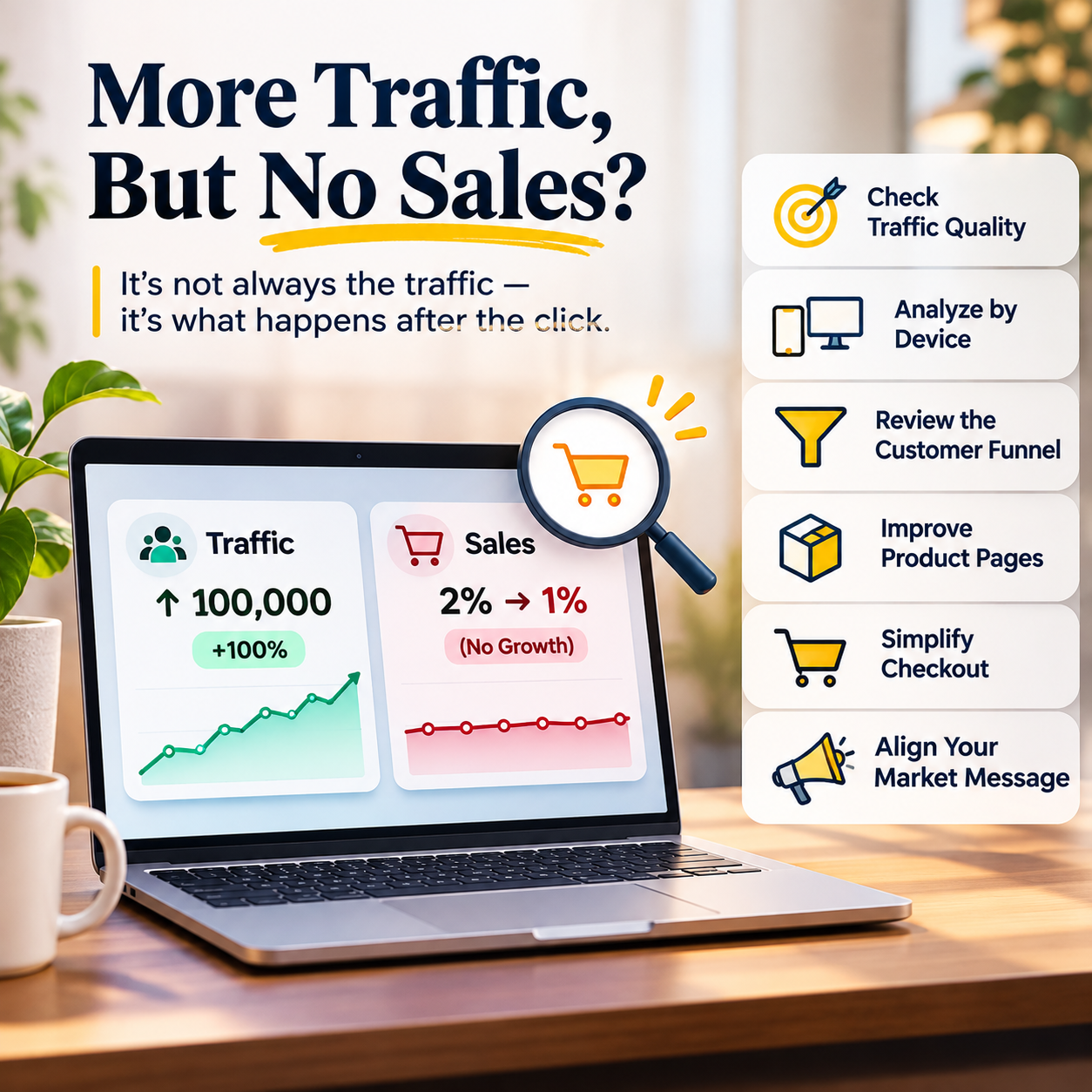
For instance, you may see a rise in the site’s traffic from 50,000 visitors to 100,000 a month. However, if your conversion rate drops from 2% down to 1%, that increase in traffic will not help you gain extra money. This is the reason why traffic should not be assessed in isolation.
Prior to making your online changes, assess if your traffic is worthwhile.As not all sources generate the same traffic and visitors. There could be a sudden rise in users coming from searches and social media platforms. Analyze how conversion rates differ through various sources.
You can distinguish between organic, paid channels, social media, email marketing, referrals and direct traffic. If one source generates a substantial number of views but fails to convert them into purchases, it means that the cause of such behavior is not the website itself but the traffic source.
When looking at conversion rates in e-commerce, it is important to look at more than just the overall number.
Analyze performance in type of device; i.e. check conversion rates separately for the mobile device, tablet and desktop.That is to say, overall conversion may remain the same but problems with conversion on mobile devices may bring decline in the rate.
Problems in the mobile version include slow loading speed, difficulty with navigation, small button size, lengthy checkout, issues with filtering of products, and payment problems. In e-commerce, mobile traffic usually accounts for a considerable share of total visits and even the smallest problems with usability may have a significant impact on the revenue received.
Diagnosing the customer funnel is one of the best ways to know about the loss of revenue due to low customer traffic. Also, you need to divide the purchase process into steps, which are as follows:
Seeing the product → Adding to the cart → Start the checkout process→ Purchasing the product
After doing so, you need to see your funnel and find out where you lose the most.
The product display is increasing, while the add-to-cart action is decreasing.Normally, this indicates a product-page problem. Customers might be confused about the product, they could consider the price to be high or lack enough confidence to make a purchase.
Check the product’s photos, descriptions, specifications, reviews, delivery information, prices, guarantees, and availability. The problem could also relate to the relevance of the traffic. When a lot of visitors with low intent come to the product page, because of this, the number of product views rises, but the add-to-cart rate remains low.
In this case, customers seem to be keen on the product but avoid going for the purchase process. Consider unexpected delivery fees, minimum order sizes, vague return policies, or complicated cart processes Customers may be using their carts as temporary wish lists. An effective conversion strategy should dispel doubts about the purchase process before moving on to checkout.
While the number of customers requesting the checkout process is very high, the number of purchases made at this process is low. This is a clear indication that you need to perform an inquiry. Look for payment problems, surprising fees, obligatory registration of an account, shipping restrictions, discount code problems, technical failures, or very tough checkout form. The closer the client is to making a purchase, the more serious the issue is.
There are times when the traffic is good and the website is technically sound, but the message is not appropriate.Customers may respond to an ad only to end up on a site with a different message from what they expected. For example, an ad might talk about being affordable, while the landing page states a more premium position.
This discrepancy can lead to poor e-commerce conversion rates because the ad and website can be effective on their own.It is important to check whether the landing page continues to deliver the promise made in the following mediums:
Keeping the message consistent means that your visitors will feel that they have come to the right place.
Customers do not buy merely based on price. They buy when they feel they are getting more value than the cost. If traffic increases while the sales do not, you should question if your website provides a clear answer as to why your product is worth buying.The communicated value can be strong where product quality, product construction, materials used, guarantees, product advantages, customer feedback, comparisons, or unique features are emphasized.
A poorly performing e-commerce conversion rate can often look like it comes from a low price point rather than a poor communication of value. Before dropping the price, make sure that the website justifies the cost.
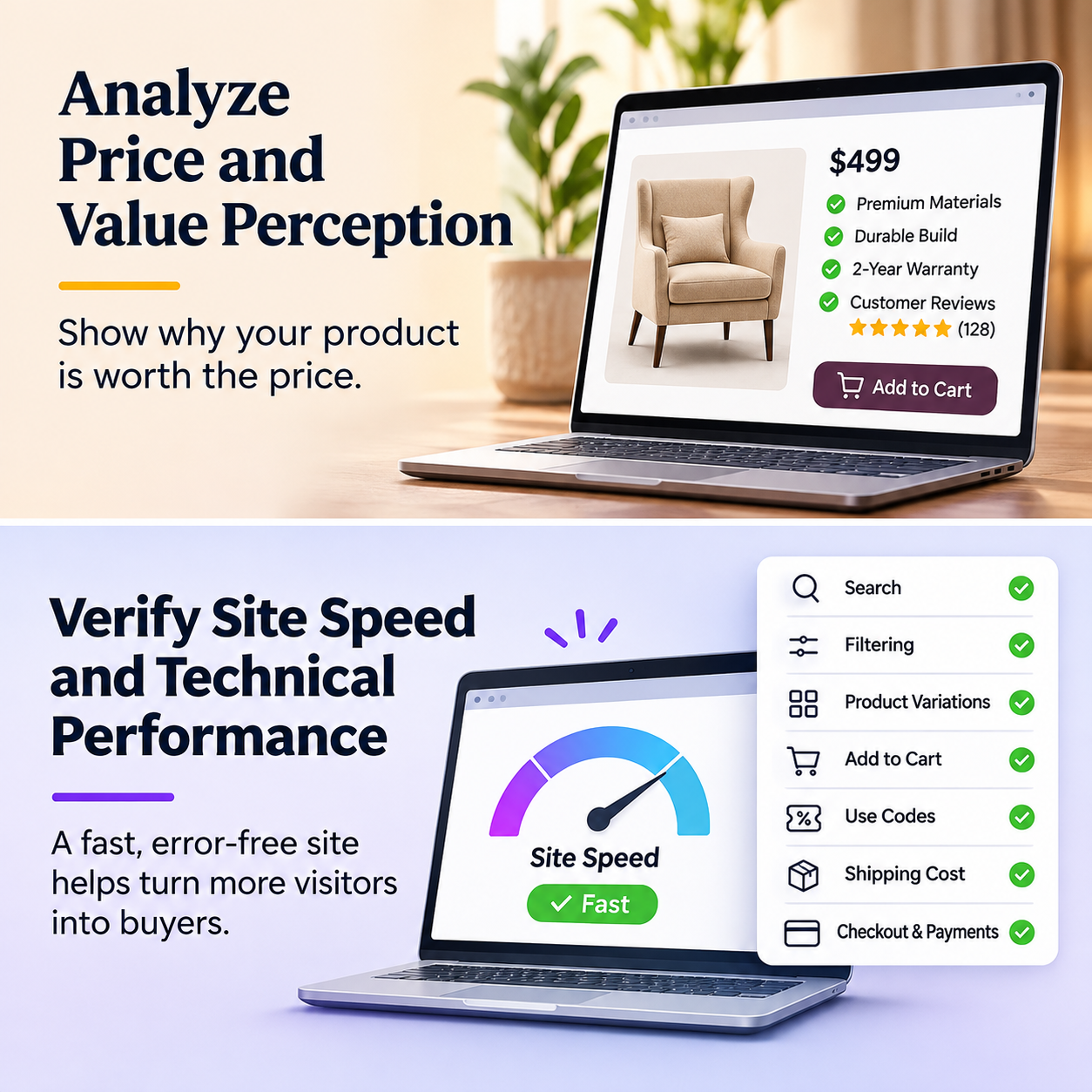
A site with technical issues can negatively impact the conversion quietly and effectively. Assess the page load time as it relates particularly to mobile access. Run tests on the main actions that should be available on the site, like:
Search function
Filtering function
Choice of product variations
Add to cart function
The use of codes
Shipping cost calculation
Checkout
Making payments
Do not think that everything works just because the home page is loading fine. Technical problems usually affect particular browsers, devices, products, or payment options. If the traffic is increasing but the technical performance is worsening, the revenue will remain on the same level despite better acquisitions.
If people can’t locate certain goods, how can they acquire? With the expansion of product catalogs, navigation and search gain more significance. When a client seeks a product, they should come with a prompt answer.
Inadequate filtering, poor search functionality, complicated categories, and elaborate menus have a negative impact on the conversion rate. This is a critical point for companies with huge catalogs. When it comes to e-commerce CRO, product discovery is regarded as an aspect of conversion rather than just a navigation element.
Traffic increases often result from the arrival of new visitors. Usually, new customers need more convincing than returning clients who are familiar with the brand. Analyze conversion ratios between new and returning visitors. If traffic increase comes from mostly new people, this could mean lower-than-average conversion rates. Your website might require some additional assurance tools like:
– Reviews
– Shipping information
– Return policies
– Contact details
– Secure payment protection
– Brand credibility
The goal is not to attract new visitors but make them feel confident enough to purchase.
Revenue may not be satisfactory although the number of orders is increasing. This situation may arise because the average order value is low. Low value of the average order may be explained by customers choosing items with lower prices, placing orders with fewer items, or applying more discounts.
Thus, a sequence of analysis should go as follows: Traffic → Conversion Rate → Number of Orders → Average Order Value → Revenue
Analyzing this sequence will give you a better understanding of the overall picture than looking only at the traffic and sales part.
In some cases, sales are on the rise yet analytics do not seem to record them correctly. Prior to any significant alterations, double check your e-commerce analytics against actual backend orders and payment information.
Sometimes there can be issues with tracking after you have upgraded your site, adjusted your checkout process, incorporated consent, or changed your analytics settings. If recording sales inaccurately, your e-commerce conversion rate will appear lower than it actually is. Before diagnosing your business, always verify the figures.
When traffic is increasing, but revenue is not, check each issue in the following way:
1. Traffic Quality
Are the new visitors appropriate and making purchases?
2. Product Engagement
Are visitors looking at the right products and putting them in carts?
3. Checkout Process
Are buyers successfully going from cart to checkout and payment?
4. Conversion Rate
Is the general or channel-level e-commerce conversion rate worse?
5. Average Order Size
Are customers buying less in each order?
6. Technical Issues
Are website or payment errors eliminating purchases?
7. Tracking
Is the analytics system precisely counting conversions?
Following this method makes e-commerce Customer Conversion Rate more straightforward and avoids random changes.
If e-commerce sales do not meet expectations, companies may opt to redesign product pages, offer discounts, modify advertising, tweak checkout processes, and change prices all at once. This complicates the diagnostic process. Instead, look for the most compelling evidence pointing to a problem. Implement one major change, follow the results, and move on from there. Conversion optimization succeeds best when seen as a diagnostic and testing process.
If there is an increase in traffic but a steady sales rate, bringing in more visitors to the website may not be the best step to take. The question now becomes which specific segment in the customer journey is failing. High e-commerce conversion rates can only be achieved if traffic quality, product quality, pricing policy, trust, user experience on the website, and transaction efficiency.
With the help of conversion rate optimization techniques, brands can identify a specific part of the process that needs improvement instead of just guessing what should be changed. When companies connect traffic data with interaction process, website performance, and financial results, it is much easier to increase e-commerce conversion rates.
What can be the possible reason behind the increase in traffic while the drop in sales for my ecommerce site?
Your ecommerce site might be receiving visits from people showing low intent or people dropping out for any reasons like issues with the product page, price point, usability issues, checkout problems, technical issues, lack of credibility, etc.
What conversion rates can be termed as good?
There is no specific conversion rate that applies to all e-commerce businesses as the rate of conversion varies depending on several factors such as the type of market, industry, product, etc. What is often considered as a good comparison is the own previous performance of the website.
What are the reasons behind the low conversion rate?
Reasons for a low conversion rate can be extremely poor traffic quality, poor product data, unclear pricing, bad website performance, poor credibility, poor navigation, delivery charge, problems with checkout, etc.
What is e-commerce CRO?
E-commerce CRO stands for e-commerce conversion rate optimization. It implies finding areas of improvement that hinder the customers from making a purchase.