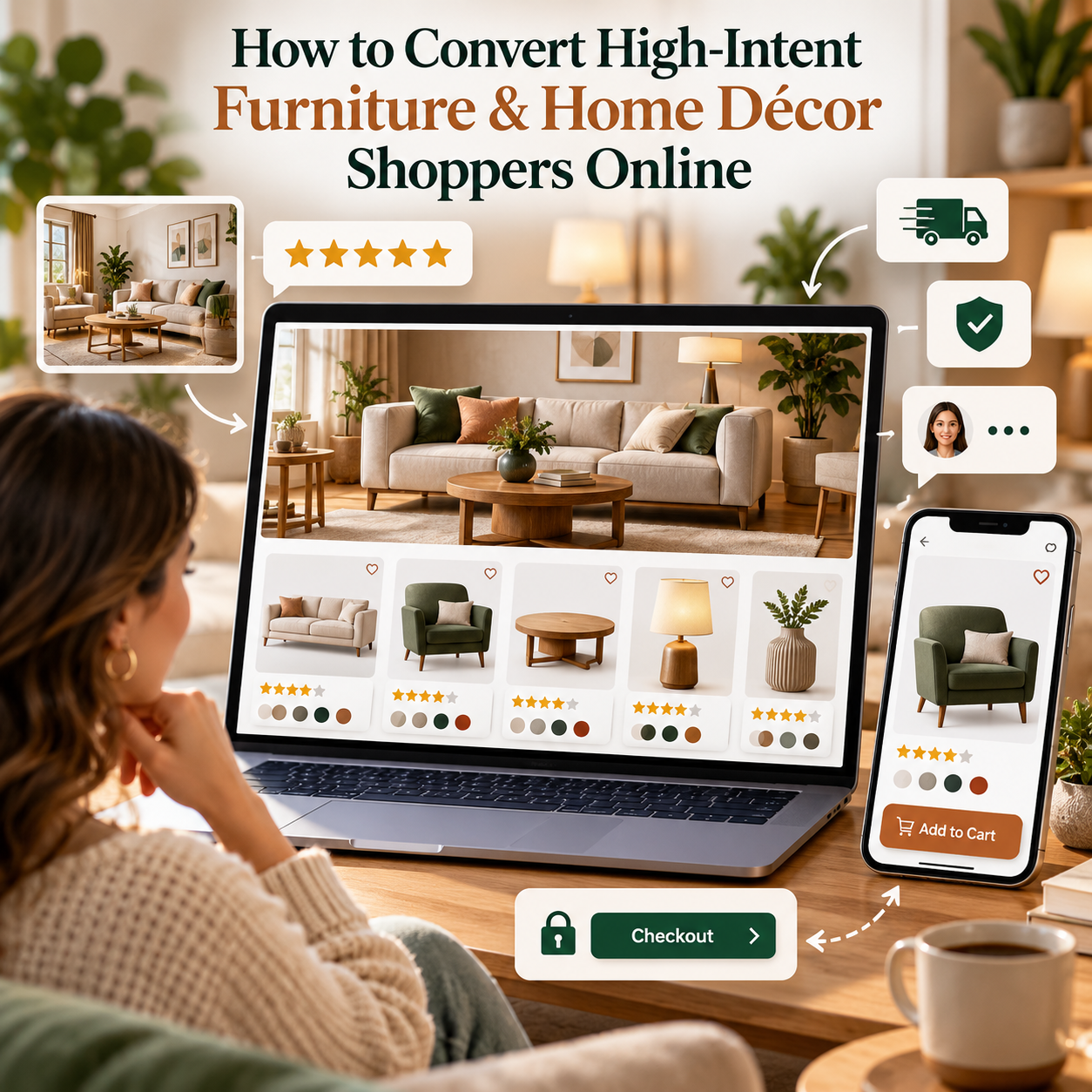
How to Convert High-Intent Furniture & Home Décor Shoppers Online
October 21, 2026
Purchasing furniture over the internet is vastly different from buying a T-shirt, case phone, or even a cosmetic. Furniture is an expensive item and highly visual, takes a lot of space, hard to get rid of, and expected to serve long within one home. Customers therefore have to be highly confident before pressing the “Buy Now” button.
Thus, furniture e-commerce requires consideration throughout the entire purchasing experience.In order to run a successful furniture or home decor e-commerce operation, you should do more than simply generating traffic and showcasing products. You have to make your customer feel confident at each step of the way.
The most successful furniture brands know that e-commerce is not just about selling. It is about helping people make decisions.
Reasons Why The Customer Journey for Furniture Needs to Differ
Customers usually don’t come to a furniture e-commerce site prepared for an immediate buy decision.They might do comparison shopping with respect to style, material, size, color, price, delivery time frames and brand for days or weeks.If a person is shopping for sofas, dining tables, beds or wardrobes – he or she might wonder:
A good furniture online store should give customers all these answers upfront, before they have to contact customer support.
1. Inspiration Before the Product Categories
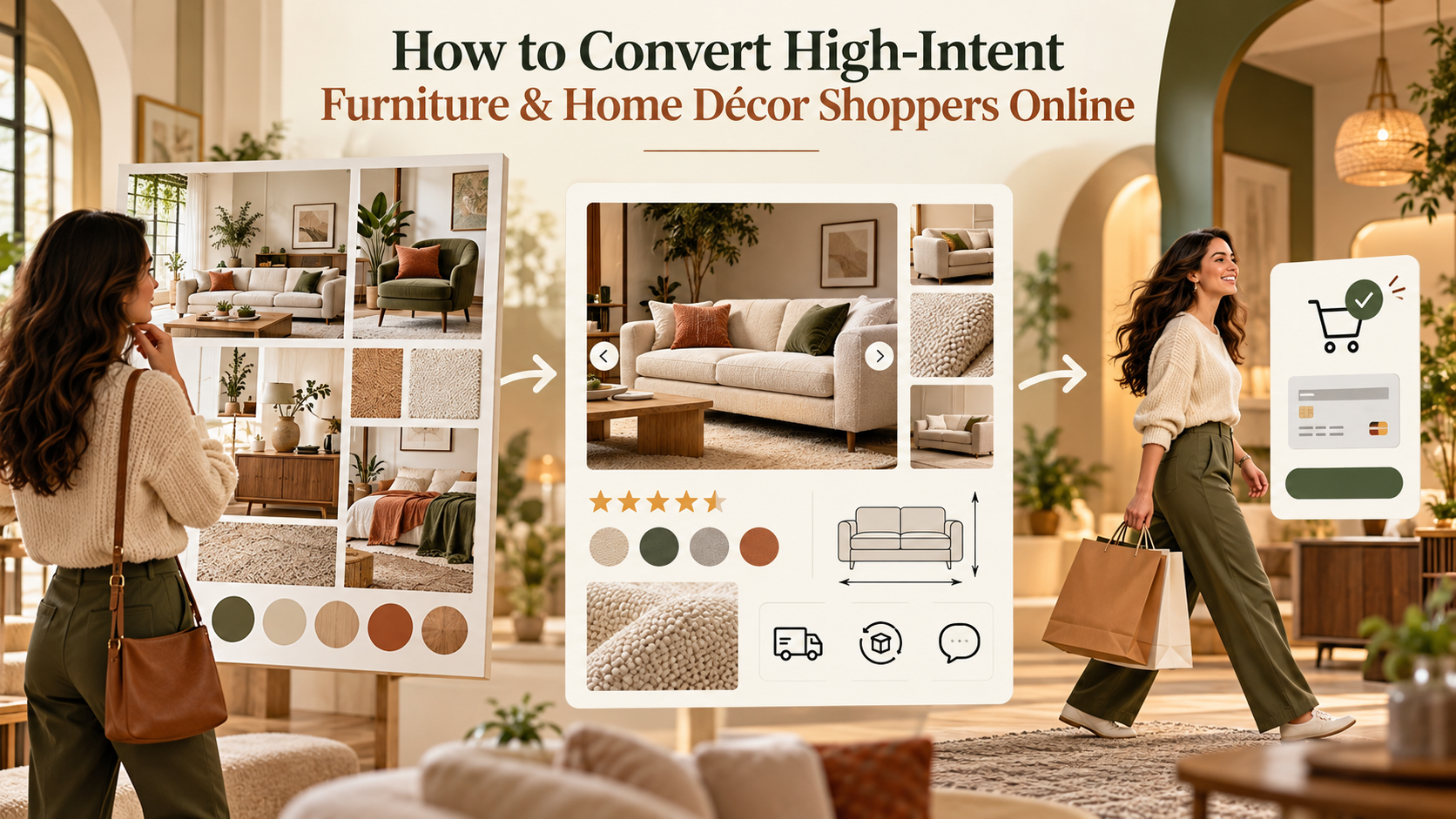
Furniture shopping usually starts with an inspiration concept rather than product category SKU. A consumer may look up the modern living room, luxury bedroom design ideas, minimalist dining furniture, or contemporary outdoor furniture before picking what to purchase.This implies that furniture online shopping has to be inspirational. Apart from using just product categories like “Sofas” or “Dining Tables”, companies can assist their clients in researching by offering:
Editorial concepts, inspirational rooms, curated collections, and buying guides can be used by clients to smoothly transition from inspiration stage to consideration phase.As far as home decor online shopping goes, this is even more critical since buyers tend to purchase several complementary items at once.
2. Let Your Product Pages Take the Place of a Showroom
When shopping for furniture in a physical showroom, consumers have the ability to walk around the item, feel the material, see the quality of the finish, and determine the size of the item. On a website, however, it is up to the product page to compensate for much of this. Good furniture product pages will include:
Video can be used to show consumers scale, texture, motion, and assembly.The objective is straightforward: to eliminate as many questions as possible.Uncertainty is a major conversion obstacle in furniture e-commerce.
3. Make Dimensions Impossible to Overlook
Size is one of the main issues when shopping for furniture online.People have to know whether the item will fit in the room, doorway, staircase, elevator, or wherever it is supposed to go.This means that dimensions should be visible and comprehensible.Do not hide dimensions in a lengthy description. A great furniture online store could offer:
Simple diagrams may help you to make dimensions even more comprehensible.
4. Employ Visual Context to Combat Uncertainty
Images of an object placed against a clean background come in handy; however, such images cannot always help shoppers determine scale.Lifestyle photography helps demonstrate the functioning of furniture pieces in an authentic setting.
It is possible to use an image of a sofa placed in a living room to help shoppers estimate the size of the product. An image of a dining table complete with chairs would be used to indicate scale. Images of a floor lamp placed by the sofa allow shoppers to gauge heights.Such information comes in handy in home decor e-commerce stores in particular, because shoppers are already trying to imagine multiple items working together. Appropriate technologies may include room planners, augmented reality tools, 3D imaging techniques, or “view in your space” tools.Technologies come second; reducing uncertainty is primary.
5. Enhance Product Discovery and Filtering
It could happen that the furniture catalogues could become challenging to use quickly.For instance, the customer might be interested in purchasing a sofa that is beige in colour, does not exceed 250 cm in width, is made of fabric upholstery, contemporary design and within the designated budget range. Poor filtering would make product discovery very difficult.
Thus, a furniture e-commerce website must implement filters for:
In addition, search functionality must be familiar with different product terminologies. Product discovery is a crucial aspect of an e-commerce experience.
6. Facilitate Customer Comparisons of Products
High-consideration buyers often do their comparisons among multiple products before making a decision. The furniture sites should facilitate this.Customers can wish to compare the:
Lists and saved products can help in lengthy decision cycles.A returning customer after three days should not start their evaluation of choices from scratch.This becomes especially significant for pricey furniture whose decision can include discussions with a spouse or family member.
7. Include Delivery Information in the Buying Decision
Delivery is not a small matter when it comes to e-commerce furniture.Delivery is a part of the shopping experience. The buyer must know:
The estimated delivery time
The cost of delivery
If the delivery includes installation
If the buyer needs to assemble the product
Where the product is delivered—doorstep or room
What will happen in case of access problems
Lack of clarity on delivery information makes buyers hesitate.
In case of bulky furniture, companies must give access information about lifts and staircases.
8. Establish Trust in Returns and Damages
Furniture is costly and hard to return. Thus, customers must feel assured before making a purchase. Policies on returns must be clearly stated. Elaborate on:
Reviews and pictures by customers will add trust. In e-commerce for home decor, user-generated content is especially helpful since customers will know what the products look like in actual houses. Trust is one of the main conversion factors in high-consideration e-commerce.
9. Help Those Customers That Need Assistance from a Person
There are some pieces of furniture that cannot be purchased without personal help. The brand may provide:
This is especially relevant for high-end furniture purchases. Here, digital experience and human experience should complement each other.
10. A Design to Lengthen the Decision Cycle
Not all consumers are going to make a purchase on their first visit. An effective e-commerce strategy for furniture needs to keep that in mind. Email follow-ups, saved products, cart recovery, recently viewed products, retargeting, and content can help bring customers back without being aggressive. Marketing automation should help with decision making and not just provide deals. Someone who is buying a ₹1 lakh sofa doesn’t necessarily need an additional 10 percent off. That’s why high-consideration e-commerce takes time and relevance.
11.Continue the Journey Post Checkout
The customer journey does not cease after checkout. Furniture customers continue to assess the brand until the product is delivered and installed.Communication post purchase should consist of:
Good post-purchase service will transform a risky purchase decision into a positive brand experience. It may also lead to repeat purchases in other categories such as furniture, lighting, accessories, and décor.
Successful furniture e-commerce is centered on minimizing uncertainty.Customers want to understand how a product looks like, feels like, fits, is delivered, and works before being comfortable making a purchase of that high value.This means that brands need to design the customer experience from start to finish.
A successful furniture e-commerce site needs to offer inspiration, product information, context, smart filtering, delivery clarity, policies, and support. In the case of home decor e-commerce, all of the above applies, with greater focus on styling and coordination.
In the end, great e-commerce UX for furniture is not about adding more things but rather addressing the customers’ questions before they become objections. When brands make difficult purchases simple, trust increases—and conversions are more likely to happen.
Why furniture e-commerce is said to be a high consideration purchase?
Furniture is typically more costly, bulkier, non-returnable, and longer-lasting than many other types of e-commerce products. The buyer thus takes his or her time researching options before making a purchase.
What should you feature on a furniture e-commerce product page?
A good furniture e-commerce product page should have multiple photos, dimensions, materials, colours, lifestyle shots, information about delivery, assembly, care and return policies.
What does a furniture e-commerce online shop need to increase conversions?
In order to increase conversions, an online shop should decrease customers’ uncertainty about products via improved product photography, dimensions, filtering, delivery information, customer service and comparison opportunities.
Why is furniture e-commerce UX design so crucial?
UX design in e-commerce allows the customer to make his or her purchase decision less stressful. It enables users to find appropriate products, to see their specs, to compare alternative products and to complete their checkout process.