AI in Ecommerce: 10 Ways to Save Time and Boost Efficiency
October 7, 2026
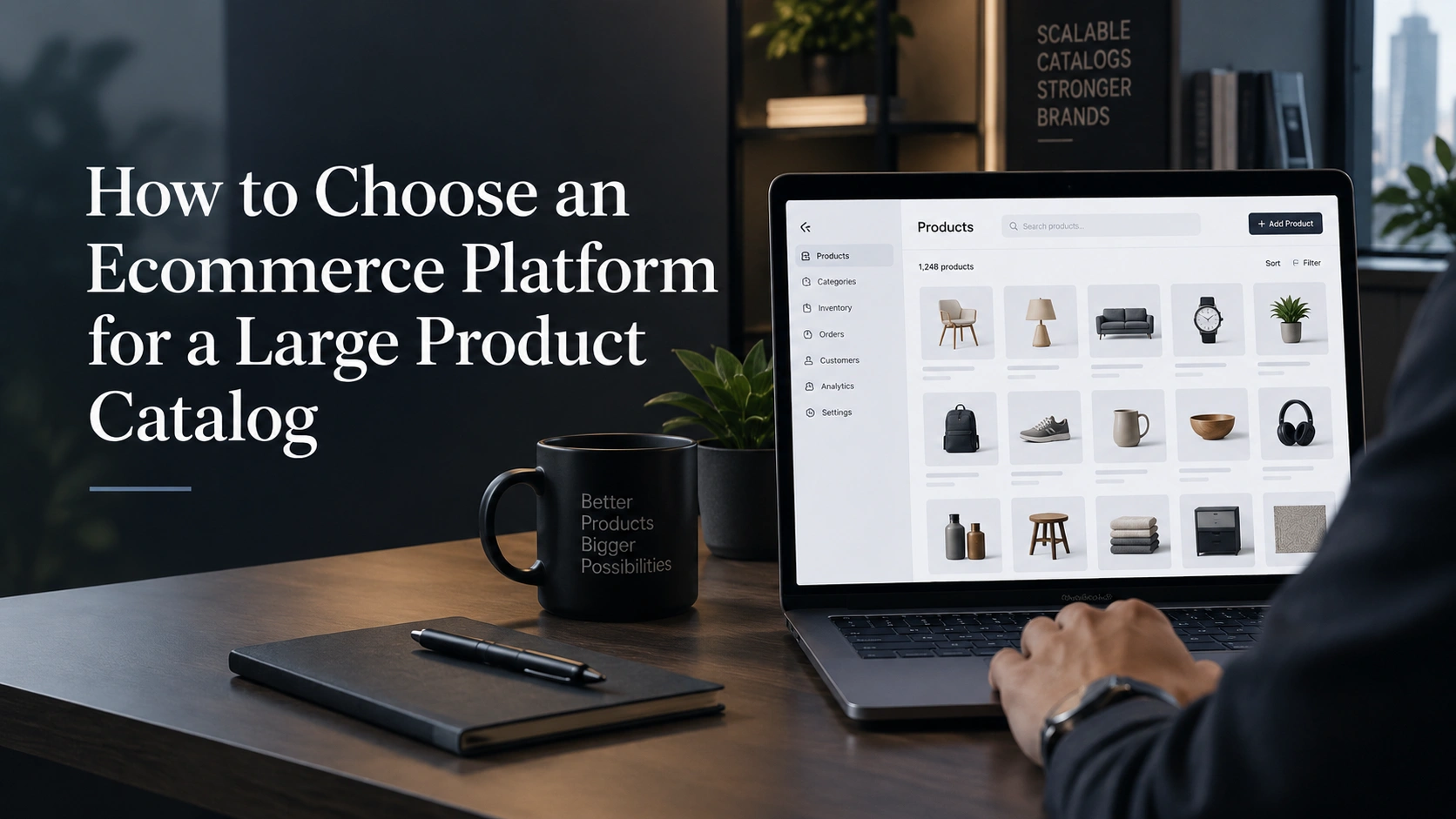
Picking an ecommerce platform has a complicated turn as your product line becomes bigger. A shop with about 50 items may manage with simpler tools, but tens thousands of products e.g., variants, SKUs, parts categories, and orders mean that much more serious groundwork is necessary.
Thus, for the business studying e-commerce platform India options, the priority is not to choose a powerful e-commerce solution with a lot of functions. The most important thing is to use the technology that will cope with the complexity of handling a large product line. The ideal platform should enable the team to organize the goods, manage the stocks, improve the customer experience, track the performance and provide support from the marketing perspective while expanding the business.
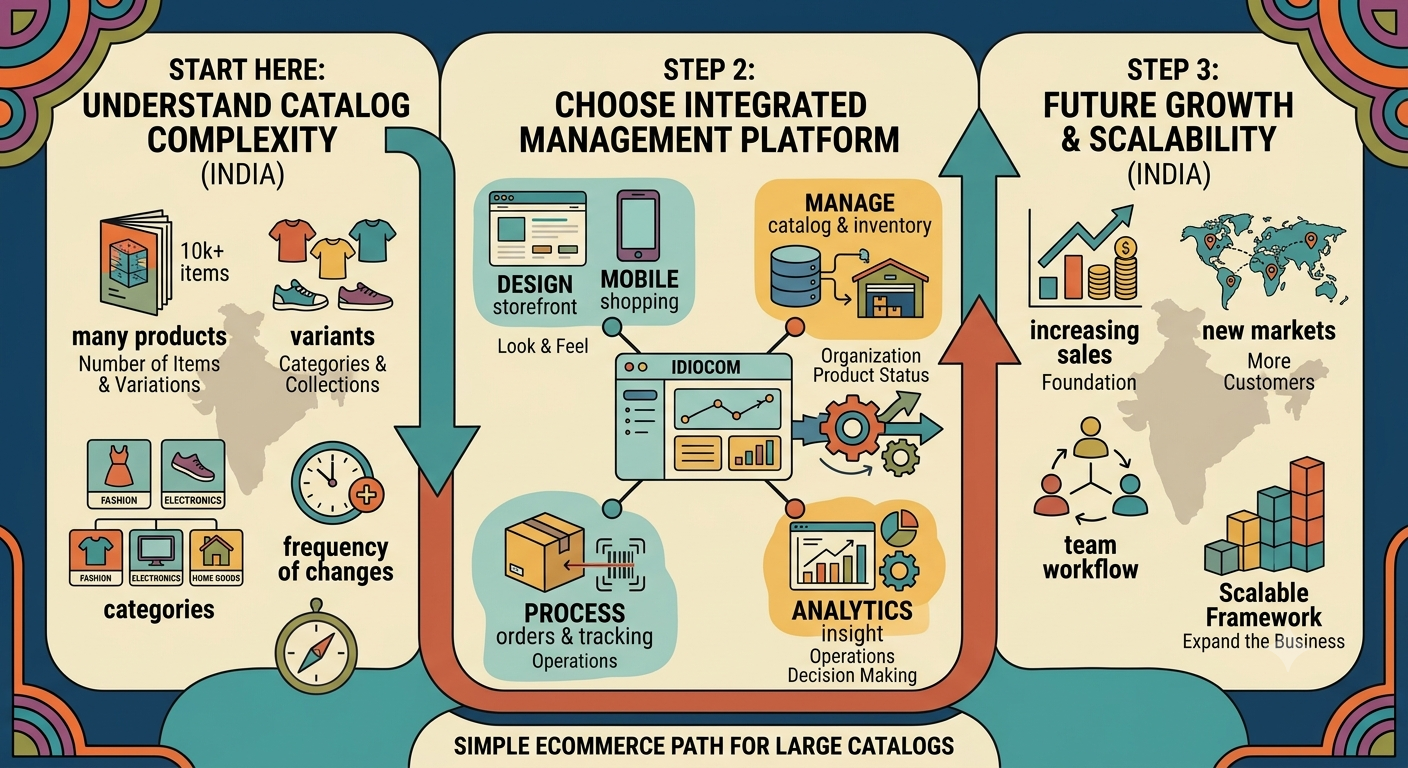
A large catalog can have thousands of products, but thousands of SKUs and product variants. For instance, a fashion label can create several designs and sell their products in different colors. An electronics company can offer different models of the same item with various specifications. Hence, one must note:
This will help to see what exactly is expected from the ecommerce technology.
While using an ecommerce website builder makes it easy to set up a website, it is difficult to utilize it properly with a large catalog. You also need to make sure that your platform can handle topics such as product management, inventory, orders, marketing, analytics, and many other business needs. In the case of small businesses, web design is often the most important factor. Meanwhile, for growing companies, the issue is whether the platform can facilitate their business activities.
This is essential when choosing the most suitable ecommerce website builder for your needs, as it is not enough to find a good template; you need something that will be capable of supporting your increasing catalog.
Catalog management is one of the primary evaluation criteria that need to be taken into account. The platform should enable you to create, organize, modify and maintain products easily. Categories, collections, variants, SKUs, prices, images, and product details should be structured clearly. Picture a situation when you are managing 3,000 products needing frequent updates of prices or other details. If every time you have to perform a labor-intensive manual task, catalog management can easily become a heavy operational burden.
An efficient ecommerce solution for Indian companies should facilitate the management of large catalogs instead of being just a place where products are displayed.
Complexity of product catalogs can be enhanced due to product variations. For instance, a fashion line may categorize its products by size and colour. A seller of furniture may specify materials, dimensions, or finishes. A retailer of electronics may refer to the types of storage available or the models of the electronic products.
Products’ variations should be easily structured and organized with the SKUs and inventory data in the platform. Moreover, customers should be able to pick variations in a user-friendly manner on product pages. As a result, effective management of the variants leads to benefits for the business processes of the companies and consumers’ satisfaction with the product purchasing process.
There is a strong correlation between inventory management and extensive catalogs. If inventory data isn’t properly linked to the e-commerce shop, then the business must contend with inaccuracies regarding product availability, as well as having to perform manual stocktaking and difficulties in procuring high-demand product lines.
When determining the right e-commerce solution in India, it is vital to analyze how the platform integrates product information with order and inventory management. The primary goal is to ensure that the employees are informed and customers receive accurate information on product availability.
A business that targets customers interested in a large number of products must have an efficient system of product categorization, product navigation, filtering, searching, and product recommendation processes. A home decor business may categorize its products by the room, type, style, material, and price.
On the other hand, a clothing business may have broader categories such as type of clothing, sex, size, color, and event thus creating the most efficient way for people to find the products they need. Even though the details of a certain business will determine product organization, the theory will stay the same: the greater the number of products offered the higher the level of product discovery needed.
Big catalogs should not lead to a difficult mobile environment.Individuals can view products by type, compare items, look at information, and purchase items using their phones. Therefore, navigation, product visuals, filtering, as well as checkout procedures must continue to be smooth and easy to handle on smaller screen devices.
While considering an ecommerce platform India companies can use for consistent growth, paying attention to how well the platform supports mobile-friendly websites is just as important as considering its desktop solutions. Mobile usability matters a lot for D2C brands whose business models heavily rely on digital interaction with customers.
Having numerous products means greater opportunities for marketing, but an increase in the complexity of marketing as well. Depending on how many products you sell on a regular basis, your company may need to advertise specific products, some type of category, a line of existing products being offered for a specific season, or some type of special offer.It is essential for your e-commerce technology to allow organizing marketing activities for specific products.
That is why a solution like e-commerce growth platform can present greater advantages than a simple website builder. The objective is to connect the management of the store with the activities aimed at attracting customers and generating sales.Firms should also think about whether the solution has analytical features that will allow them to understand which products and campaigns resulted in success.
Large product catalogs produce enormous quantities of data.Good ecommerce solutions allow you to compare traffic generated by each product in your catalog, analyze sales results by category, evaluate the conversion rates of different products, and identify when customers leave your shopping process.
Analytics can also help to discover products that are frequently purchased together and categories that have weak sales and need a stronger marketing push.For instance, when a category brings lots of traffic but does not sell enough, the problem may be in the way the product is presented, priced, its navigation, trust signals, and checkout process.
Analytics is not about presenting what happened, but about helping your team to make decisions on what to improve next.
Your current system may perfectly suit your catalog, but it could become an issue as your company grows. But before opting for anything, think of where you might be in a few years’ time. Would you have hundreds of thousands of items? Expand your territory? Up the number of orders? Launch variants of your products?
scalability is an essential factor in choosing a new platform. This issue is especially important for those who are looking for an online retail platform.
Technology is just part of a bigger ecommerce project.If the catalog features a lot of items, it means that there are various aspects such as design and development, SEO, catalog organization, conversion optimization, and ecommerce management that need to be taken care of.
Ecommerce companies give access to experts in case there are no internal resources available. When it comes to businesses in India, it is best to search for an ecommerce agency India not only regarding technical development but also taking into account how well it understands the same industry, as well as the structure of catalogs, paths of customers, and aims of businesses. It is extremely important for the platform and agency to work together as one unit instead of being connected to each other in some way.
Ecommerce technology solutions must do more than just provide the necessary tools to launch a website. It is crucial for businesses to ask how their ecommerce technology supports catalog management, operations, marketing, analytics, and future growth.
This is critical for large retailers and for growing D2C companies. The idea is to build an ecommerce framework that adapts to changing business conditions rather than having to replace technology every time the catalog or customer base grows.
Idiocom is more than a website building platform; it is an entire ecommerce growth platform. With the features included in the platform such as creating storefronts and managing wholesale operations—product management, inventory management, order management, marketing, analytics and AI-driven catalog management—the company offers a better connection between storefronts and operation and growth functions.
Depending on your company’s catalog size, business model, operational requirements, budget, and expected growth, your ideal solution will vary. However, you can consult ecommerce experts in India to understand your needs better and find a suitable solution.
When selecting an ecommerce platform with a comprehensive product catalog, design is only part of the story. Attractive design templates are relevant, but the key question to answer is whether the ecommerce solution enables your business to effectively manage a vast amount of products, variants, inventory records, orders, marketing campaigns, and customer communications.Start by identifying your catalog and operational needs. Proceed by assessing product management, inventory management, product search capabilities, mobile experience, marketing, analytics, scalability, and support options.
For growing businesses, an appropriate ecommerce technology should not simply enable the launch of a larger store. It should serve as a basis for efficient management, improvement, and growth of the entire ecommerce activity.
Common Questions
What is the most important feature for a large ecommerce catalog?
There is no universal feature that is important for every business. Good product and catalog management, SKU and variant management, inventory visibility, product discovery, analytics, and scalability are factors to consider.
Can an ecommerce website creator support thousands of products?
Some of them can, but businesses should analyze its catalog management, inventory, performance, search, filtering, and operational features before taking a decision.
What should an ecommerce platform for Indian companies provide?
It should fit company catalog, customers, payments, operations, marketing, and growth needs. Exact needs will differ according to the business model and target market.
Do large ecommerce companies need to hire ecommerce agency?
Agency can be used if a company requires a professional help in such areas as platform migration, development, integration, SEO, catalog management, or continuous improvement of the solution.