What Makes an Ecommerce Platform Truly Scalable?

A growing online store rarely fails because it cannot handle more visitors alone. The harder challenge is managing more products, orders, employees, markets, languages, sales channels and integrations without turning everyday operations into a maze of manual work. That is why choosing a scalable ecommerce platform requires looking well beyond server capacity.
True scalability means the platform can absorb business complexity as naturally as it absorbs traffic. A store may begin with 50 products and one sales channel, then expand to thousands of SKUs, multiple currencies, marketplaces, warehouses and specialized teams. If every new layer requires a separate workaround, the platform becomes a constraint even when its hosting performs well.
In this guide, we will examine the practical dimensions of ecommerce scalability—from catalog and order volume to automation, analytics, integrations and team workflows—and show what merchants should test before deciding which ecommerce solutions can support their next stage of growth.
Scalability Is Bigger Than Website Speed
When merchants hear the word “scalable,” they often think about servers.
Can the website handle a sudden traffic spike?
Will the checkout remain available during a major promotion?
Can the infrastructure add computing resources when demand increases?
Those questions matter. But they describe only technical scalability.
A growing ecommerce business creates several other types of pressure:
- More products to organize
- More orders to process
- More employees accessing the system
- More markets and languages to support
- More channels to synchronize
- More integrations to maintain
- More data to analyze
- More repetitive tasks to automate
AWS recommends loosely coupled dependencies because separating components can prevent one service’s problems from unnecessarily affecting others. In ecommerce, that could mean preventing a problem with search, promotions or delivery processing from bringing down unrelated parts of the customer journey.
So, when evaluating the best ecommerce platform for a growing business, the better question is not simply “How much traffic can it handle?”
It is:
“How much business complexity can it handle without creating disproportionate operational complexity?”
1. Catalog Scalability: Can It Handle More Than a Few Hundred Products?
A small catalog is forgiving.
If a merchant sells 30 products, manually updating titles, prices and images may seem manageable. At 3,000 products, the same approach becomes a serious operational problem.
A scalable ecommerce website should make it possible to manage large catalogs through structured product information, categories, variants, bulk updates and reusable workflows.
Consider a fashion retailer adding 1,000 products for a new season. The platform should make it practical to:
- Import products in bulk
- Assign categories and attributes
- Manage variants
- Update prices
- Control inventory
- Edit product information efficiently
- Keep product data consistent across channels
Catalog scalability is therefore partly a data architecture problem.
The platform needs to understand that a product is more than an image and a price. Attributes, variants, identifiers, categories and availability may need to flow into search, analytics, advertising and external commerce channels.
Google recommends providing product structured data and submitting product feeds through Merchant Center to help Google understand ecommerce product information and make products eligible for richer appearances across its surfaces.
A platform that makes catalog data structured and reusable gives the business a much stronger foundation for expansion.
2. Order Volume: Can Operations Grow Without Chaos?
The next test is order processing.
Imagine a store growing from 20 orders a day to 500. The customer-facing website may still look identical, but the operational workload has changed dramatically.
Orders now need to move reliably through:
Purchase → Payment → Inventory → Fulfillment → Shipping → Customer communication
A scalable platform should reduce unnecessary manual intervention across that chain.
This is where automation becomes particularly important.
For example, an order could automatically trigger:
- Inventory adjustment
- Payment confirmation
- Order status updates
- Fulfillment workflows
- Shipping notifications
- Customer emails
- Analytics events
The objective is not to automate everything blindly. It is to automate predictable work while leaving exceptions for people.
That distinction becomes increasingly important as order volume increases.
3. Team Scalability: More Employees Should Not Mean More Confusion
Business growth usually means more people need access to the ecommerce system.
Initially, the founder might manage products, orders, marketing and customer support. Later, those responsibilities may be divided among catalog managers, marketers, operations staff, customer service teams and administrators.
A scalable platform should support this transition through appropriate roles and permissions.
Ask:
Can different employees have different access levels?
Can teams work without overwriting each other’s work?
Can important changes be tracked?
Can administrators control sensitive functions?
Can workflows be divided by responsibility?
This is often overlooked when businesses compare ecommerce solutions.
A platform can support millions of page views but still become difficult to operate when ten employees need to use the same administrative account.
Operational scalability matters just as much as infrastructure scalability.
4. Language and Market Scalability
Selling in one market is relatively straightforward.
Selling across several markets introduces another layer of complexity.
Products may need different:
- Languages
- Currencies
- Prices
- Taxes
- Shipping rules
- Payment methods
- Domains
- Product availability
- Marketing messages
A platform should allow these differences to be managed without duplicating the entire ecommerce website for every market.
The ideal architecture separates the core product information from market-specific requirements.
For example, a product can retain one central SKU while its description, currency and availability are adapted for different markets.
This approach reduces duplication and makes future expansion easier.
The important thing to evaluate is not merely whether a platform says it supports multiple languages or currencies. Ask how much additional administration each new market creates.
If entering the fifth market requires rebuilding workflows that already exist for the first four, scalability is limited.
5. Channel Scalability: One Store Can Become Many Selling Points
Modern ecommerce rarely happens through one website alone.
A merchant may eventually sell through:
- Its ecommerce website
- Google
- Social commerce
- Marketplaces
- Email campaigns
- Mobile experiences
- B2B channels
The challenge is maintaining consistent information across those destinations.
Product price, availability, images and descriptions may need to move between systems without creating conflicting versions.
Google specifically recommends combining product structured data with Merchant Center feeds when sharing ecommerce product information with Google.
This is why channel management should be evaluated as part of scalability.
A store that works beautifully as a single-channel operation may become difficult to manage once the same 5,000 products need to appear accurately across several destinations.
6. Integrations: The Hidden Test of Scalability
Integrations often become the hidden complexity behind a growing ecommerce business.
At different stages, a merchant may connect:
- Payment providers
- Shipping systems
- ERP software
- CRM platforms
- Accounting systems
- Marketing platforms
- Analytics tools
- Inventory systems
- Marketplaces
The question is not simply how many integrations the platform offers.
It is how those integrations behave when something goes wrong.
AWS’s ecommerce architecture guidance recommends decoupling functions and using approaches such as queues so that a problem in one component does not necessarily overwhelm another.
For example, if a delivery API temporarily stops responding, customers should not necessarily lose the ability to browse products.
Good integration architecture isolates failures rather than allowing one broken dependency to cascade through the entire store.
7. Automation: The Real Multiplier for Growth
Scalability becomes much more valuable when repetitive work can be automated.
Imagine a merchant adding 500 new products.
Without automation, the team might manually create listings, categorize products, update feeds and configure related information.
With appropriate automation, some of these steps can happen through structured workflows.
Automation can assist with:
- Product imports
- Inventory updates
- Order notifications
- Customer emails
- Product categorization
- Marketing workflows
- Feed synchronization
- Reporting
But automation should be measured by the amount of human intervention it removes without reducing control.
A workflow that saves 20 minutes but creates frequent errors is not necessarily an improvement.
The best ecommerce platform for a particular business is therefore one that automates the right work, not simply the largest number of tasks.
8. Analytics Should Scale With the Business
As a store grows, intuition becomes less reliable.
A founder managing 20 products may know most products personally. At 20,000 products, decisions need data.
A scalable ecommerce system should make it possible to understand:
- Which products generate revenue
- Which categories are growing
- Where customers abandon the journey
- Which campaigns generate purchases
- Which products receive attention but fail to convert
- How new and returning customers behave
Google Analytics’ ecommerce framework supports events covering product views, cart actions, checkout, purchases, refunds and promotions. These events allow businesses to connect shopping behaviour with product and revenue performance.
This is important because analytics should not simply report what happened.
They should help the team decide what to change next.
A scalable analytics setup therefore needs consistent product identifiers, transaction data and event tracking as the business grows.
9. Content and SEO Must Scale Without Becoming Generic
A growing catalog creates an SEO challenge.
More products mean more opportunities for organic search, but also more opportunities for duplicate, thin or poorly differentiated content.
A scalable ecommerce website should make it practical to maintain titles, descriptions, structured data, URLs, internal links and other SEO elements across a large catalog.
But technology cannot replace editorial judgment.
Generating thousands of product pages automatically is not the same as creating thousands of useful pages.
A scalable system should make high-quality optimization easier rather than simply making content production faster.
10. Scalability Includes the Cost of Complexity
There is another dimension merchants often overlook: economic scalability.
Suppose a business doubles its revenue but also doubles the number of tools, manual processes and staff required to operate its store.
Technically, the business has grown.
Operationally, the platform may not be scaling efficiently.
Evaluate:
- Platform costs
- Integration costs
- Development requirements
- Support workload
- Manual administration
- Additional market costs
- Data and infrastructure costs
A platform should not necessarily have a perfectly linear cost curve. Growth naturally creates additional expenses.
The important question is whether the additional cost creates corresponding business value or simply compensates for platform limitations.
A Practical Framework for Evaluating Ecommerce Scalability
Before choosing or replacing a platform, create a 3× growth scenario.
Instead of asking what your store needs today, imagine:
- Products: 3×
- Orders: 3×
- Team members: 3×
- Markets: 3×
- Sales channels: 3×
- Integrations: 3×
Then ask what happens to every workflow.
Can products still be managed efficiently?
Can inventory remain synchronized?
Can employees work independently?
Can reports still provide useful information?
Can new markets be added without duplicating the entire system?
Can integrations fail without taking down unrelated functionality?
Can the business automate repetitive work?
This exercise often reveals more about scalability than a platform’s marketing page.
So, What Makes an Ecommerce Platform Truly Scalable?
A truly scalable ecommerce platform grows in several directions at once.
It can accommodate more traffic, but also more products. It can process more orders, but also support more employees. It can expand into new markets, languages and channels without multiplying administrative work. It can connect to additional systems while isolating integration failures. It can collect increasingly detailed analytics and automate repetitive operations without sacrificing control.
That is why scalability should be viewed as a business capability, not merely a hosting specification.
For a merchant evaluating ecommerce solutions, the right platform is not necessarily the one with the longest feature list. It is the one whose architecture, workflows and data model can support the way the business intends to grow.
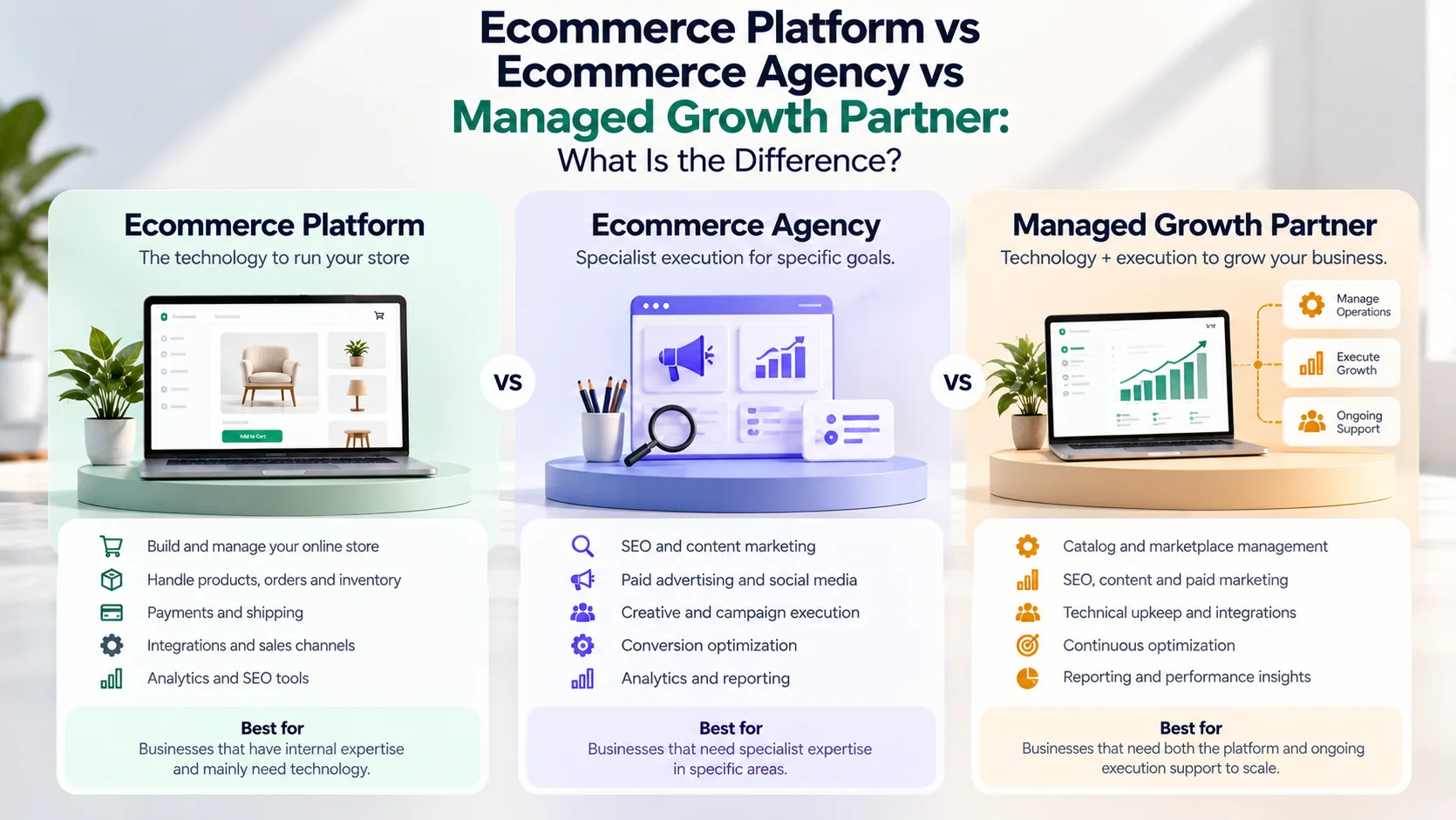
Idiocom’s approach fits into this broader view of ecommerce: store creation, product and order management, payments, shipping, SEO, analytics and multi-channel capabilities need to work together rather than becoming disconnected tools as the business expands.
Ultimately, the strongest test is simple:
If your business becomes three times larger, does your ecommerce operation become three times harder—or does the platform help you handle that growth?
That is the difference between an ecommerce platform that merely supports a business today and one designed to support its next stage.