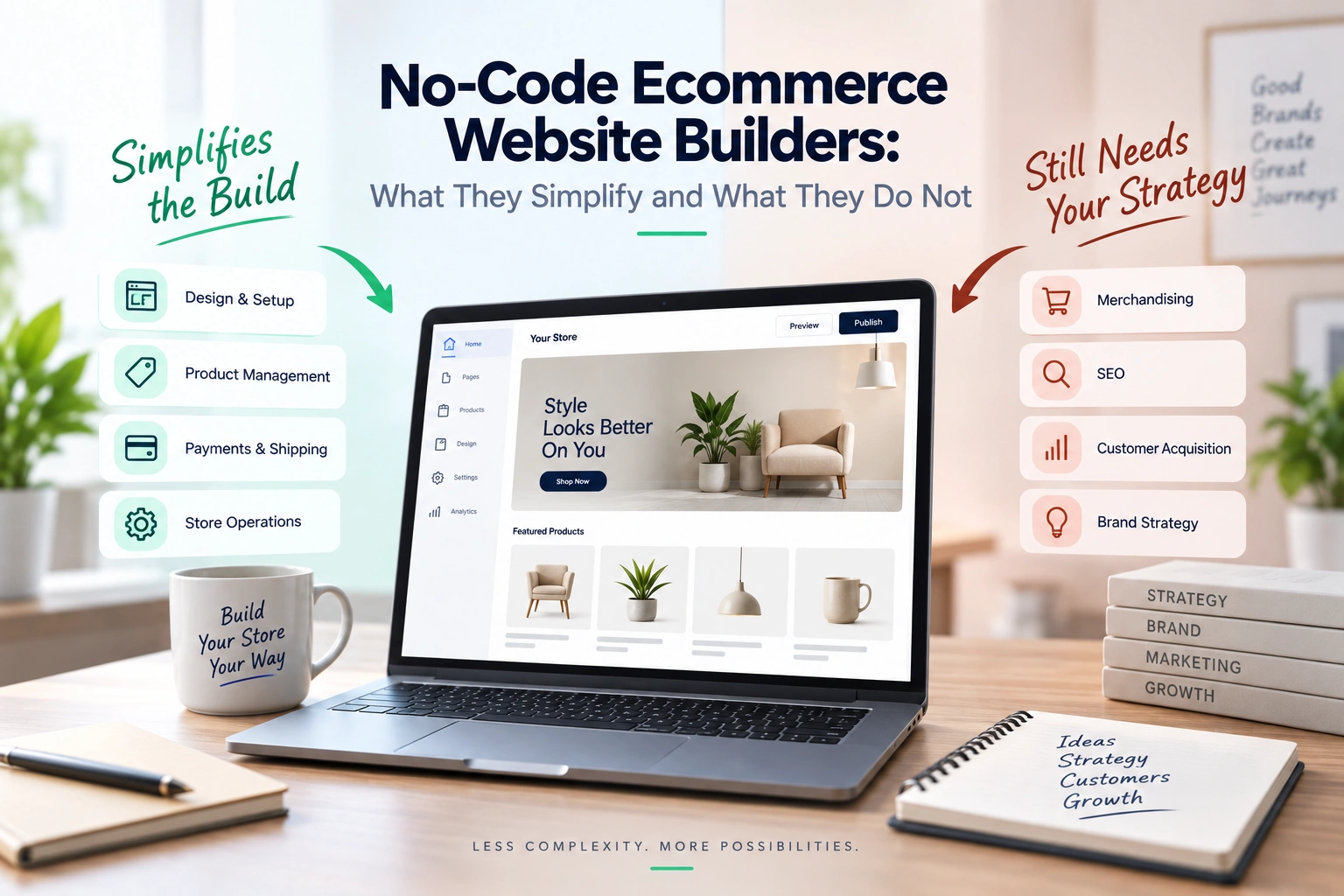
No-Code Ecommerce Website Builders: What They Simplify and What They Do Not
September 18, 2026
Building an ecommerce store used to mean coordinating designers, developers, hosting providers and multiple technical tools before a business could even begin selling. A no-code ecommerce website builder changes that equation by putting much of the store-building process directly in the merchant’s hands. Pages, layouts, products, navigation and many operational settings can be configured without writing traditional code.
But removing code does not remove the need for expertise. A technically functional store can still have weak product positioning, poor search visibility, confusing navigation or no reliable customer acquisition strategy. The real value of no-code technology is therefore not that it makes ecommerce effortless. It makes more of the execution layer accessible, allowing businesses to spend less time solving technical problems and more time making commercial decisions. Understanding that distinction is essential when choosing an online store builder and planning how the business will grow after launch.
A no-code ecommerce platform allows merchants to build and manage significant parts of their online store through visual interfaces rather than writing custom programming.
Instead of asking a developer to create every page component, a merchant might use drag-and-drop sections, configurable templates, visual product management and pre-built integrations.
This can simplify several traditionally technical tasks:
The important distinction is between building the system and running the business.
A no-code tool can make it easier to create a product page. It cannot automatically determine whether the product positioning is compelling. It can provide an SEO field. It cannot decide which search intent the page should target or whether the content genuinely answers that intent.
That distinction explains both the strength and the limitation of no-code commerce.
The most obvious benefit is speed.
Traditional ecommerce development can involve requirements gathering, design, frontend development, backend configuration, testing and deployment. A capable no-code system compresses much of this into a visual workflow.
A merchant can select a storefront structure, modify sections, add product collections and publish changes without waiting for a development cycle.
For a small business launching its first store, this can remove a significant barrier. Instead of spending early resources solving infrastructure or frontend problems, the team can focus on products, pricing, customers and positioning.
However, speed should not be confused with quality.
A store that can be launched in an afternoon can still require weeks of refinement. The platform reduces technical friction; it does not eliminate commercial decision-making.
A good ecommerce website builder can also make product operations more accessible.
Merchants can typically manage product names, descriptions, images, prices, variants, inventory and categories from a central interface.
This matters because catalog management becomes increasingly complicated as a business grows.
Imagine a merchant starting with 20 products and eventually reaching 2,000. The challenge is no longer simply adding products. It becomes maintaining consistent product information, categories, attributes, images and availability.
A useful no-code platform should therefore make repetitive catalog operations easier through bulk editing, structured product fields and reusable workflows.
This is where the quality of the underlying data model matters. A beautiful visual editor cannot compensate for poorly structured product information.
Google’s Merchant Center documentation illustrates this clearly: product visibility across Google’s commerce surfaces depends on structured attributes such as product ID, title, description, price, availability and image information.
No-code simplifies entering that information. Merchandising expertise determines whether the information is useful.
No-code systems can also reduce dependency on developers for everyday changes.
Changing a banner, creating a landing page, updating a product description or rearranging a category should not necessarily require engineering support.
This creates an important operational advantage: business teams can move at business speed.
For example, a marketing team running a seasonal campaign may need to create a promotional landing page, update featured products and change navigation. If every adjustment requires development tickets, execution slows down.
A visual management environment allows the team to make many of these changes independently.
That does not mean developers become unnecessary. Custom integrations, unusual workflows, security requirements and advanced functionality can still require technical expertise. The difference is that developers can spend more time on genuinely technical problems rather than routine content administration.
One of the biggest misconceptions about no-code commerce is that easier store creation automatically produces better merchandising.
It does not.
Merchandising involves deciding:
Consider a furniture merchant selling 500 products. The platform may make it easy to create 50 categories. But creating 50 categories does not mean customers will find products easily.
A stronger merchandising structure might organize products around room, function, style and use case rather than simply supplier classifications.
The no code website builder handles the implementation. The merchant still needs to understand the customer.
No-code platforms can make technical SEO tasks more accessible, but SEO is much broader than filling in metadata fields.
Google describes SEO as helping search engines understand content and helping users discover and evaluate pages. Its guidance emphasizes useful content, crawlable links, descriptive titles and properly optimized images.
A platform can provide fields for:
But the merchant still has to decide:
What should this page rank for?
What search intent does it satisfy?
Is the content meaningfully different from competing pages?
Does the site architecture help users and search engines discover related products?
For ecommerce, URL architecture and internal linking are particularly important. Google recommends crawlable links, meaningful anchor text and appropriate canonicalization for ecommerce sites.
No-code makes these controls easier to access. It does not create an SEO strategy automatically.
A store is not a customer acquisition strategy.
This is perhaps the most important limitation to understand.
A new merchant can build an attractive storefront without knowing how customers will discover it. Organic search, paid advertising, social content, email marketing, partnerships, marketplaces and referrals all require different strategies.
Google notes that ecommerce content can appear across multiple surfaces, including Search, Images and Google Lens, with structured product information helping Google understand ecommerce content.
That creates opportunities, but opportunities still require execution.
For example, connecting a product catalog to Google does not automatically make every product competitive for every search. Product titles, descriptions, images, pricing, availability and other attributes still need to be accurate and useful.
Google’s Merchant Center requirements reinforce this: incomplete or incorrect product data can prevent products from being processed or reduce their eligibility for relevant commerce surfaces.
The platform can connect the pipes. The business still has to create demand.
A no-code storefront can be functional and still convert poorly.
Conversion depends on factors such as:
Baymard’s 2026 compilation puts the average documented online shopping cart abandonment rate at 70.22%, based on 50 studies. The figure varies considerably between individual businesses, but it demonstrates how much shopping activity can disappear before purchase.
This is why the job does not end when the checkout button works.
A merchant should test the entire customer journey: landing page, product discovery, product evaluation, cart, checkout, payment confirmation and post-purchase communication.
Responsive templates remove much of the technical work involved in adapting a website to different screens, but merchants still need to evaluate the actual experience.
Google uses the mobile version of a site’s content for indexing and recommends responsive web design as an implementation approach.
Test the store on real mobile devices.
Look for:
Performance should also be measured rather than judged visually. Core Web Vitals currently focus on loading, interactivity and visual stability, with Google’s recommended thresholds including LCP within 2.5 seconds, INP at 200 milliseconds or less and CLS at 0.1 or less.
A no-code platform can provide the foundation. The merchant still needs to test the finished experience.
Templates are useful because they solve common design problems. But using a template does not automatically create a distinctive brand.
Brand strategy includes:
Two businesses can use the same online store builder and produce completely different commercial experiences.
The difference comes from the decisions made around the technology.
A premium skincare brand may need editorial storytelling and ingredient education. A B2B equipment supplier may need technical specifications, documentation and account-based purchasing. A fashion business may prioritize visual merchandising and collection storytelling.
The platform enables these experiences. Strategy determines what experience should exist.
A useful framework is to divide ecommerce into three layers.
This includes the storefront, hosting, product management, checkout, payments, integrations and administration.
No-code can simplify much of this layer.
This includes merchandising, content creation, SEO implementation, campaign management, catalog maintenance and customer communication.
No-code can accelerate this layer, but people still make the decisions.
This includes positioning, audience selection, pricing, acquisition strategy, product-market fit and growth planning.
No-code does not replace this layer.
This framework helps merchants avoid both extremes: believing no-code is merely a toy for beginners, or believing it can run an ecommerce business without strategic expertise.
A no-code approach can be particularly useful when a business wants:
The more important question is whether the platform remains useful as the business becomes more sophisticated.
Before choosing an ecommerce website builder, ask whether it supports the capabilities you will need later: larger catalogs, multiple sales channels, analytics, SEO controls, integrations, team permissions, custom domains and operational workflows.
Do not evaluate only what you need on launch day.
Evaluate what the business may need after its first meaningful growth phase.
Idiocom approaches ecommerce around the idea that merchants should be able to manage more of their store without depending on technical teams for every routine change.
Its visual store-building approach is designed to bring storefront creation, product management, ecommerce operations and visibility-related tools into a connected environment.
That can reduce the technical workload involved in running an online store. But the same principle applies here: technology is an enabler, not a substitute for commercial thinking.
A merchant still needs strong products, useful content, clear positioning, thoughtful merchandising and a plan for acquiring customers.
The objective of no-code is not to remove expertise from ecommerce.
It is to remove unnecessary technical friction so that expertise can be applied where it creates more value.
A no-code ecommerce website builder can simplify how a business creates, edits and operates its online store. It can reduce development dependency, accelerate routine changes and make sophisticated ecommerce functionality accessible to teams without programming skills.
What it cannot automatically provide is a compelling brand, effective merchandising, strong SEO strategy, customer demand or sustainable growth.
That is the real distinction between no-code and no-strategy.
The strongest ecommerce businesses use technology to shorten the distance between an idea and execution. They do not expect the platform to make every decision for them.
Choose an online store builder that removes technical complexity, then use the time and flexibility it creates to focus on the things technology cannot decide: what to sell, who to serve, how to differentiate and why customers should choose you.
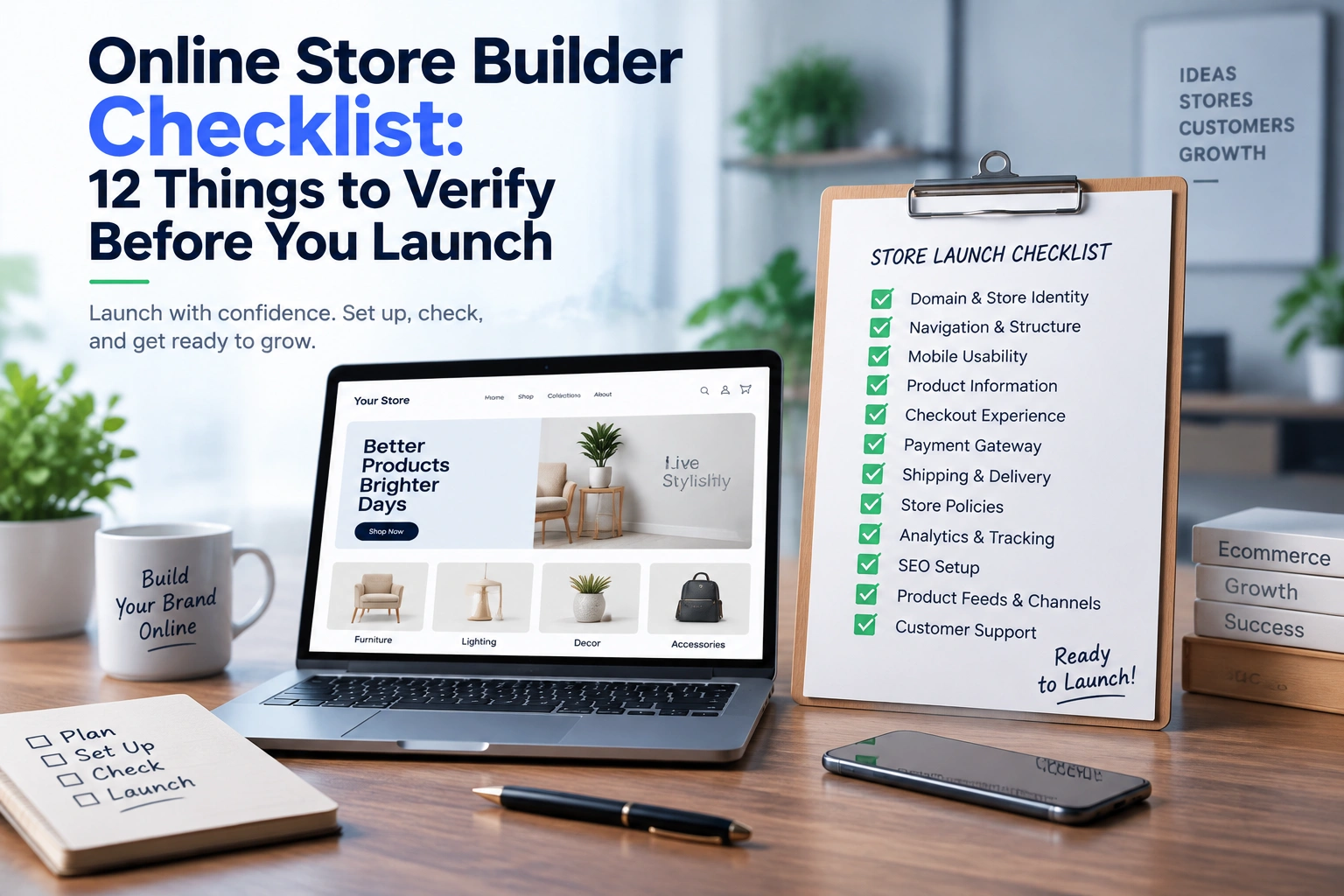

Running a business today is very different from what it was a decade ago. The internet has changed the way people sho...

If you are an e-commerce entrepreneur or small business owner, launching your online store quickly can give you an im...
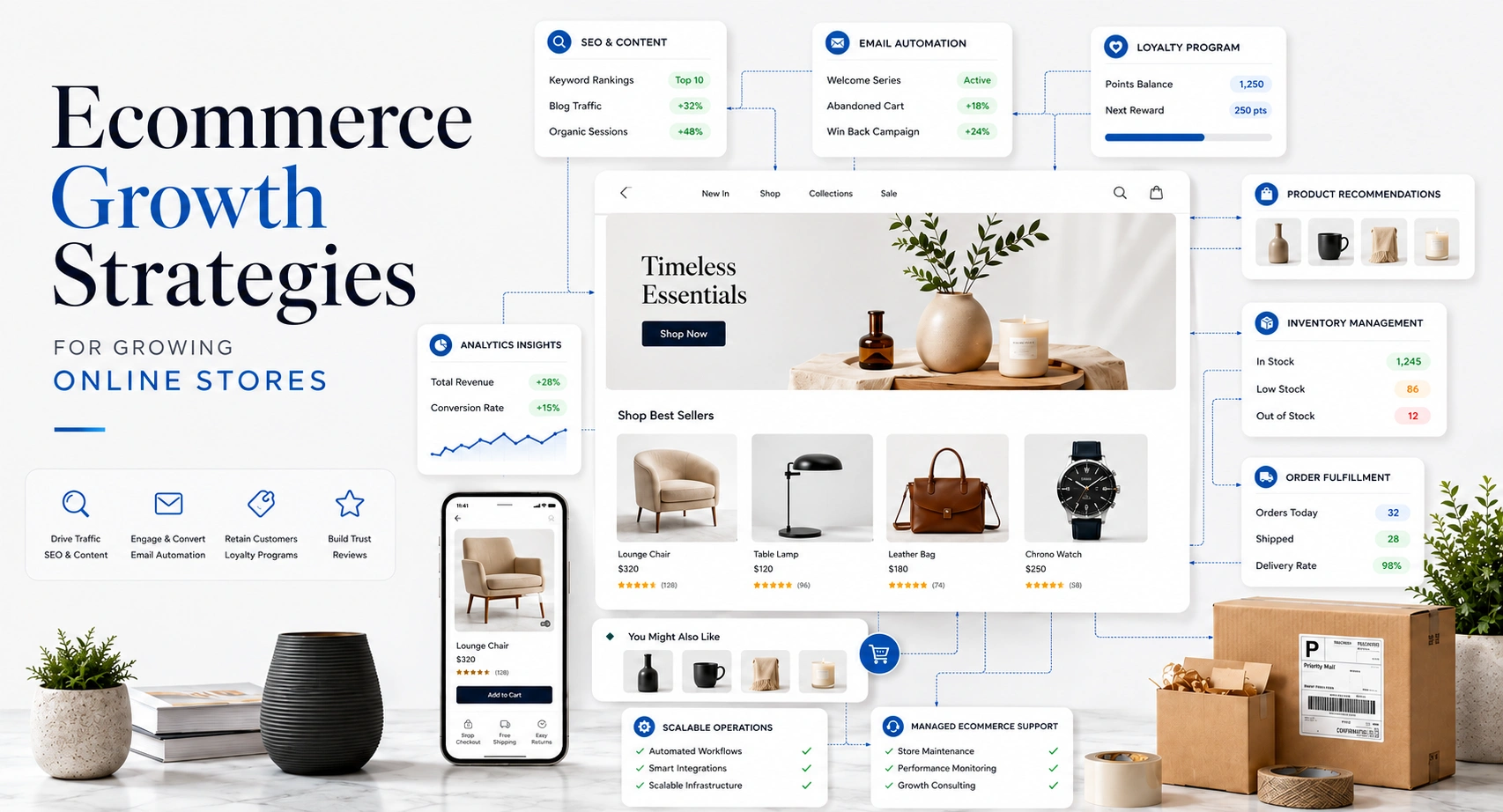
Growing an online store takes more than adding new products and launching marketing campaigns. As competition increas...